
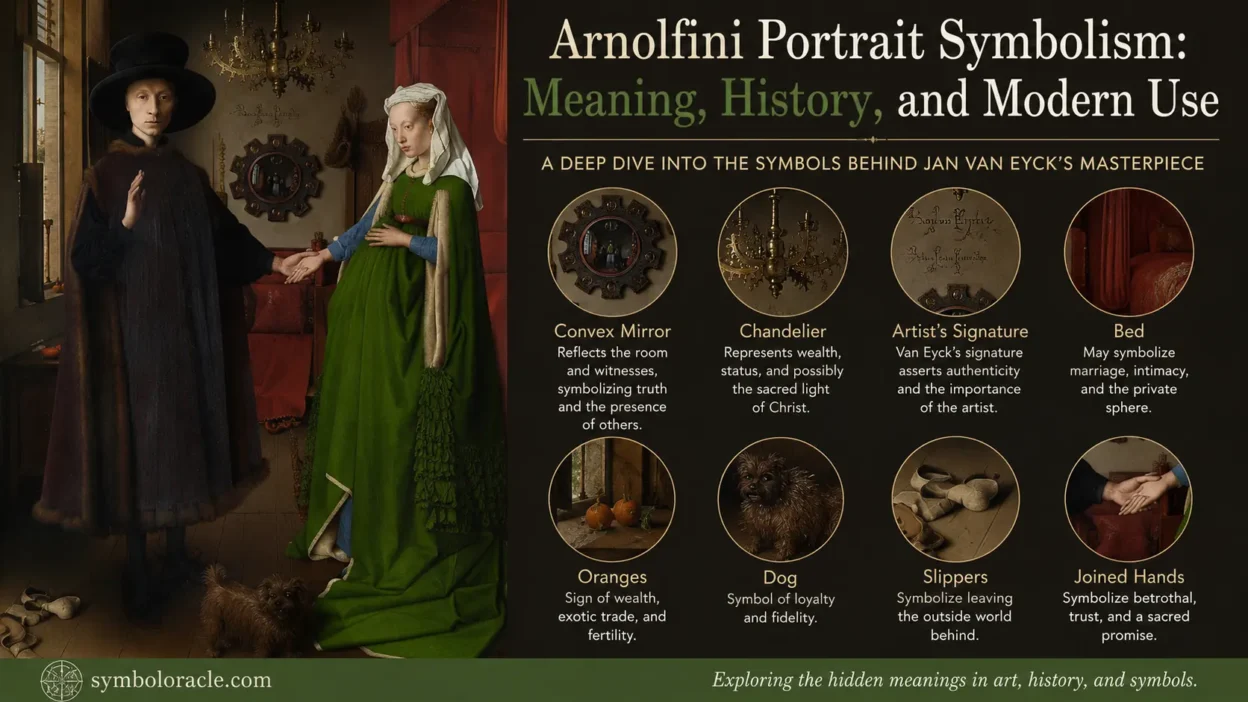
The Arnolfini Portrait symbolism is usually associated with marriage, fidelity, prosperity, religious devotion, domestic life, and social status. Jan van Eyck’s 1434 painting encourages these readings because nearly every part of the room—from the small dog and imported oranges to the convex mirror and burning candle—looks unusually deliberate.
Yet the painting is also a warning against treating symbolism as a simple code. Many familiar explanations came from later scholars, especially the idea that the scene records an actual wedding ceremony. Modern research has made that interpretation much less certain.
Today, the painting is valued not because every object has one proven meaning, but because it shows how portraiture, material wealth, faith, personal identity, and artistic invention could occupy the same domestic space. The uncertainty is part of what makes the picture so useful for understanding how symbolism actually works.
Quick Answer
Arnolfini Portrait symbolism most commonly represents marriage, fidelity, wealth, social standing, domestic partnership, and Christian devotion. Historically, the painting has also been interpreted as a wedding record, a commemoration of marriage, or simply an exceptionally elaborate double portrait whose objects carry both practical and symbolic associations.
TL;DR
- The couple primarily communicates wealth, status, partnership, and domestic identity.
- The dog is traditionally associated with fidelity and companionship.
- Oranges strongly signal luxury and access to expensive imported goods.
- The mirror expands the scene and introduces religious imagery and witnesses.
- Pregnancy and wedding-certificate interpretations remain widely repeated but disputed.
- Modern viewers value the painting partly because its symbolism remains uncertain.
What the Arnolfini Portrait Actually Shows
Jan van Eyck painted the work in 1434 on an oak panel. A richly dressed man and woman stand inside a furnished interior, touching hands while facing partly toward each other and partly toward the viewer.
The man is generally identified as Giovanni di Nicolao Arnolfini, an Italian merchant who lived in Bruges. The woman is probably his wife, although her exact identity remains uncertain. Earlier explanations identifying the couple as Giovanni di Arrigo Arnolfini and Jeanne Cenami created a major historical problem because that couple married years after the painting was dated.
Around them are a small dog, oranges, a large red-covered bed, discarded wooden overshoes, prayer beads, a chandelier, a brush, an elaborate chair, and a convex mirror.
Above the mirror, van Eyck wrote an unusual Latin inscription meaning essentially that Jan van Eyck “was here” in 1434. Inside the mirror, two additional people appear in the doorway behind the viewer.
The result feels less like an ordinary portrait than a carefully constructed social world.
The Core Symbolism at a Glance
| Detail | Common Meaning | Historical Caution | Modern Interpretation |
|---|---|---|---|
| Joined hands | Partnership, marriage, agreement | Not proof of a wedding ceremony | Commitment and relationship |
| Small dog | Fidelity, loyalty | Also simply a valuable household pet | Faithfulness and companionship |
| Oranges | Wealth, luxury | Strong material meaning is well supported | Prosperity and privilege |
| Convex mirror | Witness, truth, divine observation | No single interpretation is certain | Self-awareness and multiple perspectives |
| Candle | God, sacred presence, marriage | Marriage-candle theory is disputed | Spiritual or ceremonial atmosphere |
| Expensive clothing | Prosperity and status | Closely tied to real social display | Prestige, identity, self-presentation |
The important distinction is between possible symbolic associations and historically secure evidence. Some details clearly display wealth. Others acquire their meaning mainly through interpretation.
Marriage and Commitment: The Painting’s Most Famous Meaning
Marriage is the interpretation most closely attached to the painting in popular culture.
The couple touch hands. A dog stands between them. A large bed occupies the room. The man raises one hand in a gesture that has sometimes been read as an oath. Two people appear in the mirror, seemingly witnessing the scene.
Taken together, these details made the painting look to generations of viewers like a private marriage ceremony.
That reading became especially influential after art historian Erwin Panofsky argued in 1934 that the work functioned almost like a visual marriage document. Van Eyck’s unusual inscription and the reflected figures were interpreted as evidence that witnesses, including perhaps the painter himself, were present.
Modern scholarship is more cautious.
Early inventories called the work a portrait of a man and woman or husband and wife rather than describing it as a wedding. The gestures also do not perfectly match established marriage rituals, while historical evidence undermines the older identification of the couple on which Panofsky’s interpretation depended. The National Gallery’s detailed catalogue therefore treats the wedding-certificate theory as highly doubtful.
Marriage remains a reasonable association. It should not be presented as a proven event.
The Dog: Fidelity, Loyalty, and Household Status
The small brown dog is perhaps the painting’s easiest symbol for modern viewers to understand.
Dogs frequently carried associations with loyalty and faithfulness in European visual culture, making fidelity a natural interpretation when a dog appears beside a married couple. The National Gallery itself notes this traditional connection.
Its position strengthens the impression. The dog occupies the space between the couple while looking directly outward, almost as if it acknowledges the viewer.
But symbolism is only half the story.
The animal also appears to be a household pet. Small companion dogs were luxury possessions, so the dog can communicate status at the same time that it suggests loyalty.
For modern American viewers, this makes the dog one of the portrait’s most relatable details. It can represent marital faithfulness, but it also humanizes a formal pair who otherwise reveal little emotion.
The Convex Mirror: Witnessing, Reflection, and Sacred Meaning
The small convex mirror at the center of the back wall carries enormous visual importance.
It reflects the backs of the couple, parts of the room that cannot otherwise be seen, and two additional figures standing in the doorway. Around its frame are ten miniature scenes connected with the Passion of Christ.
Several symbolic readings have therefore grown around it.
One interpretation sees the mirror as a form of witnessing. The reflected visitors make the apparently private scene public.
Another sees reflection itself as meaningful. Mirrors can suggest truth, self-knowledge, observation, or the difference between appearance and reality.
The Passion imagery adds a specifically Christian dimension. The couple’s worldly existence—fine clothing, expensive furniture, marriage, possessions—is visually surrounded by imagery concerned with suffering, salvation, and mortality.
The mirror also demonstrates van Eyck’s artistic ambition. He effectively paints the room twice: once directly and once in miniature reflection.
Its symbolism therefore works on several levels at once. It concerns observation, religious consciousness, human identity, and the painter’s ability to represent what ordinary sight cannot capture from one position.
Why the Oranges Symbolize Wealth More Clearly Than Fertility
Oranges are sometimes described online as symbols of fertility, innocence, paradise, or love.
Those associations are possible in broader European traditions, but the strongest meaning in this particular painting is more practical: money.
Oranges were expensive in fifteenth-century Bruges. The Arnolfini family belonged to an international merchant community, and imported goods could visibly demonstrate access to trade networks and disposable wealth.
Van Eyck includes several oranges with striking casualness, as though costly fruit can simply be left around the room. The National Gallery catalogue specifically interprets that display as a sign of exceptional affluence.
This is an important lesson in reading the portrait. An object does not have to represent an abstract idea to be meaningful.
Sometimes displaying something difficult to obtain says more than attaching a hidden moral definition to it.
Clothing, Green Fabric, and the Display of Prosperity
The woman’s green gown dominates much of the composition. Its enormous folds gather around her body and trail across the floor.
Modern viewers frequently interpret green as fertility, hope, renewal, or pregnancy. Those associations may influence how the painting feels today, but the gown communicates something more historically secure: wealth.
Fabric was expensive. Large quantities of quality cloth, fur trimming, intense color, and elaborate tailoring made social position visible.
The man performs a similar function through his dark, fur-trimmed clothing and oversized hat. They are not casually dressed people caught during a domestic moment. Their appearance has been deliberately constructed.
Their clothes therefore symbolize social identity through consumption.
For Americans accustomed to reading luxury brands, designer clothing, watches, cars, and carefully styled social-media photographs as signs of status, this part of the portrait remains surprisingly familiar.
The objects have changed. The social behavior has not.
Is the Woman Pregnant?
One of the most persistent misconceptions about the painting is that the woman is visibly pregnant.
Her hand rests over a large rounded area at the front of her green gown. At first glance, the conclusion seems obvious.
The shape, however, comes largely from the extraordinary amount of fabric she gathers in front of her body. Fifteenth-century clothing and fashionable female poses could create a pronounced rounded silhouette without indicating pregnancy. The National Gallery explicitly cautions against assuming that she is expecting a child.
Fertility themes are not completely irrelevant. A carved figure on the chair has been identified as Saint Margaret, traditionally associated with pregnancy and childbirth.
But that does not turn the portrait into a pregnancy announcement.
A careful interpretation distinguishes between fertility as a culturally meaningful concern within marriage and a literal pregnancy supposedly documented in the image.
The first is plausible. The second is unproven.
The Bed and Domestic Space
The large red-covered bed seems to encourage another easy assumption: the couple must be standing in a bedroom.
That conclusion is misleading.
In wealthy fifteenth-century homes, major beds could occupy rooms used for receiving visitors. The National Gallery identifies the space as a reception room rather than a private modern bedroom and notes that the bed itself was an expensive piece of household furniture.
Its symbolism therefore goes beyond sexuality or marriage.
The bed represents household prosperity, domestic identity, lineage, hospitality, and the public display of private possessions.
The vivid red textiles amplify this sense of expense. Upholstered furniture and abundant fabrics make the room look materially comfortable without using aristocratic architectural grandeur.
The Arnolfinis can present themselves as successful without pretending to be royalty.
Prayer Beads and Christian Devotion
Beside the mirror hangs a string of translucent amber-colored prayer beads.
They are not decorative beads in the modern sense. Comparable objects were used for prayer, and valuable versions appear in inventories from the Burgundian world. The beads in the painting combine devotional purpose with material refinement.
That combination matters.
The portrait does not separate religion from money, domestic life, or public identity as sharply as modern viewers sometimes do. A precious devotional object could demonstrate piety and prosperity simultaneously.
The Passion scenes surrounding the mirror reinforce the Christian setting.
Rather than saying the portrait contains a single religious message, it is more accurate to see Christian devotion as part of the moral and social identity being constructed around the couple.
Their household contains both material abundance and reminders of spiritual obligations.
The Single Burning Candle
A solitary candle burns in the chandelier even though daylight enters through the window.
That unnecessary light has encouraged symbolic interpretation for generations.
The candle has been said to represent God’s presence, divine witness, marital ceremony, life, spiritual illumination, or even the survival of one spouse after another’s death.
None of those explanations is certain.
The once-popular claim that it is specifically a traditional “marriage candle” lacks strong supporting evidence. The National Gallery catalogue points out that van Eyck may have been interested in contrasting artificial and natural illumination, while expensive candles might also have been lit when receiving visitors.
The candle remains symbolically suggestive precisely because it seems unnecessary.
It introduces life and light into the chandelier, but its meaning should remain open rather than being converted into a factual statement about the couple.
Shoes, Everyday Objects, and the Danger of Over-Interpreting
Discarded wooden overshoes lie on the floor.
An older symbolic interpretation connected the removed footwear with sacred ground, recalling biblical scenes in which shoes are removed in a holy place. From that perspective, marriage supposedly transforms the room into sacred ceremonial space.
It is an attractive idea.
It is also difficult to prove.
The shoes may simply belong to the practical reality of entering a well-furnished home after walking outside. Their visible dirt makes that interpretation particularly reasonable.
The same caution applies to brushes, furniture, fruit, fabrics, and other household details.
Van Eyck’s realism makes viewers want everything to function as a code. Yet a painting can contain meaningful objects without every object possessing a secret definition.
Sometimes domestic realism, social display, and symbolic association overlap.
Van Eyck’s Signature and the Meaning of Presence
Above the mirror appears one of the most discussed details in the painting: Johannes de Eyck fuit hic. 1434.
Rather than simply signing the panel in a conventional location, van Eyck effectively announces that he “was here.”
Panofsky connected this wording with the reflected figures and argued that the artist had acted as a witness to a marriage.
Later research challenged the legal interpretation. The wording was not a normal formula used to record legal witnesses, and decorative scripts did not automatically indicate a legal document.
Still, the inscription is extraordinary.
It turns the painter from an invisible maker into someone whose presence matters. The mirror may even include van Eyck among the people entering the room, although this identification cannot be established with certainty.
Symbolically, the inscription can therefore represent artistic authorship, eyewitness-like presence, and van Eyck’s confidence in his ability to construct a believable reality.
Wealth and Social Status May Be the Painting’s Strongest Message
The more cautiously the portrait is examined, the more important status becomes.
Imported fruit, fur-trimmed clothing, extensive fabric, a costly bed, upholstered furniture, prayer beads, a pet, a chandelier, glass, and other furnishings repeatedly tell the viewer that this household possesses resources.
Van Eyck even shaped the room rather than simply recording it literally. Technical examination shows inconsistencies in its physical arrangement, suggesting that the interior was adjusted for artistic effect.
That makes the room a form of self-presentation.
It functions somewhat like an intentionally composed portrait photographed inside an impressive modern home. The environment tells us what the subjects want others to know about them.
They belong to the prosperous merchant world of Bruges. Their identity depends not only on faces and names, but on clothing, possessions, domestic order, religious objects, and controlled appearance.
In that sense, the painting symbolizes the growing cultural visibility of wealthy urban people who were neither peasants nor hereditary rulers.
Why Scholars No Longer Treat Every Symbol as Settled Fact
The painting became a major test case for a method sometimes called “disguised symbolism”: the idea that ordinary objects in Early Netherlandish paintings quietly communicate theological, marital, or moral meanings.
That approach produced memorable interpretations.
Dog equals fidelity. Candle equals God. Shoes equal sacred ground. Fruit equals fertility. Mirror equals divine witness.
The problem is that historical life is rarely so neat.
Some of the supposedly symbolic details were added during the painting process rather than planned in the earliest underdrawing. The gestures of the figures also changed as van Eyck worked.
That does not make them meaningless.
It simply means symbolism should be treated as layered association rather than a dictionary in which every object has one permanent translation.
An orange can display wealth and still evoke fertility. A dog can be a pet and symbolize loyalty. A mirror can demonstrate technical virtuosity while inviting thoughts about witnessing and truth.
Multiple meanings can coexist.
How Americans Commonly Encounter the Painting Today
In the United States, the Arnolfini Portrait is especially familiar through art-history education rather than everyday folk symbolism.
Students often encounter it while studying Early Netherlandish painting, the Northern Renaissance, oil painting, portraiture, visual analysis, and iconography. It has also been used in American AP Art History teaching specifically to examine competing scholarly interpretations rather than to memorize a single answer.
That educational role has shaped its modern American meaning.
For many viewers, the painting has become an example of a larger question: How much can we really know from visual evidence?
Its mirror also feels surprisingly modern. It turns looking into part of the subject. The viewer occupies the space from which the reflected visitors enter, creating an effect comparable to photographs, films, and digital images that acknowledge the person behind the camera.
Reproductions online have further encouraged close-up examination of the dog, mirror, clothing, fruit, candle, and inscription.
As a result, the painting now functions both as a Renaissance portrait and as a cultural puzzle about interpretation itself.
Emotional and Psychological Meaning
The emotional effect of the portrait comes from contradiction.
The scene is intimate, yet the couple appear formal. Their hands touch, but they do not behave affectionately in the modern romantic sense. The room is filled with possessions, yet it remains remarkably quiet.
The dog looks outward more directly than either person.
Then the mirror reveals that the couple are not actually alone.
This creates a subtle sense of observation. The viewer seems to stand at the doorway with the reflected visitors, looking into someone else’s carefully presented household.
Psychologically, the portrait can therefore suggest privacy made public, controlled identity, commitment, observation, and the tension between outward appearance and unknowable inner life.
Those meanings do not require us to diagnose the couple’s feelings.
They arise from the experience van Eyck constructs for the viewer.
Common Misunderstandings About the Painting
The biggest mistake is calling the painting a proven wedding certificate.
It may relate to marriage, and it certainly depicts a couple understood historically as husband and wife, but the legal-marriage interpretation remains disputed. Early descriptions simply treated it as a double portrait, and later historical research weakened several foundations of the wedding theory.
The second mistake is saying the woman is definitely pregnant. Her silhouette is largely created by fashionable clothing.
The third is presenting every object as a confirmed symbol.
The fourth is assuming symbolism and realism must be opposites. Van Eyck could paint a real-looking pet that also suggested faithfulness, or expensive fruit that carried cultural associations beyond its price.
The most convincing interpretation allows ordinary objects to remain ordinary while recognizing that their placement, cost, religious context, and relationship to the sitters can make them meaningful.
Frequently Asked Questions
What does the Arnolfini Portrait symbolize?
The painting commonly symbolizes marriage, partnership, fidelity, wealth, domestic identity, social status, and Christian devotion. Its larger significance also comes from the uncertainty surrounding these interpretations, since scholars disagree about how literally individual objects should be decoded.
Is the Arnolfini Portrait a wedding painting?
It has long been associated with marriage, but scholars no longer universally accept that it depicts an actual wedding ceremony. Early records describe a husband and wife or a man and woman rather than clearly identifying a marriage taking place.
What does the mirror symbolize in the Arnolfini Portrait?
The mirror has been interpreted as a symbol of witnessing, truth, divine observation, and expanded perception. Its frame contains miniature scenes of Christ’s Passion, while its reflection reveals two people standing outside the main visible space.
What does the dog mean in the Arnolfini Portrait?
The dog is traditionally associated with fidelity and loyalty, making it especially appropriate beside a married couple. It was also likely a genuine companion animal whose presence helped display the household’s comfort and status.
Why are there oranges in the Arnolfini Portrait?
The oranges most convincingly signal wealth because they were expensive imported goods in fifteenth-century Bruges. Their apparently casual placement shows that the household could afford luxuries that many people could not.
Is the woman in the Arnolfini Portrait pregnant?
There is no reliable evidence that the portrait was intended to show pregnancy. The apparent swelling is largely produced by the fashionable gown and the large amount of fabric gathered in front of her body.
What does the candle symbolize?
The single candle has been interpreted as divine presence, life, sacred witness, or marriage, but none of these meanings is certain. It may also demonstrate van Eyck’s skill with artificial light or reflect a custom of lighting costly candles when receiving visitors.
Conclusion
Arnolfini Portrait symbolism is best understood as a combination of partnership, fidelity, wealth, status, domestic identity, Christian devotion, and artistic self-consciousness rather than a fixed collection of hidden codes. The dog, oranges, mirror, clothing, bed, beads, candle, and inscription all contribute meaning, but their meanings range from historically persuasive to deliberately uncertain.
That uncertainty is not a weakness in the painting. It explains much of its lasting importance. Van Eyck created an interior that looks almost documentary while carefully controlling what viewers see, leaving us to decide where everyday life ends and symbolism begins.
Six centuries later, the painting still rewards the same skill it demanded in 1434: looking closely without assuming that everything visible has only one explanation.