
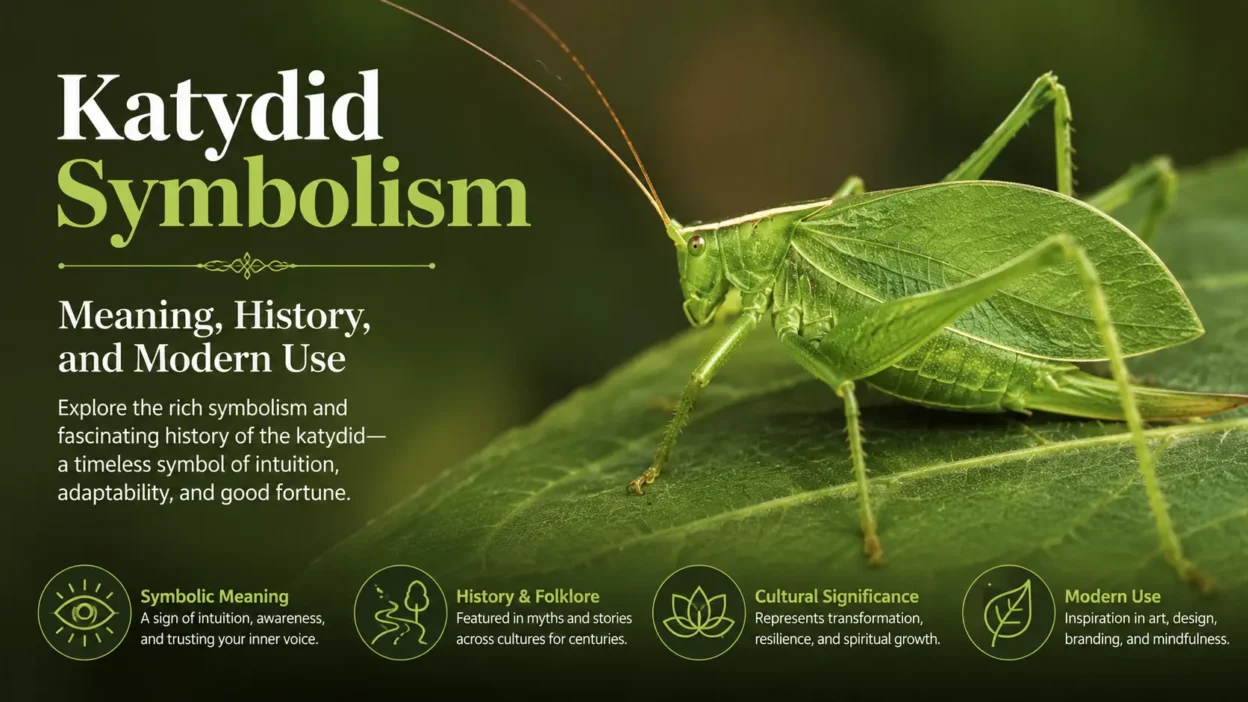
A katydid can be surprisingly difficult to notice until it begins calling. Its leaf-shaped body may disappear against green foliage, while its sharp, rhythmic song can dominate a warm summer night. Those contrasting traits help explain why katydid symbolism is commonly connected with adaptability, awareness, communication, patience, and knowing when to make yourself heard.
In the United States, katydids are especially associated with wooded yards, gardens, and the nighttime sounds of late summer. Their familiar call has even shaped their English name, which imitates a rhythm traditionally heard as “Katy-did” or “Katy-didn’t.” Unlike symbols such as the eagle or the dove, though, the katydid doesn’t have one standardized cultural meaning — some interpretations come from documented folklore, while many modern meanings are based simply on the insect’s camouflage, sound, and seasonal behavior. Keeping those categories separate makes its symbolism much more interesting, and much more accurate.
Quick Answer
Katydid symbolism commonly represents adaptability, attentive listening, communication, patience, and transition in modern American interpretations. Historically, katydids appear in a small number of Native American traditions, while their calls and seasonal presence also connect them with summer, courtship, and the changing natural year.
At a glance:
- Katydids often represent adaptability because of their remarkable camouflage
- Their loud calls connect them with communication and finding your voice
- Late-summer songs make them natural symbols of seasonal transition
- Some Native American traditions give katydids specific, localized meanings
- Modern spiritual interpretations often emphasize patience, intuition, and awareness
- Katydid symbolism should not be confused with cricket or cicada folklore
What a Katydid Is and Why Its Appearance Matters
Katydids are insects in the family Tettigoniidae, part of the same order that contains grasshoppers and crickets, often called bush crickets outside North America. Many species have extremely long antennae, powerful hind legs, and wings shaped and patterned like leaves — an appearance that provides the foundation for much of their modern symbolism.
A green katydid resting motionless on foliage can be remarkably difficult to distinguish from the plant itself. That’s a biological defense rather than a symbolic act, of course, but people naturally turn visible animal traits into metaphors anyway. For that reason, the katydid has come to suggest adapting without losing yourself, choosing when to remain unnoticed, and acting when conditions are favorable. Its symbolism is therefore less about physical strength and more about intelligent adjustment.
The Core Meanings Associated With Katydids
Several themes appear repeatedly in contemporary interpretations, though none should be treated as a universal ancient belief.
| Context | Common Meaning in the USA | Association | Important Note |
|---|---|---|---|
| Camouflage | Adaptability | Blending with leaves | Based largely on natural behavior |
| Song | Communication | Calling and listening | Strongly tied to courtship |
| Night activity | Awareness | Hearing what is not easily seen | Often interpreted metaphorically |
| Late summer | Transition | Seasonal change | Especially familiar in eastern states |
| Stillness | Patience | Waiting before moving | Mainly a modern interpretation |
| Green color | Growth and nature | Vegetation and renewal | Color symbolism adds to insect symbolism |
Together, these meanings create an image of a creature that survives by sensing its environment carefully while still possessing an unmistakable voice.
Camouflage and the Symbolism of Adaptability
Few features influence katydid symbolism more strongly than camouflage. Many katydids resemble leaves not only in color but in outline and wing venation, with some species appearing almost like living pieces of foliage — a disguise that protects them from predators while letting them stay within the vegetation where they feed and reproduce.
As a human metaphor, camouflage can suggest adaptability without surrender. That distinction matters: blending in doesn’t have to mean becoming passive or hiding your identity. Instead, the katydid can represent understanding an environment before deciding how openly to act — useful for someone entering a new workplace or handling an uncertain social situation, where the image suggests observation first and action second. There’s also a protective dimension worth naming. Not every strength has to be displayed; sometimes discretion is itself a survival strategy.
Why Katydids Symbolize Communication and Listening
The katydid may look quiet, but many species are anything but silent. Male katydids commonly produce calls by rubbing specialized structures on their forewings together, a process called stridulation, and the calls can serve reproductive, territorial, or defensive functions depending on the species — some groups even produce coordinated exchanges between males and females. This makes communication one of the most natural symbolic associations available.
The katydid can represent the need to speak clearly when something matters, to listen before responding, or to make yourself heard without constant visibility. There’s an interesting contrast built into this: visually, the insect avoids attention, but acoustically, it announces itself. That combination gives the katydid a useful symbolic tension — you don’t have to occupy the center of attention to have a distinct voice.
Katydids as Symbols of Summer and Seasonal Change
For many Americans, especially in the eastern and central United States, katydid calls belong to the soundscape of summer. True katydids mature and begin calling during the warmer months, with local natural-history calendars often noting especially noticeable activity during late summer before cold weather eventually brings that seasonal chorus to an end. That cycle naturally links katydids with transition — their calls may evoke long summer evenings, approaching autumn, or simply the awareness that seasons don’t last forever.
This meaning differs from the transformation symbolism associated with butterflies. A katydid doesn’t primarily symbolize dramatic rebirth; its seasonal meaning is quieter, closer to recognizing that one phase is beginning to give way to another. For that reason, a katydid image can work well as a personal symbol during gradual life changes rather than sudden reinvention.
What Katydids Commonly Mean in the United States
American interpretations are strongly shaped by direct encounters with the insect. People often hear katydids before seeing them — in suburban neighborhoods, parks, and gardens, their calls become part of the familiar nighttime environment. Even the word “katydid” reflects an American attempt to turn the insect’s rhythm into language; the name has been recorded in English since the eighteenth century, drawn from an imitation of its perceived call.
As a result, contemporary American symbolism often emphasizes three ideas at once: adaptation (the insect is nearly invisible among leaves), expression (its presence becomes unmistakable once it calls), and seasonal awareness (its sound is tied to a particular time of year). The katydid is therefore more closely linked with personal reflection and nature imagery than with major national or ceremonial symbolism.
Katydids in Native American Traditions
Claims about a “Native American katydid meaning” need particular care, because there’s no single Native American symbolic system. Different nations have their own languages, stories, and relationships with animals, and a meaning documented in one community should never automatically be presented as a belief shared by all Indigenous peoples.
A Cherokee story recorded by James Mooney around the turn of the twentieth century tells of a hunter who mocks a katydid for its short seasonal life; the katydid warns him against boasting, and the hunter dies the following day. The tale can be read as a warning about arrogance and dismissing creatures that appear insignificant. Other recorded traditions differ — katydids have been connected with humility in some stories, while Jicarilla Apache material associates their sound with love flutes and love-related practices. These examples are valuable precisely because they’re specific, and they shouldn’t be flattened into a claim that “the Native American meaning of a katydid is X.”
Singing Insects and Japanese Cultural Context
Katydids also fit into a much broader East Asian appreciation of singing insects. Japan has a long tradition of listening to seasonal insects and representing their sounds in poetry and decorative art — by the late Heian period, singing insects collected near Kyoto were brought to the Imperial Court, and listening to insects developed into a recognized seasonal activity in its own right.
It would be misleading to assign every belief about Japanese crickets directly to katydids, since different insects had different names and associations. Still, this tradition helps explain a broader cultural idea worth carrying over: insect sound can mark time emotionally. A call heard at night does more than identify an animal — it can indicate season, place, and the passing of a particular moment, which complements the katydid’s modern association with attentiveness and seasonal awareness.
Emotional and Psychological Meaning
Psychologically, the katydid works especially well as a metaphor for people who balance privacy with expression. Its visual and acoustic behavior produces an unusual combination — it hides well but communicates strongly — that can represent someone reserved without being voiceless. It may also appeal to people who prefer observation and deliberate timing over constant visibility.
The insect can therefore express quiet confidence, sensitivity to surroundings, or comfort with periods of solitude. Another possible meaning is self-protection — camouflage reminds us that being accessible to everyone at all times isn’t necessarily desirable. Used carefully, the katydid can symbolize choosing where, when, and with whom to reveal yourself.
Spiritual Interpretations of Seeing a Katydid
Modern spiritual writing often interprets katydids as signs of intuition, patience, or trusting one’s timing. These ideas largely grow from observable traits — camouflage, stillness, nighttime activity — rather than from one continuous ancient religious tradition. Someone who treats animal encounters symbolically might use a katydid sighting as a prompt to ask whether they’re listening carefully, whether they need to adapt rather than force a situation, or whether waiting might produce a better result than reacting immediately.
Those questions can be genuinely useful for reflection without assuming the insect literally predicts an event. A katydid appearing nearby remains, first of all, a normal wildlife encounter.
What a Katydid May Symbolize in Dreams
Dream symbolism is personal rather than fixed, so context matters more than a dictionary-style definition. A katydid hidden among leaves might represent something present in your life but difficult to notice — an overlooked opportunity, an emotion you’ve avoided examining, or a person whose influence is subtle. A loudly calling katydid may point toward communication instead, perhaps something that needs to be said, or a feeling of being surrounded by competing voices. A katydid that suddenly jumps or flies away could fit a period of uncertainty or changing plans.
The emotional tone matters most here. A peaceful dream suggests a different interpretation than one where the insect feels threatening. Rather than asking “what does every katydid dream mean,” it’s usually more useful to ask what the insect was doing, and how you felt about it in the moment.
Katydid Tattoos and Personal Symbolism
A katydid tattoo is relatively uncommon, which can make it especially personal. Someone may choose the insect to represent adaptability after navigating a difficult period, while others may focus on communication because of its distinctive call, or connect the image with summer memories or a specific place.
Design details shift the emphasis considerably. A katydid resting on a leaf highlights camouflage and harmony with surroundings, while a calling katydid emphasizes expression instead. A green botanical design strengthens associations with growth, and a night scene may suggest introspection or summer evenings specifically. Because there’s no universally fixed tattoo meaning, personal context matters more than any supposed rule.
Positive and Negative Sides of the Symbol
Katydid meanings are mostly neutral or positive, but the same trait can be read differently depending on context. Camouflage may represent adaptability, but it could also suggest hiding too much. Patience may mean good timing, but excessive waiting can become hesitation. A strong call represents communication, yet constant calling can suggest noise or an inability to listen. Sensitivity to the environment can mean awareness, but taken too far it may resemble anxiety instead.
This duality makes the symbol more realistic. Animal symbolism becomes more useful when it acknowledges that nearly every human strength can become a weakness when carried to an extreme.
Is a Katydid a Sign of Good Luck?
Some contemporary spiritual interpretations describe katydids as lucky visitors or signs that positive change is approaching. There’s no universal historical rule, though, saying that seeing one guarantees prosperity or protection. A more grounded interpretation is that the encounter represents favorable qualities — patience, alertness, and effective communication — so the “luck” associated with a katydid is best understood as encouragement rather than prediction. Its example suggests opportunities are easier to use when you notice your environment and respond at the right moment.
Common Misunderstandings About Katydid Symbolism
The biggest problem with katydid symbolism online isn’t a lack of interpretation, but excessive certainty. One common mistake is claiming every culture has viewed katydids as spiritual messengers, when the historical evidence is much more limited and localized than that. Another is giving them a universal biblical meaning — katydids don’t have an established, widely recognized symbolic role in Christian scripture comparable to animals like doves or locusts.
Katydids are also frequently mixed together with crickets, grasshoppers, and cicadas. Some cultural themes overlap — especially sound and summer — but these are different animals with different folklore attached to them. And finally, seeing a katydid shouldn’t be presented as proof that a supernatural event will occur. Symbolism can provide a framework for reflection; it isn’t a biological prediction system.
How Katydid Meaning Has Evolved
The katydid’s meaning developed through several different layers rather than one continuous tradition. Its earliest human associations likely arose from direct observation — conspicuous sound, seasonal timing, and leaf-like camouflage. Specific communities then incorporated the insect into their own stories, as with the Cherokee tale of the katydid’s warning, which uses the animal within a moral narrative rather than treating it as a universal spiritual emblem.
Modern nature symbolism has expanded these associations further. Camouflage became adaptability, calling became personal expression, seasonal appearance became transition, and stillness became patience. Those interpretations make sense metaphorically, but their modern origin should stay clear. That distinction doesn’t weaken the symbol — it gives readers a better understanding of how symbolism actually develops: people observe a creature, remember its behavior, and connect those traits with human experience.
Frequently Asked Questions
What does seeing a katydid mean spiritually?
Modern spiritual interpretations commonly associate a katydid encounter with patience, awareness, intuition, or the need to listen carefully. These are symbolic readings based largely on the insect’s behavior rather than guaranteed supernatural messages.
Is seeing a katydid good luck?
Some people interpret katydids as good-luck symbols, particularly when an unexpected encounter feels positive. There’s no universal traditional belief that a katydid predicts fortune, so luck is best understood as a personal or modern interpretation.
What does a katydid tattoo symbolize?
A katydid tattoo can symbolize adaptability, communication, patience, privacy, seasonal change, or connection with nature. Because the insect has no single standardized tattoo meaning, the wearer’s personal story usually determines the interpretation.
What does a katydid in your house mean?
Symbolically, someone might interpret a katydid indoors as a reminder to pay attention, adapt, or communicate clearly. Practically, however, a katydid inside a home usually means the insect simply wandered or flew indoors.
Does the katydid have a biblical meaning?
There’s no major established biblical symbolism specifically associated with the katydid. Claims that it has one definite Christian meaning often confuse modern spiritual interpretations with scriptural tradition.
What is the difference between katydid and cricket symbolism?
Both can be associated with sound, nighttime, and seasonal awareness, but cricket folklore is much more extensive across several cultures. Katydid interpretations more often emphasize camouflage, adaptability, and the distinctive North American summer soundscape.
Conclusion
The most convincing katydid symbolism comes directly from the insect itself. Its leaf-like camouflage suggests adaptability and discretion, while its unmistakable call represents communication and expression. Its place in the summer landscape adds another theme: recognizing change as one season quietly moves toward another.
Documented folklore gives the insect additional cultural depth, but those traditions should stay specific rather than being turned into universal claims. Modern meanings such as patience, intuition, and personal awareness are better understood as contemporary interpretations inspired by the katydid’s natural behavior.
Perhaps that combination is what makes the insect such an effective personal symbol: it demonstrates that being observant and adaptable doesn’t require becoming invisible forever. There’s also a time to make yourself heard.