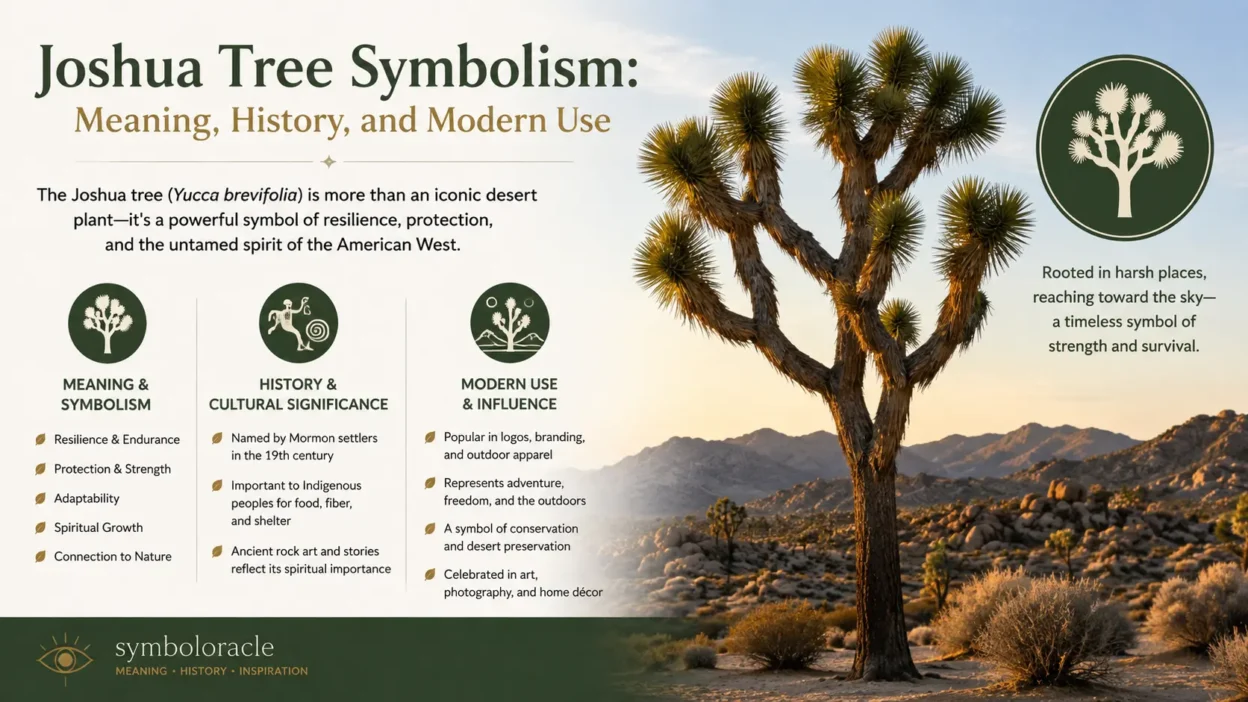
The Joshua tree is one of the most recognizable plants of the American desert. Its thick trunk, stiff leaves, and irregular branches create a silhouette that can look determined, strange, or almost human against the Mojave sky. Joshua tree symbolism today centers mainly on resilience, endurance, guidance, individuality, and attachment to the desert landscape.
Those associations didn’t come from a single ancient tradition. They developed from the plant’s ability to survive harsh conditions, stories about its biblical name, Indigenous relationships with desert plants, conservation history, and its later presence in photography, music, and tattoos. Because the Joshua tree is tied so closely to a real ecosystem, understanding its symbolism also means separating documented history from popular stories that have simply been repeated as fact.
Quick Answer
Joshua tree symbolism most commonly represents resilience, endurance, individuality, and finding direction during difficult periods in modern American culture. Its broader meanings come from its survival in the Mojave Desert, a disputed naming story connected with the biblical Joshua, and its status as an icon of the American Southwest.
At a glance:
- Joshua trees commonly represent resilience and survival under difficult conditions
- Their unusual shape also suggests independence and personal identity
- The biblical naming story is famous but historically uncertain
- Indigenous communities knew and used these plants long before settlers arrived
- American desert culture made the tree an emblem of wild open landscapes
- Conservation concerns now add responsibility and environmental vulnerability to its meaning
What a Joshua Tree Is and Why Its Appearance Matters
The Joshua tree is a large yucca native mainly to the Mojave Desert, growing across parts of California, Nevada, Arizona, and Utah. Although its common name calls it a tree, it belongs to the agave family rather than to familiar tree groups like oaks or pines — mature plants develop thick trunks topped by clusters of rigid, pointed leaves, and older specimens often branch repeatedly, producing the crooked silhouettes so common in desert photography.
That physical form strongly shapes how people interpret the plant. A perfectly symmetrical tree might suggest order, but a Joshua tree communicates something different — its branches twist in several directions, yet the plant remains upright in an environment with intense sun, limited rainfall, and strong winds. For modern observers, that combination naturally suggests survival without conformity; the tree looks adapted rather than perfected. Joshua trees are also slow-growing and long-lived, with many surviving well over a century, which adds its own associations with patience and continuity.
What It Commonly Means in the United States
In contemporary U.S. culture, the Joshua tree carries several overlapping meanings rather than one official definition.
| Context | Common U.S. Meaning | Association | Typical Use |
|---|---|---|---|
| Desert imagery | Endurance | Surviving harsh conditions | Photography, posters, artwork |
| Personal symbolism | Resilience | Recovering from difficulty | Tattoos, jewelry |
| Western identity | Freedom | Open land and independence | Clothing, branding, decor |
| Spiritual imagery | Guidance | Searching for direction | Art, personal reflection |
| Conservation | Stewardship | Protecting fragile habitats | Environmental campaigns |
Resilience is probably the most common interpretation — the plant survives where water is scarce and conditions can be severe, making it an intuitive metaphor for continuing through adversity. Independence comes from its unusual appearance, since no two mature plants develop exactly the same silhouette, which is why artists frequently use them to represent individuality or refusing to fit conventional expectations. Guidance comes partly from the story attached to the name Joshua — because the biblical Joshua led the Israelites into the promised land, later interpretations often connect the tree with direction and reaching a destination after a difficult journey. And more broadly, the plant has simply become a symbol of the American desert itself: sparse landscapes, large skies, and distance from crowded urban life.
Why the Desert Makes It a Symbol of Resilience
Much of the tree’s modern meaning can actually be understood without any mythology at all. The Mojave Desert receives little precipitation, and plants there must cope with prolonged dry periods, intense sunlight, and large swings between daytime and nighttime temperatures. Joshua trees survive through real biological adaptations — their roots spread through the surrounding soil to capture available moisture, while their structure stores water and supports survival through dry periods.
Their reproduction also depends on an unusually specialized relationship with yucca moths, which pollinate the flowers while using them as part of their own reproductive cycle — a close ecological partnership that took real evolutionary time to develop. These facts explain the resilience association well, though the symbolic lesson isn’t that hardship magically creates strength — the plant represents adaptation instead, and survival that depends on responding effectively to the environment. That distinction matters: modern tattoo and motivational imagery sometimes flattens resilience into simply “enduring unlimited hardship,” but the actual plant suggests something more practical — survival depends on timing, biological relationships, and available resources as much as toughness.
The Famous Biblical Naming Story
One of the best-known stories says Mormon travelers moving through the American West saw the plant’s branches stretching upward and compared them to the biblical Joshua raising his arms or directing people toward the promised land. That story helped create several later associations: leadership, guidance, faith during uncertainty, and perseverance through wilderness.
The problem is that historians haven’t found strong contemporary documentation proving Mormon pioneers actually created the name this way — the story is best treated as a naming tradition rather than a confirmed historical event. That doesn’t make it culturally unimportant, though. Once people began repeating the connection with the biblical Joshua, it shaped how later generations interpreted the plant regardless of its exact origin. The safest read is that the biblical association contributed to modern ideas of direction and perseverance, while the precise origin of the English name remains genuinely unresolved.
Indigenous Relationships Came Before the English Name
The Mojave Desert was not an empty wilderness waiting to be interpreted by incoming settlers. The lands around present-day Joshua Tree National Park are connected with Native peoples including Cahuilla, Chemehuevi, Serrano, and Mojave communities, whose relationships with the region extend back thousands of years. Joshua trees and related yuccas were genuinely useful plants — strong leaf fibers could be worked into cordage, baskets, and sandals, and flowers, buds, or seeds from yuccas were used as food in various communities.
This history calls for some care in how it’s discussed. It’s tempting for modern writers to assign broad concepts like “sacred wisdom” to Indigenous peoples without evidence, flattening distinct cultures into a single invented tradition. A more respectful interpretation recognizes practical knowledge and ecological familiarity built over generations, rather than treating the Joshua tree as merely an exotic visual symbol. For modern Americans, this history adds an important dimension to the tree: belonging to a place comes from real relationships with land, not just admiring its appearance.
How the Joshua Tree Became an American Desert Icon
During the nineteenth and twentieth centuries, outsiders increasingly associated Joshua trees with the strange beauty of the Mojave. The plant looked radically different from the forests familiar to many Eastern and Midwestern Americans, and its irregular limbs made it especially attractive to photographers and promoters of Western landscapes.
By the twentieth century, desert conservation strengthened that identity further. In the 1920s and 1930s, conservation advocate Minerva Hamilton Hoyt became concerned about the destruction and removal of desert plants, and her campaigning helped persuade the federal government to establish Joshua Tree National Monument in 1936 — the protected area later became Joshua Tree National Park in 1994. As millions of visitors encountered the landscape through tourism and photography, the Joshua tree became more than a species; its silhouette turned into visual shorthand for the Southern California desert, evoking road trips, camping, solitude, and escape from city life. That meaning is specifically American and relatively modern, despite how timeless it can feel.
U2 and the Tree’s Place in Pop Culture
Popular culture dramatically expanded recognition of the Joshua tree beyond the Southwest. U2 released The Joshua Tree in 1987, an enormous international success that included songs like “With or Without You” and “I Still Haven’t Found What I’m Looking For.” The band’s desert photography helped connect the tree with themes of searching, spiritual uncertainty, and personal longing.
The actual tree photographed for the album artwork wasn’t even inside Joshua Tree National Park — the band traveled through desert areas during the photo sessions, and the album’s imagery became part of a larger exploration of America rather than a promotion for the park specifically. Its cultural effect was still significant, though: after the album, the Joshua tree became recognizable to people who might never visit the Mojave, and the image could suggest both geographic America and a more abstract emotional landscape — a place of searching, distance, or possibility. Music reinforced meanings that already fit the tree’s visual character while giving them global visibility almost overnight.
Emotional and Psychological Meaning
People are often drawn to the Joshua tree during periods of transition. Someone moving to a new state, recovering from a difficult experience, or rebuilding after loss might identify with a plant that keeps growing in an unforgiving landscape. Its branches contribute directly to this reading, too — they don’t follow one clean line upward, and mature specimens may divide and change direction repeatedly. As a personal symbol, that form can represent a life that didn’t follow a predictable route, with the message shifting from “never change direction” to “continue growing even when the route changes.”
Solitude is another common association, since Joshua trees are frequently photographed against enormous stretches of open sky, creating feelings of silence and isolation in visual culture. Depending on context, that same landscape can suggest peaceful solitude or genuine loneliness — a flexibility that’s part of why the plant works so well in art. It can represent independence without necessarily representing happiness, and survival without pretending survival was easy.
What a Joshua Tree Tattoo Can Represent
Joshua tree tattoos are especially common among people who feel connected with the American Southwest or with a particular trip or period of personal change. A simple silhouette often represents endurance or independence on its own, while a tree paired with mountains or desert terrain can symbolize attachment to California, Nevada, Arizona, or Utah specifically.
Sunrise imagery may suggest a new beginning, while sunset can indicate closure or remembrance instead — stars and night skies often emphasize solitude or memorable desert experiences. A Joshua tree beside a date or coordinates usually turns the image into a memorial of a specific place or event, and the biblical interpretation is possible too, for someone familiar with the naming story who wants to represent faith or guidance. There’s no universal tattoo meaning here, though — a Joshua tree tattoo may simply commemorate a national park visit, and the surrounding imagery usually offers the strongest clue to what’s actually intended.
Religious and Spiritual Interpretations
The Joshua tree is sometimes described online as an established Christian symbol, but that description goes too far. The plant doesn’t hold the same traditional place in Christian iconography as symbols like the cross or the olive branch — its religious associations mainly come from its English name and the popular pioneer story connecting its branches with Joshua from the Hebrew Bible.
In the biblical narrative, Joshua succeeds Moses as leader and guides the Israelites into Canaan, and because of that connection, modern Christian interpretations may associate the plant with courage or entering a new stage of life. These are interpretive connections, though, rather than ancient church traditions. Claims that the Joshua tree universally represents enlightenment or supernatural protection should be treated with similar caution — those ideas generally belong to modern personal spirituality rather than documented historic symbolism. People are free to give the plant spiritual significance, but personal interpretation shouldn’t be presented as ancient fact.
Modern Design, Decor, Fashion, and Digital Culture
The Joshua tree’s silhouette works unusually well as a graphic symbol — a few angular branches and clusters of pointed leaves are enough to make the plant instantly recognizable, which is why designers use it on posters, shirts, jewelry, and travel merchandise constantly. In Southern California design, it often communicates desert minimalism or a high-desert lifestyle, paired with neutral colors, sun motifs, and rock formations to suggest calm and distance from urban environments.
Social media has strengthened these associations considerably. Photographs of isolated trees at sunrise or beneath the Milky Way can turn the plant into visual shorthand for adventure and escape. That popularity has a real downside, though — a living desert ecosystem can easily become reduced to an aesthetic backdrop, and visitors sometimes focus so heavily on getting a photograph that they overlook how vulnerable desert plants and soils actually are. The symbolic image of toughness can be misleading in this sense: Joshua trees are adapted to desert conditions, but they aren’t indestructible.
Conservation Has Changed What the Tree Represents
In the twenty-first century, the Joshua tree increasingly symbolizes environmental vulnerability alongside endurance. Researchers have examined how rising temperatures, altered precipitation, and habitat development may change where Joshua trees can successfully reproduce and survive — their long life cycle makes rapid environmental change especially consequential for the species.
California enacted the Western Joshua Tree Conservation Act in 2023, regulating activities involving western Joshua trees and establishing mechanisms intended to protect trees and habitat while addressing development needs. That legal attention has genuinely changed the plant’s cultural meaning. Earlier American imagery often emphasized the tree as an almost indestructible desert survivor, but modern conservation science presents a more complicated picture: a species can be highly adapted to a harsh environment and still become vulnerable once that environment changes faster than it can respond. As a result, the tree now represents stewardship alongside resilience — its message has shifted from simply “survive anything” toward “survival depends on protecting the conditions that make life possible.”
Common Misunderstandings and Misuse
Several claims about the Joshua tree get repeated so often they can sound more established than they really are. The Mormon naming story tops the list — it remains culturally influential, but shouldn’t be presented as firmly documented fact. Another mistake is describing the tree as having one ancient universal symbolic meaning; there’s no worldwide tradition in which Joshua trees consistently represent resilience or spiritual awakening, since the species is native to a limited part of North America and most familiar meanings developed in regional or modern cultural settings.
A third problem is assigning invented religious beliefs to Native peoples. Indigenous communities have genuine histories with these desert landscapes, and their traditions shouldn’t be replaced by vague claims about “Native spirituality.” Finally, survival symbolism can encourage the false assumption that the plant itself is extremely durable — Joshua trees can be damaged by climbing, vehicle impacts, fires, and development. Respecting the symbol should include respecting the living plant, too.
How Its Meaning Continues to Evolve
The Joshua tree’s symbolism accumulated in stages. Its earliest human importance in the region came through long Indigenous relationships with the desert and the practical uses of yuccas, and settler culture later introduced new names and biblical stories on top of that foundation. Conservation transformed the landscape into a nationally protected place, tourism turned the tree into an emblem of the Mojave, and photography and music expanded its cultural reach even further.
Today, tattoos and personal artwork emphasize resilience and identity, while environmental discussions increasingly emphasize fragility and stewardship instead. These meanings don’t cancel each other out — the same tree can represent endurance because it survives the desert, and vulnerability because even a desert specialist has ecological limits. That tension may be its most relevant modern interpretation of all.
Frequently Asked Questions
Is the Joshua tree a symbol of strength?
It can represent strength, but resilience is usually more precise. Its symbolism comes less from physical force than from its ability to persist and reproduce under difficult desert conditions.
What does a Joshua tree mean spiritually?
Modern spiritual interpretations often connect it with guidance, perseverance, and maintaining faith during uncertainty. These associations are influenced partly by its biblical name rather than a single historic religious doctrine.
Does the Joshua tree appear in the Bible?
No. The plant known today as the Joshua tree is not the biblical tree of Joshua, nor does Scripture identify it as a symbol associated with him. The connection comes from a later American naming tradition.
What does a Joshua tree tattoo mean?
It commonly represents resilience, individuality, desert identity, or surviving an important period of change. For some people it simply marks a personal connection with Joshua Tree National Park or the Mojave Desert.
Is the Joshua tree considered lucky?
There’s no widely established American tradition in which Joshua trees function as good-luck symbols. Someone may personally associate one with fortune or a new beginning, but that meaning is individual rather than traditional.
Why do Joshua trees symbolize survival?
Their association with survival comes from their ability to live in the dry, temperature-variable conditions of the Mojave Desert. Their long lives and distinctive growth patterns make them an easy visual metaphor for persistence and adaptation.
What does a Joshua tree represent in American culture?
It often represents the Mojave Desert, the American West, open space, independence, and resilience. More recently, conservation concerns have also made it a symbol of protecting desert ecosystems from environmental change.
Conclusion
The Joshua tree has become meaningful because biology, landscape, history, and culture all contribute to the way Americans see it. Its ability to survive the Mojave encourages associations with resilience, while its irregular branches suggest independence and adapting when life changes direction.
At the same time, Joshua tree symbolism is more complicated than the popular image of an invincible desert survivor. Its disputed naming story, long Indigenous history, role in American conservation, pop-culture visibility, and growing ecological vulnerability all shape what the plant represents today.
Perhaps the clearest modern message isn’t simply endurance. The Joshua tree shows that persistence depends on adaptation, relationships, place, and the conditions that allow life to continue.