The mourning cloak butterfly symbolism is closely connected to grief, remembrance, transformation, and hope after loss. With its dark, velvet-like wings and delicate yellow edges, this butterfly resembles traditional mourning clothing, giving it an unusual connection to human experiences of death and remembrance. Yet its appearance in early spring also suggests something more encouraging: life can continue after a difficult period.
The mourning cloak butterfly (Nymphalis antiopa) is one of the most recognizable butterflies in North America. Unlike many species that appear mainly during warm weather, it can emerge from winter dormancy when the landscape is still cold. This behavior gives it a natural association with endurance, survival, and the return of life.
For Americans who encounter one in a garden, woodland, cemetery, or along a quiet walking trail, the butterfly can carry personal meaning. Some people connect it with a loved one who has died, while others see it as a reminder to accept change and appreciate the present.
Quick Answer
Mourning cloak butterfly symbolism commonly represents grief, remembrance, transformation, resilience, and hope after loss in modern American culture. Its dark wings recall traditional mourning garments, while its early spring appearance and survival through winter make it a natural symbol of renewal and life continuing after hardship.
TL;DR: Key Symbolic Meanings
- Grief and remembrance: Its dark wings resemble traditional mourning clothing.
- Transformation: Its life cycle represents change and personal development.
- Resilience: Surviving winter reflects endurance through difficult periods.
- Hope: Its early spring appearance suggests life returning after hardship.
- Spiritual reflection: Some people interpret an encounter as a personal reminder of someone they miss.
- Acceptance: Its natural life cycle encourages reflection on change, loss, and renewal.
What Does a Mourning Cloak Butterfly Look Like?
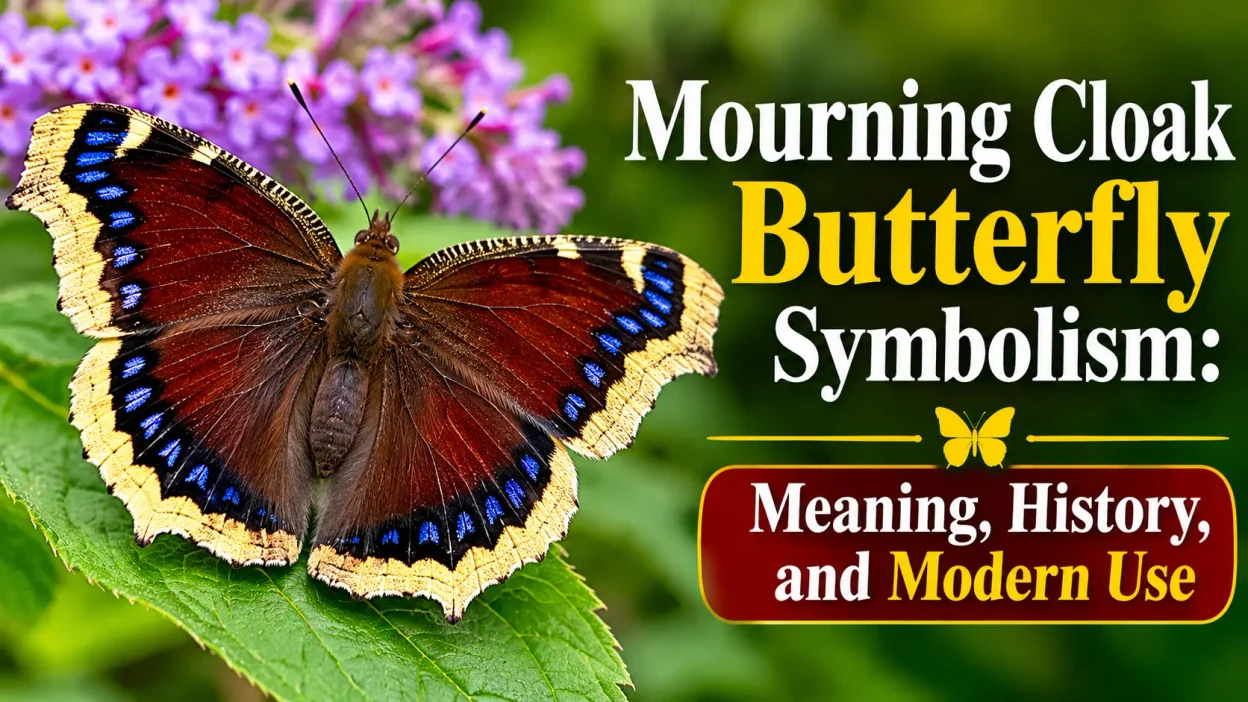
The mourning cloak is a medium-to-large butterfly with a distinctive appearance. Its wings are dark brown to purplish-black, surrounded by a broad yellow or cream-colored border. A row of small, iridescent blue spots sits just inside the yellow edges.
Its wingspan usually measures between 2.25 and 4 inches, making it relatively large compared with many familiar garden butterflies.
When its wings are open, the contrasting colors create an appearance that can remind people of formal mourning clothing. When the wings are closed, the underside looks dark and resembles weathered tree bark.
This unusual combination of dark coloring, bright borders, and blue markings contributes to its symbolic associations.
The butterfly also has an interesting seasonal pattern. Adults survive the winter by sheltering in protected places, such as tree cavities and spaces beneath loose bark. On warmer days, they may become active even when snow remains on the ground.
That behavior makes the species especially noticeable during the transition between winter and spring.
The Connection Between Mourning and Its Name
The word mourning refers to the emotional and cultural expressions associated with someone’s death. The word cloak describes a loose outer garment traditionally worn over other clothing.
The butterfly’s common name comes from its resemblance to historical mourning attire. Its dark wings look like a black or brown cloak, while the pale yellow border resembles a lighter-colored garment underneath.
In earlier European and American societies, black clothing was widely associated with bereavement. People wore dark garments to communicate that they had experienced a death and were observing a period of mourning.
The butterfly’s appearance therefore provides a straightforward explanation for its name.
However, an important distinction is necessary: its common name does not establish that every culture traditionally considered the insect an omen of death. The name describes its appearance rather than proving a universal supernatural belief.
This distinction helps separate the butterfly’s documented natural history from the personal meanings people attach to it today.
Historical Origins of Its Symbolism
The mourning cloak has a natural range extending across much of North America and parts of Europe and Asia. Its scientific name, Nymphalis antiopa, was established in the eighteenth century.
In Britain, it is commonly known as the Camberwell Beauty, a name associated with an early recorded British occurrence near Camberwell, London, in 1748.
Its dark appearance helped establish its connection with mourning imagery. In societies where clothing communicated social status, religious observance, and family circumstances, the resemblance to mourning garments was easy to recognize.
At the same time, butterflies already carried broader associations with change and the movement between stages of life.
The butterfly’s transformation from caterpillar to chrysalis to adult made it a natural image for transition. People could connect this process with human experiences such as growing older, beginning a new life, or facing the death of someone close.
The mourning cloak brought these ideas together through its particular appearance and seasonal behavior.
There is no well-established historical tradition showing that the species had one universal symbolic meaning across ancient civilizations. Its strongest historical association comes from its name and appearance, while its broader meanings developed through the symbolism of butterflies and people’s observations of nature.
Mourning Cloak Butterfly Symbolism in the United States
In the United States, this butterfly can be understood through two contrasting ideas: remembering the past and continuing into the future.
Its dark wings naturally bring thoughts of mourning, particularly for people who associate black clothing with funerals and memorial ceremonies. Someone who has recently lost a family member might find its appearance especially meaningful.
At the same time, Americans often associate butterflies with positive life changes. They appear in artwork, memorial gardens, jewelry, tattoos, and personal keepsakes.
The mourning cloak combines these associations in a recognizable way.
For example, a person remembering a parent might interpret the butterfly as a reminder that grief and love can exist together. Another person recovering from a difficult experience might see it as a representation of strength and a fresh beginning.
These interpretations are personal rather than established cultural rules.
The species is also familiar to people who spend time outdoors in northern and temperate parts of the country. Its appearance before many other butterflies become active gives it a seasonal connection with the end of winter.
Six Common Symbolic Meanings of the Mourning Cloak
Although individual interpretations vary, six meanings frequently fit the butterfly’s appearance and natural behavior.
1. Grief and Remembrance
The most recognizable association comes from its dark wings and mourning-inspired name.
The butterfly can represent the experience of remembering someone who has died. Its appearance may remind a person of a family member, friend, or important relationship that continues to influence their life.
Unlike symbols that represent sadness alone, the butterfly also carries associations with change and continued life.
This makes it suitable for memorial artwork and personal reminders that honor someone without focusing exclusively on death.
2. Transformation and Personal Change
Butterflies undergo complete metamorphosis, changing from eggs into caterpillars, pupae, and winged adults.
This biological process has made butterflies familiar symbols of personal transformation.
The mourning cloak adds another layer to that interpretation. Its dark appearance can represent a difficult stage, while its adult form suggests the possibility of moving into a different phase of life.
People experiencing major changes, such as ending a relationship, changing careers, or rebuilding their lives after a personal loss, may connect with this meaning.
3. Resilience and Survival
One of the most remarkable characteristics of the mourning cloak is its ability to survive winter as an adult butterfly.
Many butterfly species spend winter in other developmental stages. The mourning cloak, however, can remain alive in sheltered locations and become active again when temperatures rise.
This behavior provides a natural comparison with human resilience.
Its symbolism can represent someone who has endured a difficult experience without losing the ability to move forward.
It does not suggest that hardship is easy or that people should hide their emotions. Instead, it offers an image of persistence during periods when progress may not be visible.
4. Hope After Loss
The mourning cloak often appears when winter has not completely disappeared.
Seeing a butterfly moving through a landscape that still looks cold can create a striking contrast. The insect becomes a reminder that seasonal change does not happen all at once.
In personal symbolism, this can represent hope after bereavement, disappointment, or emotional exhaustion.
A person may interpret the butterfly as a reminder that happiness can return without requiring them to forget what happened.
5. Acceptance and the Natural Cycle of Life
The butterfly’s development and seasonal behavior illustrate the natural processes of change.
Its life includes growth, reproduction, dormancy, and eventually death. These stages can encourage people to consider their own experiences of beginnings and endings.
Acceptance does not mean approving of every painful event. It means recognizing that change is part of life and learning to live with circumstances that cannot always be reversed.
For some people, the mourning cloak represents this kind of understanding.
6. Quiet Strength and Independence
Mourning cloaks are often encountered alone rather than in large groups around flowers.
Adult butterflies also display territorial behavior, particularly males defending suitable areas.
These characteristics can inspire associations with independence, self-reliance, and quiet strength.
In personal interpretation, the butterfly may represent someone who has learned to stand independently after a challenging period.
This meaning is especially relevant when its appearance reminds someone of their own progress rather than a specific person or event.
What Its Colors Represent
The mourning cloak’s coloring is central to its appearance and much of its symbolic interpretation.
| Color | Common Symbolic Association | Connection to the Butterfly |
|---|---|---|
| Dark brown or black | Mourning, memory, reflection | Resembles traditional mourning garments |
| Yellow | Hope, warmth, optimism | Forms the bright outer wing border |
| Blue | Calm, reflection, emotional depth | Appears in small iridescent wing spots |
| Purple undertones | Dignity, contemplation, individuality | Can be seen in the dark upper wing surface |
These associations are based on common interpretations of color rather than fixed meanings.
For example, black is associated with mourning in many American funeral traditions, but it can also represent formality, elegance, and seriousness.
Yellow often suggests warmth and optimism, while blue can create a feeling of calm.
The combination makes the mourning cloak visually interesting because its appearance does not communicate sadness alone. Its lighter markings provide contrast against the darker background.
Why Its Early Spring Appearance Matters
The mourning cloak is particularly unusual because it can become active before many familiar butterflies appear.
Adults spend winter in sheltered locations and emerge when temperatures become suitable. In some parts of the United States, people may see them flying during late winter or early spring.
This timing gives the species a connection with seasonal renewal.
Consider a person walking through a wooded area in March. The trees may still be bare, the ground may be cold, and most flowering plants may not have started growing. Suddenly, a large dark butterfly flies across the path.
The encounter can feel surprising because the insect appears before the landscape looks ready for spring.
Symbolically, this can represent:
- Progress before circumstances become comfortable.
- Hope during a difficult period.
- The ability to survive unfavorable conditions.
- New opportunities after an extended period of waiting.
The butterfly does not wait for summer to return before becoming active. Its behavior provides a natural example of endurance and adaptation.
Mourning Cloak Butterfly Symbolism Across Cultures
Butterfly symbolism varies considerably between cultures, religions, and historical periods.
The mourning cloak’s particular association with grief is connected primarily to its European-derived common name and the appearance of its wings. Its wider symbolism is better understood through traditions involving butterflies generally.
European Traditions
European naming traditions connect the mourning cloak with dark mourning clothing.
Its British name, Camberwell Beauty, reflects a different historical approach to identifying the species. The two common names show how the same butterfly can acquire different cultural identities depending on where people encounter it.
European butterfly imagery has also been used in art and literature to represent change, beauty, and the transition between stages of existence.
Ancient Greek Connections
The ancient Greek word psyche could refer to both the soul and a butterfly.
This linguistic connection helped establish a long-lasting relationship between butterflies and ideas about the soul in later European artistic and literary traditions.
However, this should not be interpreted as evidence that ancient Greeks specifically associated the mourning cloak with death or bereavement.
The connection concerns butterflies more broadly.
East Asian Traditions
Butterflies appear in several East Asian artistic and cultural traditions.
In Chinese symbolism, paired butterflies have been associated with love, companionship, and marital happiness. In Japanese visual culture, butterflies can represent change, beauty, and aspects of personal identity.
These meanings depend on the artwork and cultural context. They are not specific to the mourning cloak.
Indigenous North American Traditions
Indigenous communities across North America have distinct relationships with butterflies, animals, land, and spiritual traditions.
There is no single Indigenous interpretation of the mourning cloak that can represent all Native American nations.
Some communities have butterfly stories and cultural teachings, but meanings must be understood within their particular traditions rather than combined into one general belief.
Respectful interpretation means avoiding claims that a butterfly has the same sacred meaning for every Indigenous community.
Emotional and Psychological Meaning
People often connect natural objects with personal memories. A particular bird, flower, or butterfly can remind someone of a person or experience even when no established cultural tradition supports that association.
The mourning cloak is especially suitable for this kind of emotional interpretation because its appearance combines dark and bright elements.
Its dark coloring may remind someone of grief, while its lighter edges can suggest hope or emotional recovery.
This contrast can reflect the experience of bereavement itself.
People who have lost someone may experience sadness alongside gratitude, love, and positive memories. These feelings do not cancel one another out.
The butterfly can serve as a visual reminder that healing does not require forgetting.
It may also represent a person’s changing relationship with a difficult memory. Something that once felt overwhelming can gradually become part of their personal history.
From a psychological perspective, this is a form of personal meaning-making. The butterfly does not need to possess supernatural properties for the encounter to feel important.
Mourning Cloak Butterfly Meaning in Dreams
Dream interpretations are subjective, and there is no scientifically established meaning for seeing a particular butterfly in a dream.
However, the mourning cloak’s appearance can provide useful starting points for personal reflection.
Seeing a mourning cloak flying: This may represent moving forward while carrying memories of an earlier experience.
Seeing one resting on a tree: Some people might associate this image with patience, stability, or a period of reflection.
Seeing one in winter: The contrast between the butterfly and the cold surroundings may suggest endurance during an uncertain period.
Seeing a dead mourning cloak: This might bring up thoughts about endings, grief, or a relationship that has changed.
Seeing several mourning cloaks: The image could encourage reflection on family memories, shared experiences, or a period of personal transition.
The most useful question is how the dream made you feel. A peaceful encounter may carry a different personal meaning from one that creates fear or sadness.
What Does It Mean When You See a Mourning Cloak Butterfly?
An unexpected encounter with a mourning cloak can feel memorable, especially if it happens during a period of personal change.
There are several ways to understand the experience.
As a reminder of someone who died: Its name and appearance may naturally connect with memories of a loved one.
As a sign of changing circumstances: Its transformation can represent the beginning of a different stage in life.
As an image of resilience: Its ability to survive winter can remind people that difficult periods do not necessarily last forever.
As a seasonal reminder: Its early appearance can mark the return of warmer weather and outdoor activity.
Some people interpret such encounters spiritually, believing that a butterfly appears at a meaningful moment for a reason. Others understand the experience as a natural coincidence that becomes personally significant.
Neither interpretation needs to be imposed on everyone.
There is no scientific evidence that encountering a mourning cloak predicts a death, communicates a message from the deceased, or guarantees a future event.
Its significance can come from the memories and thoughts it brings forward.
Spiritual Interpretations and Religious Connections
In contemporary spiritual discussions, butterflies are frequently connected with the soul, renewal, and the continuation of life.
The mourning cloak can be included in these interpretations because of its name and distinctive dark appearance.
Some people view it as a comforting symbol after losing someone. They may interpret an encounter as a reminder of continuing love or a connection with cherished memories.
Others understand it as a symbol of personal growth after an emotionally difficult experience.
Christian artistic traditions have sometimes used butterflies to represent resurrection and new life. This association draws on the insect’s transformation and emergence rather than on the mourning cloak specifically.
However, the mourning cloak is not an official religious symbol in Christianity or a universal sign across religions.
Its spiritual meaning depends on the beliefs of the individual and the tradition in which the interpretation is being made.
It is reasonable to find comfort in a butterfly encounter without claiming that its appearance proves a supernatural event.
Why People Choose Mourning Cloak Butterfly Tattoos
The mourning cloak has a distinctive appearance that makes it an interesting choice for personal artwork.
Unlike brightly colored butterflies, its dark wings create a design that can communicate both elegance and remembrance.
People may choose this butterfly tattoo for several reasons.
Memorial tattoos: Someone may use it to honor a deceased family member, friend, or partner.
Personal transformation: The butterfly can represent a significant change after a difficult experience.
Resilience: Its ability to survive winter makes it suitable for representing strength and perseverance.
Emotional balance: The combination of dark wings and bright borders can represent the coexistence of sadness and hope.
Individuality: Its unusual coloring distinguishes it from more common butterfly tattoo designs.
Some tattoo designs include dates, initials, names, flowers, or short memorial messages. Others feature the butterfly alone, allowing its natural appearance to carry the meaning.
A realistic design can preserve the yellow border and blue spots, which are important identification features.
The meaning ultimately comes from the person choosing the tattoo, not from a universal rule about the species.
Modern Uses in Jewelry, Fashion, and Home Decor
The mourning cloak can also inspire decorative objects and personal accessories.
Its combination of dark brown, yellow, and blue works well in designs that balance traditional elegance with natural imagery.
In jewelry, the butterfly may appear on pendants, earrings, bracelets, and memorial charms. A small design can serve as a personal reminder of someone who has died or a difficult period that has passed.
In fashion, its wing pattern can inspire printed fabrics, brooches, accessories, and nature-themed designs.
In home decor, the butterfly may appear in framed illustrations, garden artwork, decorative plates, and memorial displays.
People sometimes choose natural-history illustrations because they preserve the actual markings of the species rather than presenting it as a generic butterfly.
Social media has also made it easier for people to share butterfly photographs and connect natural encounters with personal experiences.
A photograph of a mourning cloak might accompany a memorial message, a reflection about personal growth, or simply an observation about the changing seasons.
These uses show how an insect with a historical name can acquire new personal meanings in contemporary American life.
Common Misunderstandings About Mourning Cloak Symbolism
The butterfly’s name can create confusion, particularly when its symbolism is discussed online.
Several distinctions are worth keeping in mind.
It does not automatically represent death. The word mourning comes from its resemblance to traditional mourning garments. It does not mean that the butterfly predicts someone’s death.
It is not universally considered a bad omen. Interpretations vary, and many people associate it with hope, resilience, and renewal.
Its spiritual meaning is not scientifically proven. A personal experience can feel meaningful without establishing a supernatural explanation.
It is not exclusively a memorial symbol. People may appreciate the butterfly because of its appearance, natural history, or seasonal behavior.
Its symbolism is not identical across cultures. General butterfly traditions should not be incorrectly presented as specific mourning cloak beliefs.
Understanding these distinctions allows people to appreciate the butterfly without confusing personal interpretation with historical fact.
How Its Meaning Has Evolved Over Time
The mourning cloak’s symbolic identity has developed through the relationship between its physical appearance, its name, and broader butterfly imagery.
Its early naming tradition emphasized the resemblance between its dark wings and mourning garments. That connection remains one of its most recognizable associations.
Later interpretations drew more attention to the butterfly’s transformation and its unusual ability to survive winter as an adult.
These natural characteristics made it suitable for representing endurance, renewal, and the continuation of life.
In modern America, personal expression has expanded its meaning further. Memorial tattoos, garden photography, jewelry, and social media have made it easier for individuals to connect the species with their own experiences.
The result is a symbol that can represent sadness without being limited to sadness.
Its meaning has moved from a primarily visual association with mourning clothing toward a broader interpretation involving memory, personal change, and hope.
Frequently Asked Questions
1. Is seeing a mourning cloak butterfly a sign of a deceased loved one?
Some people interpret an encounter as a comforting reminder of someone who has died. This is a personal or spiritual belief rather than a scientifically established message from the deceased.
2. Does a mourning cloak butterfly symbolize death?
It is associated with mourning because its dark wings resemble traditional funeral clothing. However, it also represents resilience, transformation, remembrance, and hope.
3. What does a mourning cloak butterfly tattoo mean?
A mourning cloak tattoo can represent honoring a deceased loved one, surviving hardship, or beginning a new chapter. Its dark and yellow coloring can also symbolize the coexistence of grief and hope.
4. Is the mourning cloak butterfly a good or bad omen?
There is no scientific evidence that it predicts good or bad events. Many modern interpretations associate it with positive ideas such as endurance, renewal, and emotional healing.
5. What does a mourning cloak butterfly symbolize spiritually?
Some people associate it with the soul, remembrance, continuing love, and transformation. These interpretations depend on personal beliefs rather than a universal religious teaching.
6. Why is it called a mourning cloak butterfly?
Its dark brown or purplish-black wings resemble traditional mourning garments, while the yellow border creates the appearance of a lighter-colored layer underneath. Its name describes its distinctive coloring.
7. What makes the mourning cloak butterfly different from other butterflies?
It can survive winter as an adult and become active during warm periods before spring fully arrives. It is also recognized by its dark wings, yellow borders, and small blue spots.
Conclusion
Mourning cloak butterfly symbolism brings together grief, remembrance, transformation, and resilience. Its dark wings explain its connection with traditional mourning clothing, while its ability to survive winter and appear during early spring gives it an association with renewal.
For Americans, the butterfly can serve as a memorial image, a reminder of personal strength, or simply a beautiful example of nature’s ability to adapt. Its appearance does not predict death or prove a supernatural message, but it can still hold genuine emotional significance.
Perhaps its most meaningful lesson is that remembering someone and moving forward are not opposing experiences. Both can remain part of the same life.