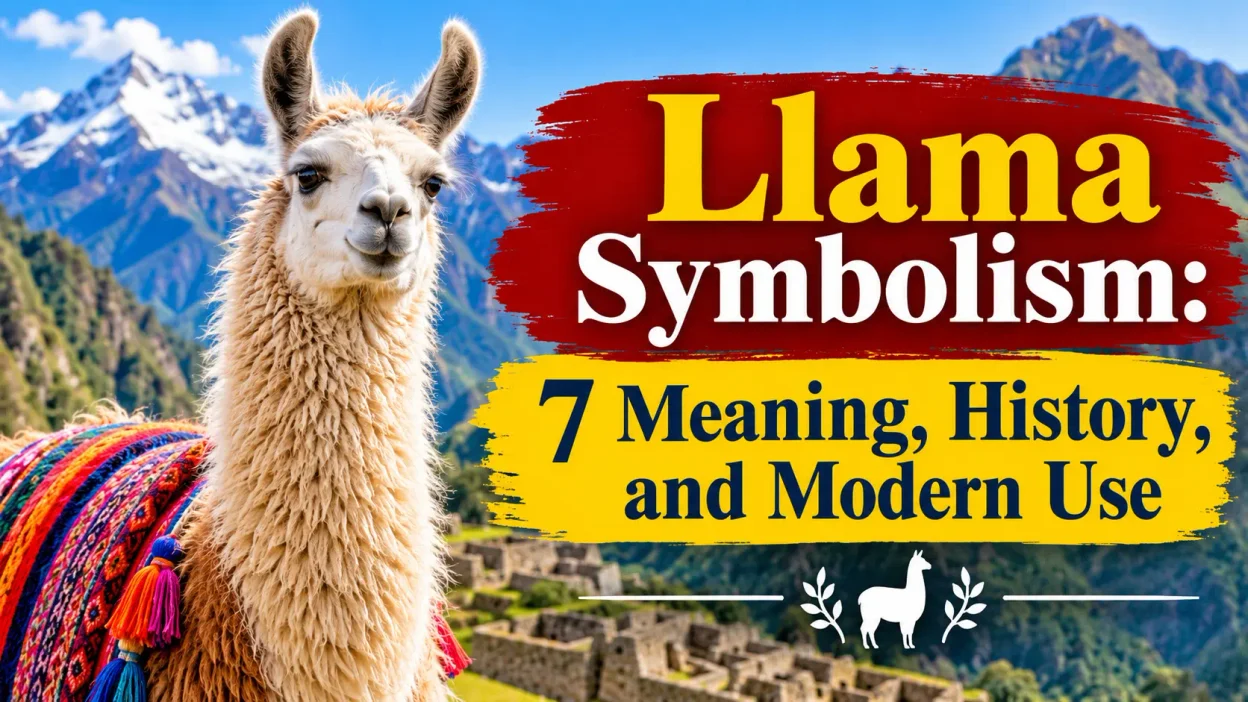
A llama is often associated with patience, endurance, independence, and the ability to carry responsibilities without losing its balance. In llama symbolism, this familiar South American animal represents more than its gentle appearance. Its long history as a working animal in the Andes connects it with survival, cooperation, prosperity, and the relationship between people and the natural world.
For centuries, llamas have helped communities travel across difficult mountain landscapes, transport valuable goods, and maintain connections between distant settlements. They also held religious and ceremonial importance in several Andean societies. These practical and cultural roles explain why the animal developed meanings that extend beyond its physical appearance.
Today, Americans encounter llamas in everything from farm visits and children’s books to clothing, home decorations, artwork, and tattoos. Their friendly faces often suggest humor and relaxation, while their historical background adds associations with perseverance, cultural heritage, and resourcefulness.
Quick Answer: What Does a Llama Symbolize?
Llama symbolism commonly represents patience, endurance, independence, responsibility, and peaceful cooperation. Historically, llamas also symbolized prosperity, survival, spiritual offerings, and community connections in Andean cultures because of their essential role in transportation, agriculture, trade, and religious ceremonies.
TL;DR: Key Meanings of Llama Symbolism
- Endurance: Continuing through difficult circumstances without giving up.
- Patience: Remaining steady when progress requires time and effort.
- Independence: Maintaining personal boundaries and making individual choices.
- Responsibility: Carrying duties and supporting others through practical action.
- Prosperity: Representing wealth, productive herds, and agricultural stability in Andean traditions.
- Community: Reflecting cooperation, shared resources, and connections between people.
1. What Does a Llama Represent?
The llama is a domesticated South American camelid recognized by its long neck, upright ears, woolly coat, and distinctive facial expression. It is closely related to the alpaca, guanaco, and vicuña, although these animals have different physical characteristics and uses.
Its symbolism comes largely from the qualities people have observed through centuries of interaction.
A llama can carry substantial loads across challenging terrain. It is adapted to high-altitude environments and can survive conditions that make transportation difficult. These characteristics have encouraged associations with strength, endurance, and practical intelligence.
However, a llama does not represent strength in the same way as a lion or bear. Its image suggests a quieter kind of strength: the ability to continue working, adapt to circumstances, and maintain stability.
Its most recognizable symbolic associations include:
- Steadiness: Remaining dependable during difficult periods.
- Self-respect: Maintaining boundaries rather than accepting every demand.
- Adaptability: Adjusting to changing environments.
- Cooperation: Contributing to the well-being of a larger community.
- Resourcefulness: Making practical use of available resources.
The exact meaning depends on the setting. A llama in traditional Andean artwork carries different cultural associations from a cartoon llama printed on a modern American T-shirt.
2. Ancient Andean Roots of Llama Symbolism
The history of llamas is closely connected to the development of human communities in the Andes, particularly in present-day Peru, Bolivia, Chile, and Argentina.
People in these highland regions domesticated South American camelids thousands of years ago. Archaeological evidence places early llama domestication in the Andean region several millennia before the rise of the Inca Empire.
These animals provided resources that were essential to everyday survival. Their meat supplied food, their hides served practical purposes, their fiber was used for textiles and other materials, and their dung provided fuel and fertilizer.
Their ability to carry goods was especially important.
Unlike many other domesticated animals, llamas could travel across mountainous terrain while transporting supplies. This made them valuable to communities separated by valleys, mountains, and different agricultural environments.
As a result, the llama became associated with:
- Economic stability.
- Household resources.
- Long-distance exchange.
- Agricultural productivity.
- Cooperation between settlements.
These associations were not simply invented symbolic meanings. They developed from the animal’s actual contribution to Andean life.
A llama represented something people could depend on, making it an important part of the region’s economic and cultural identity.
3. Llama Symbolism in Inca Culture
The Inca Empire, which expanded across much of the western Andes during the fifteenth and early sixteenth centuries, relied heavily on camelid herding.
Llamas supported transportation, agriculture, military supply systems, and trade. They carried food, textiles, and other goods along extensive road networks connecting different parts of the empire.
Their importance extended into religious and ceremonial life.
Inca communities used small animal-shaped figures in ritual practices. Some carved llama and alpaca figures, known as conopas, had hollow spaces on their backs that could hold offerings.
These objects were associated with household prosperity, animal fertility, and the well-being of herds.
Llamas were also used in ceremonial offerings. Archaeological evidence from Andean sites shows that camelids could be sacrificed and consumed during important religious events.
Their ceremonial role reflected the connection between livestock, agricultural success, community survival, and religious belief.
It is important to distinguish these historical practices from modern decorative interpretations. A llama image today does not automatically represent an Inca religious symbol.
Nevertheless, understanding this history explains why llamas have a cultural significance that goes beyond their usefulness as pack animals.
4. What Llamas Symbolize in Modern American Culture
In the United States, llamas have developed a broader and often more playful cultural identity.
Many Americans first encounter them through petting farms, agricultural exhibitions, children’s entertainment, and travel photography. Their unusual appearance and expressive faces make them recognizable even to people unfamiliar with Andean history.
Modern American interpretations commonly connect llamas with:
Friendliness and humor: Their unusual facial expressions and distinctive appearance make them popular subjects for funny illustrations, gifts, and social media content.
Individuality: A llama’s recognizable appearance makes it a natural symbol for people who appreciate being different.
Outdoor living: Llamas are associated with farms, rural communities, mountain landscapes, and animal care.
Travel and adventure: Their historical role in mountain transportation connects them with exploration and journeys through unfamiliar environments.
Relaxation: Decorative llama illustrations often appear in products designed around comfort, cozy living, and cheerful home environments.
In American popular culture, the llama can communicate a relaxed attitude toward life. It may suggest that someone does not take every situation too seriously.
However, its historical meaning remains important. The llama is not simply a humorous animal or a fashionable design. Its cultural roots deserve recognition, particularly when its image is used in artwork inspired by traditional Andean communities.
5. Llama Symbolism and the Meaning of Endurance
Endurance is one of the most natural symbolic associations of the llama.
The animal developed a close relationship with high-altitude environments, where cold temperatures, thin air, and difficult terrain create demanding conditions.
Its ability to transport goods across mountain routes made it a dependable resource for communities that needed to move supplies over long distances.
This practical ability gives the llama a useful symbolic connection with perseverance.
In personal life, a llama may represent someone who continues working toward a goal despite delays or obstacles.
For example:
- A student who continues studying after disappointing results.
- A worker who manages responsibilities during a difficult period.
- A family member who supports others while handling personal challenges.
- Someone rebuilding their life after a major change.
The symbolism is not about forcing yourself to carry every burden. It is about recognizing the value of steady progress and understanding your limits.
A llama can therefore represent the difference between genuine perseverance and unnecessary exhaustion.
6. Patience, Independence, and Personal Boundaries
Llamas are social herd animals, but they also have individual behavioral characteristics. They can be selective about their interactions and may resist handling or carrying excessive weight.
Their reputation for sitting down when overloaded has contributed to modern associations with personal boundaries.
This has become especially noticeable in humorous American illustrations and merchandise.
A llama refusing to move can represent someone who has reached their limit and is no longer willing to accept additional responsibilities.
In this interpretation, the animal communicates three related ideas:
- Patience: Not everything needs an immediate response.
- Independence: Personal decisions should not depend entirely on outside approval.
- Boundaries: Supporting others does not mean accepting unlimited demands.
These meanings are particularly relevant in modern conversations about work-life balance and personal well-being.
However, llamas should not be reduced to symbols of stubbornness. Their behavior has practical explanations, and refusing an excessive load is not the same as being unwilling to cooperate.
The more balanced interpretation is that independence and cooperation can exist together.
7. Llama Symbolism and Wealth in Traditional Andean Communities
The connection between llamas and prosperity is rooted in their economic importance.
For many Andean households, maintaining healthy herds meant having access to food, fiber, transportation, and valuable materials.
A productive herd could support a family’s livelihood and provide resources for exchange with other communities.
Llamas also played a role in long-distance trade caravans. Their ability to transport goods helped connect different ecological regions, allowing communities to exchange products that were not locally available.
This created a connection between the animal and material well-being.
In traditional Andean contexts, llama-related symbolism could therefore include:
- Household prosperity.
- Healthy livestock.
- Agricultural success.
- Economic security.
- Social status.
- Continuity between generations.
The animal’s importance was not limited to wealthy households or political leaders. It was closely connected to the everyday systems that allowed communities to function.
Modern interpretations sometimes simplify this history into a general symbol of good luck or financial abundance. Those meanings should be understood as modern adaptations rather than universal traditional beliefs.
8. Spiritual and Religious Meaning of the Llama
Llamas have occupied a place in Andean religious traditions for centuries.
Their connection with ceremonial offerings, herd fertility, and agricultural prosperity made them significant within different local belief systems.
Some archaeological evidence also connects camelid imagery with sacred objects and ritual practices.
In Andean cosmological traditions, animals were not always viewed as separate from human economic and spiritual life. Their health, reproduction, and relationship with the environment could have religious importance.
Some Andean communities associated llama herds with rainfall, fertility, and the well-being of pastoral life.
In certain historical and regional traditions, camelid figures were also connected with supernatural beings and sacred landscapes.
However, there is no single religious interpretation shared by every Andean community. Beliefs varied by region, period, and cultural group.
For modern American readers, a llama may symbolize spiritual connection with nature, gratitude for everyday resources, or respect for traditional ways of life.
These are reasonable personal interpretations, but they should not be presented as universal Inca teachings or formal religious doctrines.
9. Llama Symbolism Across Different Cultural Contexts
The llama has its strongest historical cultural associations in the Andes, but its image now appears in many countries.
Understanding the difference between traditional and modern interpretations helps prevent cultural confusion.
| Cultural context | Common associations | Important distinction |
|---|---|---|
| Ancient Andean societies | Wealth, transportation, fertility, ritual offerings | Based on practical and ceremonial importance |
| Inca civilization | Trade, agricultural resources, herd prosperity | Connected with imperial and religious life |
| Modern Andean communities | Livelihood, pastoral identity, cultural continuity | Practices vary between communities |
| United States | Humor, individuality, patience, farm life | Often influenced by popular entertainment |
| Modern global culture | Travel, nature, uniqueness, decoration | Frequently separated from historical context |
One important distinction concerns alpacas.
Both llamas and alpacas belong to the South American camelid family, but they have different physical characteristics and historical uses.
Llamas were particularly important as pack animals, while alpacas were especially valued for their fine fiber.
Their symbolic meanings sometimes overlap, but treating the two animals as interchangeable can erase meaningful cultural and historical differences.
10. The Emotional and Psychological Meaning of a Llama
People often respond to animals through a combination of appearance, behavior, personal memories, and cultural associations.
The llama’s upright posture, soft-looking coat, and unusual facial expression can create an impression of friendliness and calm.
For some people, it represents a comfortable connection with nature. For others, it suggests humor, independence, or the freedom to behave differently from social expectations.
Its emotional associations can include:
Comfort: The animal’s woolly appearance can suggest warmth, safety, and a relaxed environment.
Confidence: Its recognizable personality can represent the freedom to stand out without constantly seeking approval.
Resilience: Its working history makes it an appropriate image for perseverance.
Connection: Its role in herd life and human communities can suggest cooperation and belonging.
Self-acceptance: Its unusual appearance makes it a popular symbol for embracing individual differences.
These interpretations are personal rather than scientifically established psychological meanings.
A person who grew up around farm animals may associate llamas with childhood memories, while someone familiar with South American history may connect them with Andean heritage.
The same animal can therefore communicate different emotions depending on someone’s background.
11. Why People Choose Llama Tattoos and Jewelry
Llama tattoos are less conventional than designs featuring wolves, butterflies, or lions. That relative uniqueness is part of their appeal.
People who choose llama imagery may want a design that represents personal qualities without relying on traditional animal symbolism.
Common tattoo interpretations include:
- Endurance: A reminder to keep moving through difficult circumstances.
- Individuality: A celebration of being different.
- Humor: An expression of a playful personality.
- Cultural appreciation: An interest in Andean history and traditions.
- Adventure: A connection with travel, mountains, and outdoor experiences.
The design itself can change its meaning.
A realistic llama portrait may emphasize appreciation for animals or rural life. A colorful illustration may communicate creativity and optimism. A small minimalist design may serve as a personal reminder of patience or independence.
Llama jewelry can carry similar associations.
Pendants, earrings, bracelets, and charms featuring llamas are often selected because of their unusual appearance or personal significance.
When choosing artwork inspired by Andean traditions, it is worth distinguishing authentic cultural designs from generic commercial imagery.
12. Llamas in Home Decor, Fashion, and Popular Culture
The llama has become a recognizable decorative subject in the United States.
Its appearance works particularly well in playful designs because it is distinctive without requiring elaborate details.
Common examples include:
- Llama illustrations on pillows and blankets.
- Ceramic llama figurines and decorative ornaments.
- Children’s bedroom artwork.
- Printed sweaters, socks, and T-shirts.
- Greeting cards and stationery.
- Farm-themed decorations.
- Social media illustrations and stickers.
In these settings, the llama usually communicates friendliness, creativity, and humor.
Some designs include colorful blankets, geometric patterns, or landscape elements inspired by the Andes. Others use cartoon expressions and exaggerated features for entertainment.
The distinction matters because not every llama design is intended to communicate historical symbolism.
A decorative object may simply celebrate an animal that people find charming.
Nevertheless, artwork that borrows specific Andean textiles, clothing, or ceremonial imagery carries a stronger cultural connection and should be treated with greater care.
13. What Does It Mean When You Dream About a Llama?
Dream interpretations involving llamas are generally personal and depend on the details of the dream.
There is no universally accepted scientific or religious explanation that assigns one fixed meaning to seeing this animal while sleeping.
However, its familiar symbolic associations can provide useful themes for personal reflection.
Dreaming of a calm llama
A peaceful llama may reflect a desire for stability, patience, or a more manageable daily routine. It could also connect with feelings of comfort and familiarity.
Dreaming of a llama carrying something
This image may bring attention to responsibilities you are managing. It can encourage you to consider whether your current commitments are reasonable.
Dreaming of a llama refusing to move
This could reflect frustration, resistance, or a need to establish clearer personal boundaries.
Dreaming of a group of llamas
A herd may bring attention to friendship, family connections, teamwork, or the importance of belonging.
Dreaming of a white llama
Some personal interpretations associate white animals with peace, simplicity, or a fresh beginning. The meaning depends on the dreamer’s personal and cultural associations.
Instead of treating these interpretations as predictions, consider the emotions you experienced during the dream. Those feelings often provide a more useful starting point for understanding its personal significance.
14. Common Misunderstandings About Llama Symbolism
The llama’s popularity has created several misunderstandings about its cultural and symbolic meaning.
Misunderstanding 1: Llamas and alpacas represent exactly the same thing.
They are related animals, but their historical roles differ. Llamas were especially important for transportation, while alpacas were highly valued for their fine fiber.
Misunderstanding 2: Every llama image is an ancient spiritual symbol.
Many modern images are simply decorative or humorous. An animal illustration does not automatically have a religious meaning.
Misunderstanding 3: Llamas symbolize only stubbornness.
Their behavior can be selective, but their historical role demonstrates cooperation, usefulness, and adaptability.
Misunderstanding 4: Llama symbolism is identical throughout South America.
Different Andean communities developed their own customs and beliefs. Their traditions should not be treated as one uniform religious system.
Misunderstanding 5: Llamas are universally recognized as symbols of good luck.
Good fortune is one possible modern interpretation, but it is not a universal historical meaning.
Recognizing these differences makes it easier to appreciate the animal without turning a complex cultural history into a collection of simplistic claims.
15. How Llama Symbolism Has Changed Over Time
The meaning of the llama has changed as its relationship with people has expanded beyond traditional Andean communities.
In early Andean societies, its significance was closely connected to survival, food, transportation, textiles, and agricultural life.
During the development of the Inca Empire, the animal became increasingly important to large-scale trade, political organization, and ceremonial practices.
Following Spanish colonization, Andean communities experienced major economic and cultural changes. Nevertheless, camelid herding and textile traditions continued, adapting to new social and economic conditions.
In later centuries, llamas became known outside South America through travel, scientific interest, exhibitions, agriculture, and international trade.
Their modern global popularity introduced new interpretations.
In the United States, the llama gradually became a familiar subject in farm culture, children’s entertainment, novelty merchandise, and decorative design.
Today, its symbolism can operate on two levels:
- Traditional significance: A connection with Andean livelihoods, cultural heritage, prosperity, and religious practices.
- Modern popular meaning: An expression of patience, individuality, humor, friendliness, and outdoor living.
Neither interpretation completely replaces the other. The animal’s contemporary popularity exists alongside its continuing importance to Andean communities.
Frequently Asked Questions About Llama Symbolism
1. Is a llama a symbol of good luck?
A llama can represent good fortune, prosperity, and abundance in modern personal interpretations. Historically, its connection with productive herds and household resources made it important to economic well-being in Andean communities.
2. What does a llama symbolize spiritually?
Spiritually, a llama can represent a connection with nature, gratitude, endurance, and the responsibilities people share with their communities. In historical Andean traditions, camelids also had ceremonial importance connected with offerings and herd fertility.
3. What does a llama tattoo mean?
A llama tattoo can represent individuality, perseverance, independence, humor, or an appreciation for South American culture. Its meaning often depends on the design and the personal experiences of the person wearing it.
4. Are llamas symbols of patience?
Yes, patience is a common modern interpretation. Their association with steady transportation across challenging mountain environments makes them suitable symbols of persistence and measured progress.
5. What is the difference between llama and alpaca symbolism?
Llama symbolism is often connected with transportation, endurance, and practical support because llamas historically carried goods across the Andes. Alpaca symbolism is more closely associated with fine textiles, warmth, and craftsmanship because of the animal’s valuable fiber.
6. Why are llamas popular in American decorations?
Their distinctive appearance, friendly expressions, and association with rural life make them attractive decorative subjects. American designs frequently use llamas to communicate humor, comfort, creativity, and individuality.
7. Are llamas considered sacred animals in Andean traditions?
Llamas held religious and ceremonial importance in several historical Andean societies, including the Inca civilization. However, beliefs and practices differed between communities, so it would be inaccurate to describe every Andean tradition as having identical views about llamas.
Conclusion
Llama symbolism connects practical strength with patience, independence, cooperation, and cultural heritage. Its historical importance in Andean communities explains its associations with prosperity, transportation, agricultural stability, and ceremonial life.
In modern American culture, the llama has gained additional meanings connected with individuality, humor, relaxation, and a willingness to be different. These newer interpretations coexist with the animal’s older cultural significance.
Ultimately, the llama represents more than a charming face or an unusual farm animal. Its story reminds us that endurance is not always about moving quickly or carrying the heaviest load. Sometimes it is about knowing what matters, supporting others, and understanding when to stand your ground.