Javelina symbolism is closely connected to resilience, community, adaptability, courage, and survival in the American Southwest. The javelina, also called the collared peccary, is a distinctive desert animal known for living in groups, navigating harsh environments, and defending itself when threatened. Its unusual appearance and strong connection to Southwestern landscapes have made it an interesting symbol of regional identity and determination.
Unlike animals with established meanings in major religious traditions, the javelina does not have one universally recognized symbolic interpretation. Much of its modern symbolism comes from observing its natural behavior and understanding its place in desert ecosystems. For people familiar with Arizona, Texas, and New Mexico, it can represent the character of a landscape where cooperation and resourcefulness matter.
Understanding this animal’s symbolism means looking beyond its resemblance to a wild pig. Its family relationships, survival strategies, and cultural presence reveal why it has become a recognizable figure in Southwestern American life.
Quick Answer: What Does Javelina Symbolize?
Javelina symbolism commonly represents resilience, family loyalty, adaptability, courage, and community in modern American interpretations, particularly in the Southwest. Its historical associations come mainly from its presence in desert ecosystems and regional culture, while its group behavior and ability to survive difficult conditions inspire modern meanings of cooperation and determination.
TL;DR: The Main Symbolic Meanings
- Resilience: Surviving in challenging desert environments.
- Family: Maintaining strong connections within a herd.
- Courage: Defending itself when threatened.
- Adaptability: Finding food and shelter in changing conditions.
- Community: Depending on group relationships for protection.
- Southwestern identity: Representing the distinctive wildlife of the American Southwest.
1. What Is a Javelina and What Makes It Symbolic?
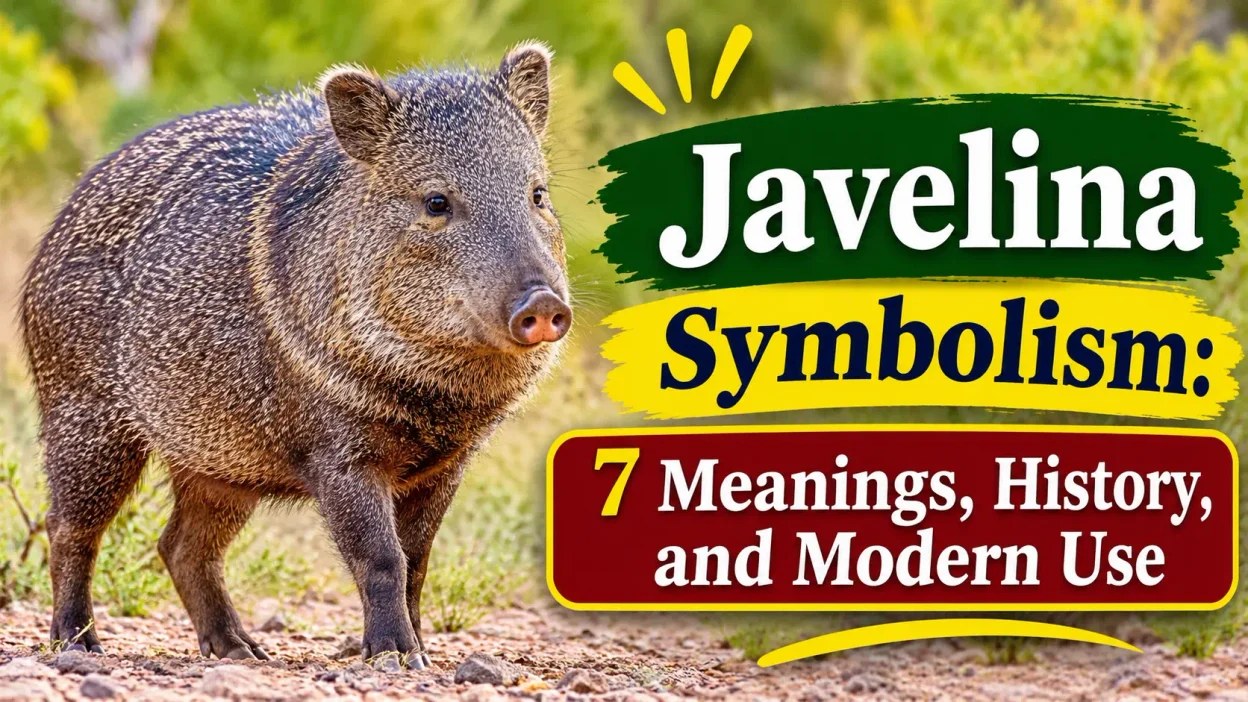
A javelina is a medium-sized hoofed mammal commonly known as the collared peccary. It lives in parts of the American Southwest, including Arizona, New Mexico, and Texas, as well as Mexico, Central America, and South America.
Its appearance is distinctive. It has coarse grayish-black hair, short legs, a strong snout, noticeable canine teeth, and a lighter band of hair around its shoulders that resembles a collar.
Although it looks similar to a wild pig, a javelina is not a true pig. It belongs to the peccary family, which has a separate evolutionary history.
Several characteristics make this animal interesting from a symbolic perspective:
- It survives in dry environments where resources can be limited.
- It lives in social groups that provide protection.
- It communicates through sounds and scent.
- It defends itself when necessary but generally avoids unnecessary conflict.
- It relies on a varied diet that includes cactus, roots, mesquite beans, and other vegetation.
These behaviors provide the foundation for its modern symbolic associations. Rather than representing an abstract idea without context, the javelina reflects qualities that can be observed in the animal itself.
2. The Core Meaning of Javelina Symbolism
The central meaning of this animal is the ability to survive while remaining connected to others.
Its symbolism is especially relevant to people who value independence without isolation. A javelina can navigate difficult surroundings, but it also depends on its group for protection and social interaction.
Its main symbolic meanings include the following.
Resilience and survival: The javelina represents the ability to continue through difficult circumstances. Its adaptation to dry habitats makes it a natural example of endurance.
Family and loyalty: Because javelinas live in groups, they can symbolize the importance of staying connected with family and trusted companions.
Courage and self-defense: Their sharp canine teeth and defensive behavior can represent standing up for oneself when necessary.
Adaptability: Their flexible diet and ability to use different types of desert habitat suggest resourcefulness and practical problem-solving.
Community: Their social behavior reflects cooperation, shared protection, and the benefits of belonging to a group.
These meanings are related, but they are not interchangeable. Resilience concerns surviving challenges, while community concerns the relationships that help make survival possible.
3. Ancient Roots and the Historical Background
The javelina has a long evolutionary history in the Americas, although its presence in the southwestern United States is more recent than many people assume.
Peccaries developed in the Western Hemisphere and spread across different parts of the Americas. The collared peccary eventually established populations in the southwestern United States.
Archaeological evidence in Arizona does not support the idea that javelinas were a widespread, ancient feature of every Southwestern community. Evidence indicates that they became established in the region relatively recently, with historical records documenting their presence during the colonial period.
This distinction matters when discussing symbolism.
It would be inaccurate to claim that every ancient Southwestern civilization treated the javelina as a sacred animal or assigned it one established spiritual meaning.
Instead, its cultural importance developed through its relationship with the environment and the people who encountered it.
Early observers recognized a pig-like animal with a distinctive appearance, strong teeth, and noticeable musk. Spanish-language terminology also influenced the English name. The word javelina entered American English through Spanish-language usage associated with wild boars.
Over time, the animal became a recognizable part of Southwestern wildlife and regional identity.
4. What Javelina Symbolizes in American Culture
In the United States, the javelina is most strongly associated with the Southwest.
People living in Arizona, Texas, and New Mexico may recognize it as a familiar neighborhood visitor, a wildlife encounter, or an emblem of regional character.
Its cultural meaning is shaped by several ideas.
Regional identity: The javelina represents the distinctive wildlife of the desert Southwest. It helps distinguish the region from other American landscapes associated with deer, bears, or elk.
Determination: Its ability to survive in challenging habitats makes it a natural representation of persistence.
Independence: The animal’s self-sufficient behavior suggests resourcefulness and the ability to manage difficult circumstances.
Local character: Its unusual appearance and sometimes unpredictable behavior make it a memorable part of Southwestern life.
A particularly interesting example is Texas A&M University–Kingsville. Students selected the javelina as the university’s mascot in 1925, choosing it over other animals, including the coyote, badger, and jackrabbit.
The mascot became associated with tenacity, school spirit, and devotion to the university community.
This example demonstrates how an animal’s natural characteristics can become part of a larger cultural identity.
5. Javelina Symbolism and the Importance of Family
Family is one of the most meaningful interpretations associated with the javelina.
These animals generally live in social groups called squadrons. Group members interact regularly and rely on one another for protection, communication, and other aspects of daily life.
Their social behavior creates a natural connection with family loyalty.
A javelina appearing in artwork or personal symbolism may represent:
- Protecting loved ones.
- Staying connected during difficult periods.
- Supporting relatives through change.
- Maintaining trust within a close group.
- Recognizing the value of belonging.
This interpretation is particularly relevant to people who see family as a source of security.
The animal also offers an interesting reminder that independence and family connection do not have to compete. A person can develop individual strength while maintaining meaningful relationships.
In this sense, the javelina represents a balance between personal survival and shared responsibility.
6. The Javelina as a Symbol of Resilience and Adaptability
The desert is not an easy environment. Water availability changes, temperatures can become extreme, and food sources vary throughout the year.
Javelinas have developed several adaptations that help them live in these conditions.
Their diet includes prickly pear cactus, agave, mesquite beans, roots, and other vegetation. They also have physiological adaptations that help them conserve water.
These characteristics explain why people often associate the animal with endurance.
Its symbolism can be understood in three ways.
Surviving difficult conditions: The javelina suggests that difficult surroundings do not necessarily prevent growth or continued progress.
Using available resources: Its flexible feeding habits represent making practical use of available opportunities rather than depending on ideal circumstances.
Adjusting to change: Its ability to use different habitats reflects flexibility when familiar conditions become less favorable.
For someone experiencing a major life transition, this animal can serve as a reminder to adjust expectations, use available resources, and continue moving forward.
The lesson is not that hardship should be ignored. It is that responding intelligently to changing circumstances can make a meaningful difference.
7. Courage, Protection, and Personal Boundaries
Javelinas have sharp canine teeth and can defend themselves when threatened. Their physical appearance can seem intimidating, especially when the hair along their backs rises during defensive behavior.
However, they generally prefer to avoid people and will often retreat when given space.
This distinction is important because their symbolism is not simply about aggression.
A more accurate interpretation connects the animal with protective courage.
It can represent:
- Knowing when to defend yourself.
- Protecting people who depend on you.
- Establishing personal boundaries.
- Avoiding unnecessary confrontation.
- Responding firmly when a genuine threat appears.
This makes the javelina an interesting symbol for someone who wants to become more confident without becoming hostile.
Its behavior suggests that strength does not always require confrontation. Sometimes the best response is to create distance, remain aware, and protect what matters.
8. Javelina Symbolism in Native American and Indigenous Cultures
The javelina’s presence in the American Southwest makes questions about Indigenous symbolism particularly important.
However, there is no single Native American interpretation that applies to every tribe, nation, or community.
Indigenous cultures have distinct relationships with animals, land, hunting, food, and spiritual traditions. Their interpretations should not be combined into one generalized belief system.
The collared peccary’s presence across parts of the Americas also means that its relationship with Indigenous communities differs according to geography and local history.
It is reasonable to recognize that people living in regions where peccaries occur have encountered these animals through their relationships with the natural environment. However, specific spiritual meanings should only be attributed to a community when supported by its own cultural knowledge and historical records.
For modern readers, the most respectful approach is to distinguish between documented cultural traditions and personal symbolic interpretations.
A javelina can represent endurance, family, or environmental awareness to an individual without claiming that these meanings are universal Indigenous teachings.
This distinction helps preserve cultural accuracy while allowing people to appreciate the animal’s significance.
9. Spiritual Meaning of the Javelina
Some people interpret animal encounters through personal spirituality. In this setting, the javelina can become a reminder to pay attention to relationships, surroundings, and personal decisions.
Its possible spiritual associations include:
Grounded living: The animal’s connection to the land can encourage people to remain practical and aware of their immediate environment.
Family responsibility: Its social behavior may inspire reflection on the importance of supporting loved ones.
Personal strength: Its defensive abilities can represent the importance of maintaining healthy boundaries.
Acceptance of change: Its ability to survive in different conditions can encourage flexibility during uncertain periods.
These interpretations are personal rather than established religious teachings.
There is no widely recognized Christian doctrine, biblical passage, or universal spiritual tradition that assigns the javelina a specific sacred meaning.
People may still use the animal as a personal reminder of values they consider important. The distinction is that personal reflection should not be presented as an ancient religious rule.
10. Javelina Symbolism in Dreams
Dream interpretations involving javelinas are not based on a universally accepted psychological system. Their meaning often depends on the dreamer’s emotions, experiences, and associations with the animal.
Still, several interpretations can be explored as personal reflection.
| Dream Situation | Possible Symbolic Meaning | Personal Reflection |
|---|---|---|
| Seeing a javelina | Awareness and resilience | What challenge needs your attention? |
| Seeing a herd | Family and community | Are your relationships receiving enough attention? |
| Being chased by one | Feeling pressured or defensive | Is something making you feel threatened? |
| Seeing a baby javelina | Vulnerability and care | Is someone depending on your support? |
| Watching one walk away | Independence and distance | Is it time to give yourself or someone else space? |
A dream about a javelina does not predict a future event.
For example, someone who recently experienced a family disagreement might associate a herd with belonging or the need for stronger relationships. Another person who encountered a javelina while hiking might simply be processing a memorable wildlife experience.
The emotions surrounding the dream are often more useful than assigning a fixed meaning to the animal.
11. What Does a Javelina Tattoo Symbolize?
A javelina tattoo can communicate personal identity, regional pride, determination, or appreciation for Southwestern wildlife.
Unlike widely recognized tattoo symbols such as roses, anchors, or certain religious designs, the javelina does not have one standardized tattoo meaning.
Its interpretation depends on the person wearing it.
Common personal associations include:
Southwestern heritage: Someone who grew up in Arizona, Texas, or New Mexico may choose the animal to represent a connection with home.
Resilience: Its desert adaptations can make it a fitting image for someone who has overcome difficult circumstances.
Family loyalty: A group of javelinas may represent relatives, close friendships, or a strong support system.
Individuality: Its unusual appearance can appeal to someone who prefers an uncommon design.
Courage: Its defensive nature may represent confidence and personal boundaries.
Design choices can add further meaning. A javelina standing beside a cactus may emphasize desert identity, while a group design may highlight family and community.
A realistic portrait can celebrate the animal itself, while a minimalist outline may work as a quieter expression of regional pride.
12. Javelina Symbolism in Art, Jewelry, and Home Decor
The javelina’s distinctive appearance makes it suitable for different forms of Southwestern-inspired design.
Its dark coat, pale shoulder marking, strong profile, and connection to desert plants create a recognizable visual identity.
In artwork, it may appear alongside prickly pear cactus, mesquite trees, desert mountains, and other regional wildlife.
These combinations can communicate a connection with the natural landscape.
In jewelry: A javelina pendant or engraved design may represent personal attachment to the Southwest.
In home decor: Wildlife illustrations and sculptures can celebrate desert living and local character.
In clothing: Javelina graphics can communicate regional pride, humor, and appreciation for unusual wildlife.
In handmade crafts: The animal can appear in illustrations, pottery designs, decorative objects, and other Southwestern-inspired pieces.
There is no universal color code associated with javelina symbolism. However, natural desert colors such as brown, charcoal, gray, sand, and cactus green can reinforce its connection with the environment.
13. Negative Symbolism and Common Misunderstandings
Not every interpretation of the javelina is positive.
Some people associate it with stubbornness, danger, destruction, or an unpredictable personality.
These interpretations often come from experiences with wildlife rather than established cultural traditions.
Javelinas sometimes enter residential neighborhoods in search of food. They may damage gardens, disturb landscaping, or investigate accessible garbage.
Their sharp teeth and defensive behavior can also make encounters frightening.
However, describing the animal as naturally aggressive creates an incomplete picture. Javelinas generally avoid people, although they may defend themselves if cornered or threatened.
Another common misunderstanding is treating the javelina as a wild pig.
Although the two animals look similar, they belong to different biological families. Confusing them can also distort the animal’s regional history and identity.
It is equally important not to assume that every unpleasant encounter carries a negative symbolic message.
A javelina damaging a garden is an example of wildlife behavior, not evidence of bad luck, an approaching disaster, or a supernatural warning.
14. How Javelina Symbolism Has Evolved in Modern America
The meaning of the javelina has developed through people’s changing relationship with Southwestern wildlife.
Earlier encounters were often practical. People recognized the animal as part of the local environment and understood its relationship with vegetation, hunting, and rural life.
As Southwestern communities developed, the javelina became more visible in regional identity.
Its adoption as the Texas A&M University–Kingsville mascot in 1925 is an important example. The animal’s reputation for tenacity helped turn it into a symbol of school pride and community belonging.
Today, its presence in residential areas has also made it familiar to people who might never encounter it in remote desert habitats.
In Arizona communities, photographs and videos of javelinas wandering through neighborhoods have become recognizable examples of everyday desert wildlife.
This has added another dimension to its cultural meaning: the ability of wild animals and human communities to share the same landscape.
Modern interpretations increasingly emphasize environmental awareness, respect for wildlife, and the importance of protecting natural habitats.
The javelina is no longer viewed only as an unusual animal to encounter outdoors. It can also represent the distinctive character of Southwestern living.
15. What the Javelina Can Teach Us About Life Today
The javelina offers several practical ideas that people can apply to everyday situations.
Stay adaptable. Conditions do not always remain comfortable or predictable. Learning to adjust can help you respond more effectively.
Protect meaningful relationships. Family and trusted companions can provide support during challenging periods.
Know your boundaries. Being confident does not mean confronting every problem. Recognizing when to step away is also a form of strength.
Use what is available. Resourcefulness often matters more than having perfect circumstances.
Respect your environment. The javelina’s survival depends on its relationship with the desert ecosystem. Human communities also benefit from understanding and protecting the natural world around them.
These lessons are interpretations drawn from observable behavior, not instructions supposedly delivered by the animal.
Their value comes from how they encourage people to think about resilience, responsibility, and the balance between independence and cooperation.
Frequently Asked Questions About Javelina Symbolism
1. What does a javelina symbolize spiritually?
A javelina can represent resilience, family connection, protection, and adaptability in personal spiritual interpretations. These meanings are modern interpretations rather than universally established religious beliefs.
2. Is seeing a javelina a good sign?
Many people interpret seeing a javelina positively because of its associations with survival and community. However, there is no established evidence that an encounter predicts good fortune or a particular future event.
3. What does a javelina tattoo mean?
A javelina tattoo often represents Southwestern identity, personal determination, family loyalty, or appreciation for desert wildlife. Its exact meaning depends on the wearer’s personal experiences and design choices.
4. What does a javelina symbolize in Native American culture?
There is no single interpretation shared by all Native American nations. Specific cultural meanings must be understood within the traditions of individual communities rather than assumed to be universal.
5. Does a javelina represent strength or aggression?
It is more accurately associated with protective strength and self-defense than constant aggression. Javelinas generally avoid people but can defend themselves when threatened.
6. What does dreaming about a herd of javelinas mean?
A herd may personally symbolize family, belonging, cooperation, or the need for social support. The dreamer’s emotions and real-life experiences help determine which interpretation feels relevant.
7. Why is the javelina important in Southwestern American culture?
The javelina is a recognizable part of Southwestern wildlife and regional identity. It also represents tenacity and community through cultural examples such as Texas A&M University–Kingsville’s long-standing mascot tradition.
Conclusion
Javelina symbolism centers on resilience, family loyalty, adaptability, courage, and community. These interpretations come primarily from the animal’s natural behavior and its relationship with the landscapes of the American Southwest. Its ability to survive in dry environments and maintain strong social connections makes it an interesting representation of practical strength.
In modern American culture, the javelina also represents regional pride and the distinctive character of Southwestern wildlife. From university mascots to tattoos and desert-inspired artwork, people use its image to express determination, belonging, and appreciation for their surroundings.
Ultimately, the javelina reminds us that strength is not simply about standing alone. It can also mean adapting to change, protecting meaningful relationships, and knowing when to stand your ground.