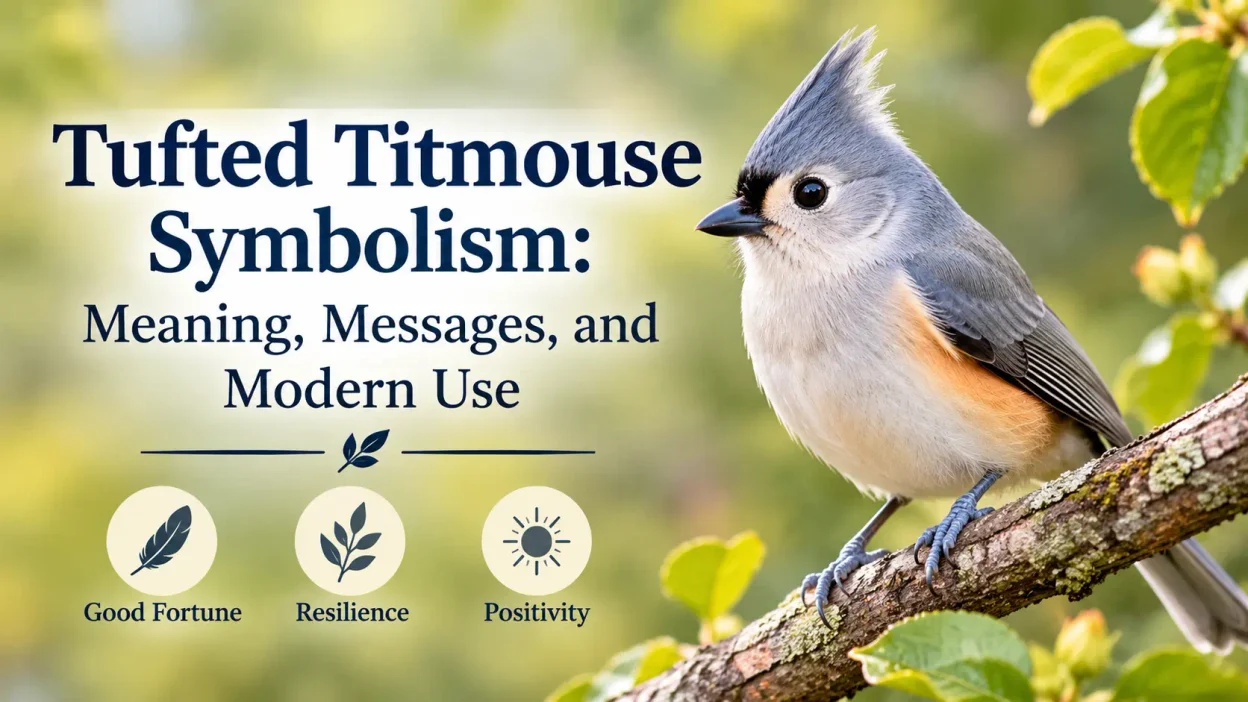
The tufted titmouse symbolism often centers on curiosity, alertness, adaptability, and the value of paying attention to everyday life. This small songbird, recognized by its pointed crest, large dark eyes, and quick movements, is a familiar sight at bird feeders and in wooded neighborhoods across the eastern United States. Its lively behavior makes it an appealing symbol of awareness and resourcefulness.
Unlike birds with established roles in religious traditions or national identity, the tufted titmouse does not have one universally recognized symbolic meaning. Many of its modern interpretations come from observing how it behaves: investigating unfamiliar objects, moving confidently among branches, and returning to reliable food sources. People may connect these habits with curiosity, preparation, and resilience.
Understanding this bird’s symbolism begins with its natural history. By looking at where the tufted titmouse lives, how it finds food, and how it interacts with its surroundings, readers can distinguish grounded interpretations from spiritual claims that have no established historical basis.
Quick Answer
Tufted titmouse symbolism commonly represents curiosity, alertness, adaptability, and resourcefulness in modern American nature appreciation. Its historical significance is rooted more in natural observation and regional birdwatching traditions than in a widely documented religious or mythological system, although individuals may give encounters personal spiritual meaning.
TL;DR
- Curiosity reflects the bird’s habit of investigating its surroundings.
- Alertness connects with its quick movements and awareness of potential danger.
- Adaptability reflects its ability to find food in changing environments.
- Familiar backyard visits can symbolize comfort and connection with nature.
- Its crest and expressive appearance make it memorable in art and photography.
- Spiritual interpretations are personal rather than universal historical traditions.
1. What Does a Tufted Titmouse Look Like?
<text> </text>
The tufted titmouse (Baeolophus bicolor) is a small songbird native to the eastern United States. It has soft gray upperparts, pale underparts, a rusty-colored patch along its flanks, large dark eyes, and a distinctive crest that rises from the top of its head. Its compact body and expressive face give it an alert appearance.
<text> </text>
<text> </text>
Its appearance helps explain why people find it symbolically appealing. The upright crest can suggest attentiveness or confidence, while its bright eyes may remind observers of curiosity and quick thinking. These are human interpretations of visible traits, not evidence that the bird consciously represents those qualities.
Tufted titmice frequently visit backyard feeders, especially where people offer sunflower seeds, peanuts, or other suitable foods. They also inhabit deciduous forests, wooded parks, and suburban areas with mature trees. Their presence in ordinary outdoor spaces makes them accessible to people who may not consider themselves serious birdwatchers.
Unlike a rare bird that appears only during a special trip, a titmouse may become a familiar neighbor. Repeated encounters can give an otherwise ordinary sighting personal significance.
2. The Core Symbolic Meaning of the Tufted Titmouse
The tufted titmouse is most naturally associated with four symbolic ideas: curiosity, alertness, adaptability, and resourcefulness. These interpretations come from its observable behavior rather than a single ancient story or formal belief system.
Curiosity reflects the bird’s habit of inspecting branches, foliage, feeders, and potential food sources. It often approaches its surroundings actively instead of remaining still for long periods.
Alertness comes from its quick responses and constant attention to movement. Like other small birds, it must recognize potential threats and react quickly to survive.
Adaptability reflects its ability to use different food sources and live in a range of wooded environments, including many residential neighborhoods.
Resourcefulness is visible in its feeding habits. A titmouse may collect a seed and carry it elsewhere before eating or storing it, demonstrating behavior that people can interpret as preparation and practical problem-solving.
These meanings are useful starting points, but context matters. Someone who sees a titmouse during a peaceful morning may associate it with comfort, while someone photographing its energetic movements may focus on curiosity and alertness.
3. Curiosity and the Willingness to Explore
Curiosity is one of the clearest symbolic interpretations of the tufted titmouse. The bird often investigates its surroundings, moves between branches, and examines possible food sources. Its behavior can remind observers that exploration does not always require dramatic change or a distant destination.
In everyday American life, curiosity is often associated with learning, creativity, and personal growth. A titmouse visiting a new feeder or investigating a tree branch can serve as a small reminder to remain open to unfamiliar experiences.
This interpretation can be especially meaningful during a period of transition. Someone beginning a new job, learning a skill, or adjusting to a different community might see the bird as a personal emblem of exploration.
The symbolism does not mean that a bird sighting predicts an opportunity. Instead, the encounter can prompt a useful question: What might you discover if you pay closer attention to what is around you?
That connection makes the tufted titmouse a fitting symbol for people who value observation and lifelong learning.
4. Alertness, Awareness, and Paying Attention
The tufted titmouse rarely appears entirely disconnected from its surroundings. It moves through branches, searches for food, and responds to possible danger with the attentiveness expected of a small wild animal.
People may interpret this behavior as a reminder to notice details they usually overlook. In a culture shaped by busy schedules, constant notifications, and screen-based routines, observing a bird for even a few minutes can encourage a slower, more attentive way of experiencing the outdoors.
Alertness also differs from anxiety. Symbolically, the bird can represent awareness without suggesting that a person must remain tense or suspicious. Its quick reactions are part of how it navigates its environment, not a lesson that humans should treat every situation as a threat.
For a student, awareness might mean listening carefully before responding. For someone making a major decision, it could mean gathering information before acting.
The tufted titmouse therefore offers a grounded symbol of attention: notice what is happening, respond when necessary, and avoid moving through life without observing the details.
5. Adaptability and Resourcefulness
Tufted titmice live in forests, wooded edges, parks, and residential areas where suitable trees and food sources are available. Their ability to use different environments illustrates flexibility without suggesting that they can thrive under every condition.
Their feeding behavior provides another useful example. Titmice eat insects, seeds, nuts, and other foods, changing their choices according to availability and season. They may also carry food away from a feeder before consuming it.
These habits support interpretations of adaptability and preparation. The bird does not depend on one single food source, and its behavior demonstrates practical ways of responding to changing circumstances.
For people, this symbolism can apply to adjusting plans, learning unfamiliar routines, or using available resources wisely. It may be particularly relevant during a career change, a move, or a period of financial uncertainty.
Adaptability, however, does not mean accepting every circumstance without question. The more useful lesson is to recognize what can change, understand what resources are available, and respond thoughtfully rather than rigidly.
6. Historical Origins and the Bird’s Place in American Culture
The tufted titmouse has a long-standing place in the natural history of eastern North America. Its scientific name, Baeolophus bicolor, identifies it as a distinct species within the titmouse family, and its familiar presence in wooded landscapes has made it a recognizable bird for generations of American observers.
The word titmouse has an older linguistic history. The name combines elements from earlier English bird names, with mouse historically associated with smallness rather than the mammal itself. The tufted titmouse’s common name refers to its prominent crest, which distinguishes it from several related birds.
Unlike eagles, ravens, or owls, the tufted titmouse does not have a widely established place in a single, nationally recognized mythological tradition. Its symbolic associations are more commonly developed through natural observation, local familiarity, and modern personal reflection.
Birdwatching and backyard feeding have helped make small songbirds part of everyday American nature appreciation. People observe them at kitchen windows, in neighborhood trees, and in public parks, often developing an emotional connection through repeated encounters.
This background matters because it prevents a modern interpretation from being mistaken for an ancient tradition. Curiosity and resourcefulness are reasonable symbolic readings of the bird’s behavior, but claims that the tufted titmouse has always represented a particular spiritual message would require evidence that is not broadly established.
7. What a Tufted Titmouse May Mean Spiritually
In contemporary spiritual interpretation, a tufted titmouse may represent awareness, curiosity, encouragement, or a renewed appreciation for ordinary experiences. Some people interpret an unexpected bird encounter as a personal reminder to slow down, remain observant, or approach a difficult situation with greater flexibility.
These interpretations belong to personal spirituality rather than a universally accepted religious doctrine. There is no single established spiritual message that every tufted titmouse sighting is supposed to convey.
For someone experiencing uncertainty, the bird might become a reminder to remain curious instead of assuming the worst. Someone recovering from disappointment might associate its lively behavior with the possibility of finding new interests or routines.
The value of such an encounter lies in the meaning a person draws from it. A bird can inspire reflection without being treated as a supernatural messenger or a prediction of future events.
8. Tufted Titmouse Symbolism in the United States
In the United States, the tufted titmouse is especially familiar in the eastern half of the country, where it inhabits wooded neighborhoods, parks, and backyards. Its presence around homes gives it a different cultural role from birds known primarily through national emblems, religious stories, or major folklore traditions.
For many Americans, the bird represents an accessible connection with wildlife. A person does not need to travel to a national park to see one. A mature oak, a backyard feeder, or a tree-lined street may provide an opportunity to observe it.
That familiarity can encourage associations with home, routine, and the value of nearby nature. Families may recognize the bird from a feeder, children may learn its name through school activities, and photographers may appreciate its expressive crest and quick movements.
The tufted titmouse is also a useful reminder that wildlife conservation begins close to home. Maintaining mature trees, planting native vegetation, reducing unnecessary pesticide use, and providing suitable habitat can support birds and other local species.
Its modern American symbolism is therefore less about a formal national meaning and more about everyday encounters, environmental awareness, and a personal relationship with the natural world.
9. Emotional Comfort and the Meaning of Familiar Birds
Seeing the same bird repeatedly can create a sense of familiarity. A tufted titmouse that visits a backyard feeder each morning may become part of someone’s daily routine, much like the changing light or the sound of rain.
That familiarity can carry emotional meaning. During a stressful period, watching birds may provide a brief break from responsibilities and encourage attention to the present moment. The bird’s movements give the observer something concrete to notice without requiring a particular belief system.
For someone grieving, a familiar bird might also become associated with a loved one, a shared memory, or a place where the two spent time together. Such associations are personal, and they can be meaningful without establishing that the bird is carrying a message from someone who has died.
The tufted titmouse’s symbolism of comfort grows from this relationship between observation and memory. Its presence can remind someone of an ordinary moment worth appreciating.
It is important not to assume that every sighting carries emotional significance. Sometimes a titmouse is simply looking for food. The meaning emerges when the encounter connects with a person’s experiences, thoughts, or memories.
10. Tufted Titmouse Symbolism in Different Cultural Traditions
Birds have held important roles in many cultures, but their meanings differ widely. Some traditions associate particular species with ancestors, divine communication, protection, wisdom, or the boundary between life and death. Those meanings cannot automatically be transferred from one bird to another.
The tufted titmouse does not have a widely documented, standardized symbolic role across major world religions. Its strongest cultural associations are connected with its native North American habitat and the everyday experience of observing wild birds.
Indigenous nations across North America have distinct histories, languages, and relationships with local wildlife. It would be inaccurate to claim that all Indigenous communities assign the tufted titmouse one shared spiritual meaning. Specific cultural interpretations should be attributed only when they are supported by reliable evidence from the relevant community.
Likewise, general ideas about birds as messengers in European folklore or other cultural traditions do not establish that the tufted titmouse itself has the same role.
A respectful cross-cultural interpretation begins with these differences. People can explore personal spiritual meanings while recognizing that a modern individual association is not necessarily an inherited cultural tradition.
11. What Does It Mean to See a Tufted Titmouse Near Your Home?
A tufted titmouse near your home most directly indicates that the surrounding habitat provides suitable conditions for the bird. Mature trees, access to food, nesting opportunities, and nearby cover can make a residential area attractive to this species.
Symbolically, some people associate a backyard visit with comfort, attentiveness, or a closer relationship with nature. The bird’s regular appearance can become a reminder to appreciate the life unfolding outside the window.
If you keep seeing one near your house, consider whether the repeated encounters have become part of your routine. Perhaps the bird prompts you to take a morning break, notice seasonal changes, or spend more time outdoors.
There is no reliable basis for treating the sighting as a guaranteed sign of financial luck, romantic success, or an approaching life event. A repeated visit may simply reflect the bird’s familiarity with a dependable food source.
You can appreciate both explanations at once. The bird has a natural reason to visit, and you can still choose to regard the encounter as a personal reminder to pay attention to your surroundings.
12. Tufted Titmouse Symbolism in Dreams
A tufted titmouse appearing in a dream can be interpreted through the dreamer’s own experiences and associations. Because the bird is often linked with curiosity and alertness in modern symbolic readings, a dreamer might connect it with learning, observation, or the need to consider a situation more carefully.
The details of the dream may influence that interpretation. A bird exploring a tree could bring to mind curiosity, while one repeatedly returning to a feeder might remind the dreamer of a familiar routine or dependable source of support.
An injured bird could evoke concern, vulnerability, or a desire to protect something important. These are possible personal associations, not established universal definitions.
Dreams do not have one scientifically validated dictionary of symbolic meanings. Their content can reflect memories, recent experiences, emotions, and ordinary mental activity during sleep.
Rather than assuming that a titmouse dream predicts an event, consider what the bird represents to you. Your feelings during the dream and the circumstances of your life may offer more useful clues than a fixed interpretation.
13. Tufted Titmouse Tattoos, Jewelry, and Personal Art
A tufted titmouse can make a distinctive subject for a tattoo, pendant, illustration, or nature-inspired piece of home decor. Its pointed crest and compact shape remain recognizable even in relatively simple artwork.
People who choose the bird as a personal symbol may associate it with curiosity, adaptability, attentiveness, or a meaningful connection to a particular place. Someone who grew up in the eastern United States might choose it as a reminder of home, family, or childhood spent watching backyard wildlife.
A minimalist tattoo could emphasize the crest and silhouette, while a detailed design might include an oak branch, leaves, or seeds to reflect the bird’s natural habitat. A piece created to commemorate a loved one might include a date or another personal detail, giving the image meaning specific to the wearer.
There is no traditional tattoo meaning that applies to everyone who chooses this species. Its significance depends on the person’s reasons for selecting it.
Compared with more common bird designs, a tufted titmouse can offer a quieter expression of identity: an appreciation for local wildlife, small discoveries, and the details that make a familiar place feel like home.
14. Common Misunderstandings About Tufted Titmouse Symbolism
Several misconceptions can arise when people search for the spiritual meaning of a particular bird.
First, the bird does not have one universal message. Curiosity, alertness, and resourcefulness are reasonable interpretations, but individuals may connect the species with entirely different experiences.
Second, a natural behavior is not proof of supernatural intention. A titmouse carrying away a seed is displaying a feeding behavior, not necessarily delivering a lesson about preparation. A person may draw inspiration from the behavior without claiming that the bird intends to teach it.
Third, cultural meanings should not be invented. Claims that the tufted titmouse is sacred to every Indigenous nation, belongs to a particular ancient prophecy, or represents one universal religious principle should not be repeated without credible, specific evidence.
Fourth, symbolism should not replace natural history. A bird appearing near a home usually has practical reasons for being there. Food availability, suitable trees, weather, and habitat are more reliable explanations than predictions about future events.
Recognizing these distinctions does not diminish the bird’s appeal. It allows people to enjoy personal interpretations while respecting the species and the cultures whose traditions deserve accurate representation.
15. Quick Comparison of Tufted Titmouse Meanings
The following table summarizes common interpretations and separates observable behavior from personal symbolism.
| Context | Common symbolic meaning | Natural or cultural basis |
|---|---|---|
| Curiosity | Exploration and learning | Active investigation of surroundings |
| Alertness | Awareness and attentiveness | Quick responses to movement and danger |
| Adaptability | Flexibility and resourcefulness | Use of varied food sources and wooded habitats |
| Backyard encounters | Comfort and connection with nature | Familiarity through repeated observation |
| Dreams | Personal reflection or a need to notice details | Individual associations rather than a universal dream code |
| Tattoos and artwork | Home, identity, or appreciation for wildlife | Personal choice and creative interpretation |
These meanings are starting points, not fixed rules. The same encounter can mean different things to different people, and a natural explanation can coexist with a personal emotional response.
Frequently Asked Questions
What does a tufted titmouse symbolize spiritually?
A tufted titmouse may symbolize curiosity, awareness, adaptability, and appreciation for everyday life in modern personal spirituality. These associations are interpretive rather than part of a universally recognized religious tradition.
Is seeing a tufted titmouse a good sign?
Many people may experience a sighting as encouraging because the bird is lively, familiar, and visually distinctive. There is no established evidence that seeing one predicts good fortune or a specific future event.
What does a tufted titmouse symbolize in a dream?
A dream featuring this bird might prompt reflection on curiosity, attention, or familiar routines. Its meaning depends on the dreamer’s experiences and emotions rather than a universal symbolic rule.
What does a tufted titmouse tattoo mean?
A tufted titmouse tattoo can represent curiosity, resourcefulness, a connection to home, or a love of nature. Its personal significance depends on the wearer’s memories, beliefs, and reasons for choosing the bird.
Why does a tufted titmouse keep visiting my backyard?
It may be returning because your yard offers food, mature trees, shelter, or other suitable habitat. If you associate its visits with comfort or encouragement, that is a personal interpretation rather than proof of a supernatural message.
Is the tufted titmouse associated with a particular religion?
The species does not have a widely established, universal religious meaning. Individual people may incorporate it into their spiritual lives, but specific cultural or religious claims require reliable evidence.
What makes the tufted titmouse different from other symbolic birds?
Its symbolism is closely tied to familiar behavior and its presence in everyday eastern American landscapes. Unlike birds with prominent roles in national emblems or well-known mythological stories, its meaning is more often personal, nature-centered, and shaped by direct observation.
Conclusion
Tufted titmouse symbolism centers on curiosity, alertness, adaptability, and the value of noticing what happens around us. Its distinctive crest and active behavior make it an appealing symbol for people who appreciate local wildlife, personal growth, and the comfort of familiar natural surroundings.
The bird does not need an ancient legend or a supernatural explanation to become meaningful. Its place in American backyards, wooded neighborhoods, and everyday routines offers a more grounded connection between nature and human experience.
When a tufted titmouse catches your attention, consider what you notice about the bird and what the encounter brings to mind. Sometimes the most useful meaning comes not from predicting what will happen next, but from paying closer attention to what is already there.