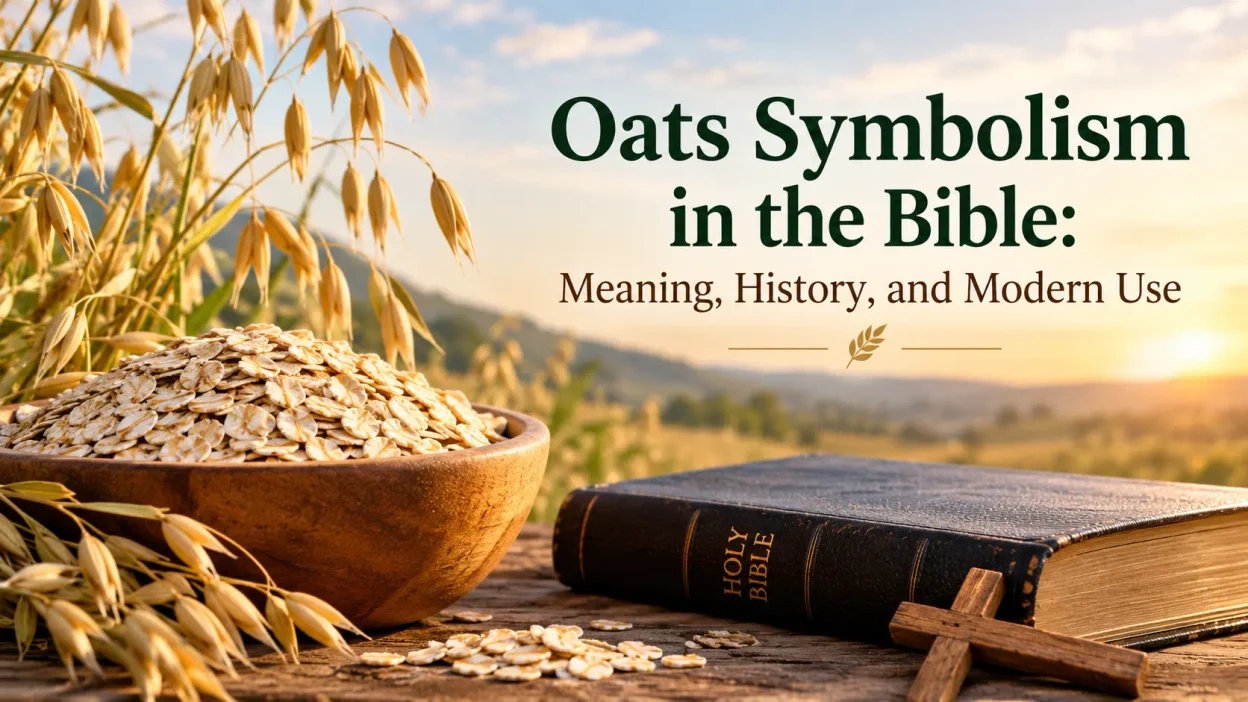
Oats symbolism in the Bible is best understood through the broader biblical imagery of grain, harvest, bread, and God’s provision. Although oats are not a prominent, clearly identified symbol in the biblical text, grain holds an important place in Scripture as a source of food, a sign of agricultural abundance, and a reminder of humanity’s dependence on the land and its Creator.
For modern American readers, oats are familiar as oatmeal, breakfast cereal, livestock feed, and an ingredient in traditional home cooking. Their everyday role makes them a natural starting point for reflecting on biblical themes such as gratitude, daily sustenance, honest work, and care for others. However, these modern associations should not be mistaken for direct biblical teachings about oats themselves.
The distinction matters because biblical symbolism depends on the words, customs, and agricultural realities found in Scripture. By examining grain and harvest imagery in its historical context, readers can explore the spiritual ideas that oats may help illustrate today without assigning the Bible meanings it does not explicitly establish.
Quick Answer
Oats symbolism in the Bible is commonly interpreted through related biblical themes of nourishment, provision, gratitude, and the harvest, rather than through a specific biblical teaching about oats. Grain imagery in Scripture connects food with God’s provision, the work of farmers, seasonal growth, and the responsibility to share resources with people in need.
TL;DR
- Oats are not a major, explicitly established symbol in the Bible.
- Biblical grain imagery often represents food, provision, labor, and harvest.
- Harvest passages connect agricultural abundance with gratitude and responsibility.
- Bread and grain appear in teachings about daily needs and spiritual life.
- Modern Christians may use oats as a reminder of ordinary blessings.
- Personal symbolism should remain distinct from the Bible’s actual wording.
1. Are Oats Mentioned in the Bible?
The first step in understanding oats symbolism is distinguishing oats from the grains explicitly discussed in biblical passages. Wheat and barley appear frequently in Scripture, while other agricultural products also feature in descriptions of food, farming, offerings, and trade.
Oats are not a prominent biblical grain, and readers should not assume that every reference to grain includes them specifically. The Bible emerged from ancient Near Eastern and Mediterranean societies whose agricultural practices and staple crops differed from those familiar to many Americans today.
This distinction does not make oats irrelevant to modern biblical reflection. It simply means that their spiritual significance must be explored by analogy with better-established biblical themes rather than presented as a direct scriptural definition.
For example, someone eating a bowl of oatmeal might reflect on the importance of daily food, the effort required to produce it, and the people who help bring it to the table. These ideas align with biblical teachings about provision and gratitude, even though Scripture does not establish oatmeal as a special religious symbol.
A careful interpretation begins with what the text actually says and then explains how its broader lessons can apply to ordinary life.
2. What Grain Symbolizes in Biblical Tradition
Grain is closely connected with survival in the Bible. In an agricultural society, a successful harvest meant food for families, seed for future planting, and resources that could support trade and community life. A failed harvest could lead to hunger, debt, displacement, or death.
Because grain was essential, it naturally became part of the Bible’s language about God’s care and humanity’s dependence on the natural world. References to abundant crops could communicate prosperity and relief, while empty fields and shortages could describe hardship.
Grain also required sustained effort. Farmers prepared the ground, planted seed, managed crops, and gathered the harvest when it matured. The final crop therefore reflected both environmental conditions and human labor.
These practical realities help explain why agricultural imagery carries spiritual meaning. Food is a gift people receive, but producing it also requires patience, skill, cooperation, and responsibility.
Oats can illustrate these same ideas for modern readers. They grow through a process that takes time, and their value becomes clear when they are harvested, processed, and prepared as food. The connection is meaningful as a modern reflection, even when it is not a specific biblical symbol.
3. Grain as a Sign of God’s Provision
One of the clearest themes associated with food in Scripture is God’s provision for human needs. Biblical prayers, teachings, and narratives repeatedly treat food as essential to life and as something for which people should give thanks.
Matthew 6:11 contains the familiar request, “Give us this day our daily bread.” In the Lord’s Prayer, bread represents a basic daily need. The request expresses dependence on God rather than confidence that people can secure everything through their own efforts.
Although the passage refers to bread rather than oats, its principle applies naturally to everyday foods. A simple breakfast can remind a person that nourishment depends on more than the meal itself. Farming, weather, transportation, preparation, and the work of many people all contribute to what appears on the table.
This interpretation does not require oats to possess a hidden spiritual property. Instead, oats become an ordinary example of a larger biblical lesson: receive what sustains life with gratitude, recognize the work involved in obtaining it, and remember those who lack sufficient food.
In modern Christian life, this can be a practical form of reflection. A meal becomes an opportunity to pause, give thanks, and consider how material blessings can be used responsibly.
4. Harvest Symbolism and the Value of Patience
Harvest imagery is important throughout Scripture because crops develop gradually. A farmer cannot sow seed in the morning and expect a mature harvest by the afternoon. Growth requires time, favorable conditions, and continued care.
Galatians 6:7–9 uses the principle of sowing and reaping to discuss moral responsibility and perseverance. The passage explains that actions have consequences and encourages readers not to grow weary in doing good.
This teaching is not specifically about oats. Nevertheless, an oat crop provides a useful modern illustration of the principle. The harvest depends on decisions made earlier, from preparing the soil to protecting the growing plants and choosing the right time to gather them.
For Christians, this connection may represent patience, faithful effort, and the importance of continuing to do what is right even when results are not immediate. It can also encourage humility because farmers cannot control every condition that affects a crop.
The lesson should not be reduced to the claim that good people always receive wealth or that hardship proves someone has acted wrongly. Biblical agricultural imagery can communicate responsibility and perseverance without promising that every effort will produce an easy or predictable outcome.
Oats therefore serve as a practical reminder of gradual growth, while the spiritual lesson comes from the broader biblical teaching.
5. Wheat, Barley, and the Historical Importance of Grain
To understand why grain carries such strong biblical associations, it helps to consider the crops familiar to the ancient world. Wheat and barley were important foods in the agricultural economies of the biblical lands. They supplied flour, bread, and other staple foods, and their harvests influenced household security and local prosperity.
Barley was often associated with ordinary sustenance and appears in accounts of food, harvests, and offerings. In John 6:9, a boy has five barley loaves and two fish before Jesus feeds a large crowd. The story connects a modest food supply with an event that demonstrates Jesus’ provision for the people.
Ruth 2 also offers a detailed picture of harvest life. Ruth gathers leftover grain in the fields of Boaz, an established practice that provides food for vulnerable people. The narrative connects agricultural work with generosity, dignity, and the responsibility to care for those who have limited resources.
These passages provide a more reliable foundation for biblical grain symbolism than assigning a special meaning to oats. They show how familiar crops could become part of stories about provision, hospitality, compassion, and faith.
Modern oats can be compared with wheat and barley because all are cereal grains, but their historical roles are not identical. A sound interpretation recognizes the shared agricultural context without claiming that every grain has precisely the same place in Scripture.
6. Oats, Daily Bread, and the Meaning of Nourishment
Food imagery in the Bible often begins with a straightforward reality: people need nourishment to live. Bread and grain are not merely abstract religious concepts. They represent the food that sustains households, supports communities, and makes ordinary life possible.
In the United States, oats are familiar in oatmeal, granola, breakfast bars, and baked goods. Their association with a simple, filling meal makes them a useful illustration of daily provision. For someone approaching the Bible devotionally, preparing oatmeal may prompt reflection on the value of receiving enough food rather than constantly pursuing more.
The connection also encourages gratitude for ordinary routines. Religious reflection often focuses on major events, difficult decisions, or extraordinary experiences, but the biblical emphasis on daily bread draws attention to basic needs. Eating, working, resting, and caring for a household are all parts of human life.
Oats can therefore symbolize the practical side of gratitude: recognizing that an ordinary meal has value even when it is neither expensive nor impressive.
This interpretation also challenges the assumption that prosperity must look extravagant. A simple meal can meet a real need, and its value does not depend on its price or presentation. The spiritual lesson is about nourishment and gratitude, not about oats being holier than other foods.
7. Sowing and Reaping as a Spiritual Lesson
The agricultural cycle provides another way to understand grain as a metaphor for human choices. Farmers plant seed with the expectation that it will grow, but the result depends on several factors, including soil, rainfall, pests, and careful management.
In the New Testament, the language of sowing and reaping is used to explain spiritual and moral principles. Galatians 6 connects a person’s choices with their consequences, while Jesus uses seed and growing plants in several teachings to explain aspects of God’s kingdom.
The parable of the sower in Matthew 13:1–23 describes seed falling on different types of ground. The different outcomes illustrate how people respond to the message of the kingdom. The seed in this parable is not oats, and the story does not assign oats a special meaning. Its central image is the relationship between the seed, the soil, and the conditions that affect growth.
For a modern reader, oats can provide a familiar comparison. A crop cannot develop without the right conditions, and growth cannot be forced simply by wishing for it. In a similar way, habits, relationships, and spiritual maturity require attention over time.
The analogy has limits. Farming outcomes depend partly on circumstances beyond a person’s control, and the Bible does not teach that every personal hardship results from a moral failure. The useful lesson is to practice patience, make responsible choices, and recognize the conditions that help growth take place.
8. Gratitude and the Practice of Giving Thanks
Gratitude is a natural connection between food and biblical faith. Meals make dependence visible: people need food, and obtaining it requires resources, work, and cooperation. Giving thanks acknowledges these realities rather than treating nourishment as something that should never be noticed.
First Thessalonians 5:18 encourages believers to give thanks in all circumstances. This instruction does not mean that suffering or hunger should be dismissed as unimportant. Instead, it encourages a posture of gratitude even when life is difficult.
An everyday food such as oats can support this practice without requiring a special ritual. A person might give thanks before breakfast, consider the people involved in producing the food, or reflect on whether a neighbor or family member needs assistance.
In American Christian households, meals are often a natural setting for prayer and conversation. Oatmeal may be part of a weekday breakfast, while oats baked into bread or cookies may appear at family gatherings. The specific dish does not carry a fixed biblical meaning, but it can become part of a personal practice of gratitude.
This distinction is important. The spiritual value lies in the act of giving thanks and the attitude behind it, not in treating a particular ingredient as a guaranteed sign of divine favor.
9. Caring for People Who Lack Food
Biblical teachings about food extend beyond personal nourishment. They also address the needs of people who cannot reliably provide for themselves.
Ruth’s story offers a practical example. Ruth is a widow and a foreigner living in a vulnerable position. By allowing her to gather grain, Boaz helps provide for her and Naomi. His conduct illustrates a form of generosity built into ordinary economic activity.
Leviticus 19:9–10 similarly instructs landowners not to harvest every part of their fields, leaving some produce for the poor and the foreigner. The practice of leaving grain behind made agricultural provision a matter of social responsibility rather than private profit alone.
These passages are especially relevant to modern reflections on food. Oats may be inexpensive and widely available in many American communities, but access to nutritious food is not equal for everyone. Food insecurity can affect children, older adults, working families, and people facing sudden financial hardship.
A person who connects oats with biblical provision might respond by supporting a food pantry, sharing groceries, donating to a community meal program, or helping a neighbor. These actions fit the wider biblical concern for people in need.
The emphasis should remain on compassion and justice. The Bible’s teachings about food are not simply about appreciating what one has; they also call attention to how communities treat people who have less.
10. What Oats May Mean in Modern American Christian Life
In contemporary America, oats have practical associations with breakfast, farming, rural traditions, home cooking, and everyday health-conscious eating. They may appear in family recipes, church breakfasts, community meals, and food donations.
For Christians, those ordinary contexts can become occasions for spiritual reflection. An oat-based meal may remind someone of daily provision, the value of honest labor, or the importance of sharing food with others.
Oats can also serve as a personal symbol of simplicity. Unlike an elaborate feast, a bowl of oatmeal is usually uncomplicated and familiar. Someone might associate it with a modest lifestyle, consistent routines, or the comfort of a home-cooked meal.
However, these are contemporary personal associations, not established meanings shared by all American Christians. A person raised on a farm may connect oats with harvest work, while another may associate them with a grandparent’s kitchen or a favorite breakfast.
The Bible does not require believers to assign symbolic meanings to individual foods. It provides broader teachings that people can apply thoughtfully to the foods they encounter in everyday life.
11. Cross-Cultural and Religious Perspectives on Grain
Grain has religious and cultural importance beyond Christianity because agricultural societies have long depended on the successful production of staple crops. Across different traditions, harvest celebrations can express gratitude, communal identity, remembrance, and hope for future abundance.
In Jewish tradition, grain and harvest have important roles in biblical festivals. Shavuot, for example, is associated with the wheat harvest in the biblical agricultural calendar and is also connected with the giving of the Torah in later Jewish tradition. These meanings belong to a specific religious history and should not be treated as interchangeable with modern Christian interpretations.
In many agricultural communities around the world, oats and other grains also carry practical associations with seasonal work, animal husbandry, food security, and rural life. The symbolic meaning of a particular crop varies according to local history and agricultural conditions.
For readers in the United States, these comparisons offer useful context. Grain can become a symbol of shared dependence on the land while still carrying different religious meanings in different communities.
It is important not to claim that all traditions interpret oats in the same way. The strongest common connection is the practical importance of food and harvest, while specific religious meanings depend on each tradition’s teachings and practices.
12. Emotional and Personal Meanings of Oats
Personal symbolism often grows out of repeated experience. A food eaten during childhood may become associated with family care, safety, or a particular season of life. For someone else, the same food may bring back memories of illness, financial hardship, or an unfamiliar environment.
Oats may evoke warmth because oatmeal is often served hot. They may suggest routine because many people eat them regularly, or resilience because cereal crops require time and favorable conditions to grow. These associations are understandable, but they are not universal psychological rules.
For a Christian reader, the emotional meaning of oats may also be shaped by prayer, family traditions, or a personal reflection on daily provision. Someone who has experienced food insecurity might find an ordinary bowl of oatmeal especially meaningful because it represents reliable access to nourishment.
Such experiences deserve respect without being presented as universal biblical interpretations. A personal association can be spiritually valuable even when it does not appear in Scripture as an established symbol.
If oats appear repeatedly in someone’s thoughts, dreams, or private reflections, the experience alone does not prove that God is sending a specific message. It may be more helpful to consider the person’s circumstances, memories, and current concerns while grounding any religious conclusions in their broader faith and understanding of Scripture.
13. Oats in Dreams, Devotional Art, and Modern Symbolism
Some modern symbolism websites and personal dream interpretations associate grains with abundance, patience, nourishment, or new beginnings. Oats may be included in these interpretations because they are familiar crops and common foods.
These associations should be distinguished from biblical interpretation. Scripture contains dreams with symbolic meanings, but it does not provide a general rule that dreaming about oats predicts wealth, marriage, spiritual advancement, or future events.
Likewise, a devotional illustration might depict grain, a field, or a simple bowl of oats to communicate gratitude and provision. The image can help explain a religious idea, but the meaning comes from the teaching being illustrated rather than from a biblical definition of oats.
Oats may also appear in contemporary home decor, farm-themed artwork, food photography, and social media posts celebrating rural life or simple living. In those settings, they can suggest natural materials, traditional food, or a connection to agriculture.
Modern symbolic uses are not inherently wrong. They become misleading when personal interpretations are presented as direct biblical promises or universal religious truths.
A responsible approach allows room for creativity while keeping the distinction clear between Scripture, cultural association, and individual experience.
14. Common Misunderstandings About Oats Symbolism in the Bible
One common misunderstanding is the claim that oats have a clearly defined biblical meaning, such as wealth, healing, fertility, or divine protection. Those claims should not be presented as established biblical teachings without direct textual support.
Another mistake is treating oats, wheat, and barley as completely interchangeable. All are cereal grains, but biblical passages name particular crops in particular contexts. Their historical roles and literary functions should be respected rather than flattened into a single category.
It is also misleading to claim that eating oats produces spiritual benefits or guarantees God’s favor. The Bible connects food with provision and gratitude, but it does not establish oats as a special means of obtaining blessings.
Finally, modern dream dictionaries and social media interpretations should not be confused with historical biblical exegesis. A personal interpretation may provide an opportunity for reflection, but it does not become scriptural simply because it uses religious language.
The most reliable approach is to begin with the biblical text, understand its agricultural setting, and then apply its broader lessons carefully. This preserves the value of symbolic reflection without inventing meanings that Scripture does not support.
Frequently Asked Questions
What does oats symbolism mean in the Bible?
Oats do not have a clearly established symbolic meaning in the Bible. Readers can explore their significance through biblical themes of grain, nourishment, harvest, gratitude, and care for people in need.
Are oats mentioned in the Bible?
Oats are not a prominent grain in the biblical text. Wheat and barley appear much more clearly in biblical accounts of farming, food, offerings, and harvests.
Do oats symbolize abundance or prosperity?
Oats can represent abundance in modern personal symbolism because a successful crop provides food and useful resources. In biblical interpretation, however, harvest abundance is a broader theme and should not be presented as a specific promise attached to oats.
What does grain symbolize in Christianity?
Grain commonly appears in Christian discussions of provision, nourishment, labor, harvest, and spiritual growth. Its meaning depends on the passage, including whether grain is being used as food, seed, an offering, or part of a teaching.
What does it mean to dream about oats from a biblical perspective?
The Bible does not establish a specific meaning for dreaming about oats. Rather than treating such a dream as a prediction, a Christian may reflect on personal circumstances and consider relevant biblical teachings without assuming that the dream carries a divine message.
Can oats symbolize gratitude and simplicity?
Yes, oats can serve as a personal reminder of gratitude and a simple daily meal. These are reasonable modern associations, although they are applications of broader biblical principles rather than explicit scriptural definitions.
How can Christians use oats as a reminder of biblical values?
Christians may use an ordinary meal containing oats as an opportunity to give thanks, recognize the labor behind their food, and consider ways to help people experiencing hunger. The practice reflects broader biblical teachings about gratitude and generosity, not a special religious property of oats.
Conclusion
Oats symbolism in the Bible is best understood through the wider biblical themes of nourishment, provision, harvest, patience, and generosity. Although oats are not a major, explicitly defined biblical symbol, they offer a familiar modern example of how ordinary food can prompt reflection on faith and daily life.
The biblical stories of Ruth, the teachings about daily bread, and the agricultural imagery of sowing and reaping provide a stronger foundation for this reflection than unsupported claims about oats having hidden spiritual powers. They direct attention toward gratitude, responsible work, and concern for people who lack the resources they need.
A simple bowl of oatmeal does not need a special biblical meaning to become an occasion for faith. It can remind someone to appreciate daily provision, recognize the work that sustains a household, and share what they have with others.