
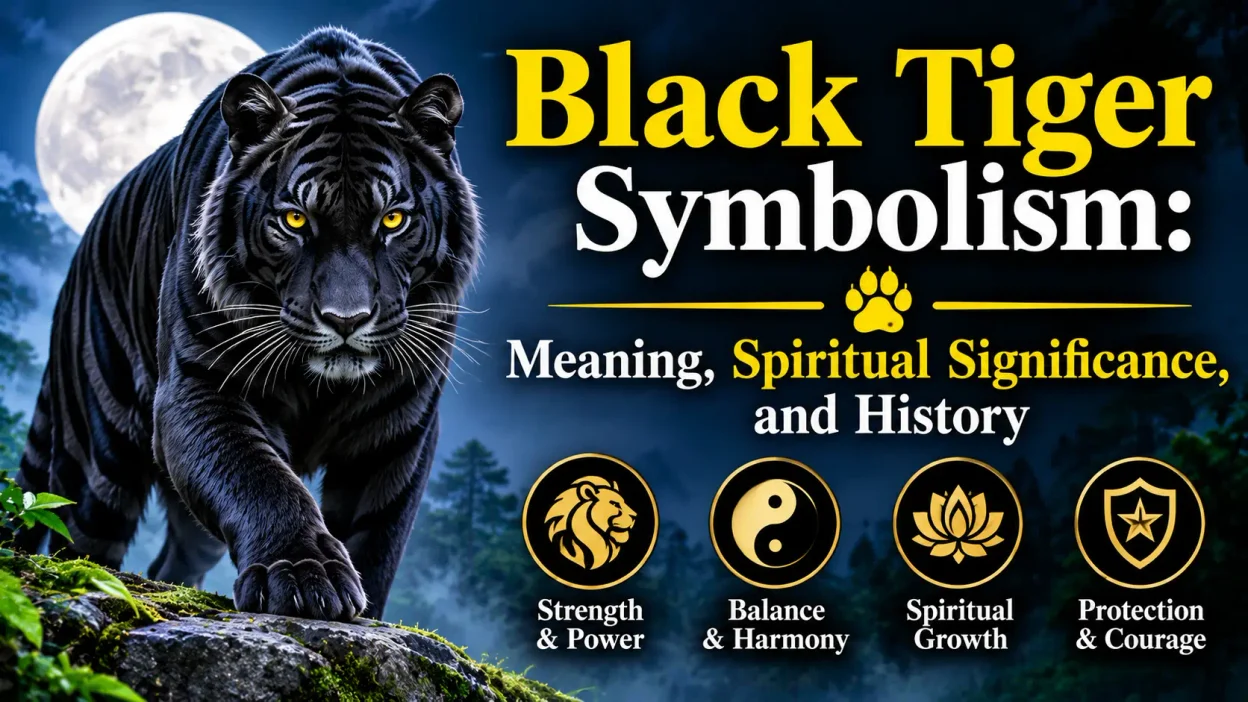
Black tiger symbolism is commonly associated with hidden strength, courage, protection, independence, and the ability to face difficult situations without backing down. A black tiger combines the familiar physical power of the tiger with the cultural associations of black, a color often connected with mystery, authority, privacy, and the unknown. This combination makes the animal an interesting subject in modern art, tattoos, personal identity, and spiritual interpretation.
Unlike the familiar orange-and-black tiger, a black tiger is an unusual animal. Some tigers have exceptionally dark coats because of a genetic condition called pseudomelanism, which makes their black stripes unusually broad and their orange background less visible. These animals are real, although extremely rare. Their unusual appearance has also contributed to stories, artistic representations, and modern interpretations.
The meaning of a black tiger is not identical across cultures. In some Asian traditions, the Black Tiger has a specific place in systems of direction, seasons, and natural elements. In contemporary American culture, people are more likely to associate its appearance with personal strength, resilience, confidence, and individuality. Understanding these differences helps separate established cultural traditions from newer personal interpretations.
Quick Answer
Black tiger symbolism commonly represents hidden strength, courage, independence, protection, and the ability to overcome challenges. In historical Chinese and other Asian traditions, the Black Tiger also appears in specific cosmological and protective traditions, sometimes associated with the north, winter, and water.
TL;DR
- Black tigers represent strength, courage, independence, and protection.
- Their dark appearance combines tiger symbolism with associations of mystery and authority.
- Chinese traditions connect the Black Tiger with winter, water, and the north.
- American interpretations often emphasize confidence, resilience, and individuality.
- Black tiger tattoos can express personal strength and overcoming adversity.
- Real dark-coated tigers are rare genetic variations, not mythical creatures.
1. What Does a Black Tiger Look Like?
A black tiger is generally understood as a tiger whose dark markings cover much more of its body than usual. Rather than having the familiar orange coat with clearly separated black stripes, an unusually dark tiger may have broad, closely connected black markings that make much of its body appear nearly black.
This appearance is associated with pseudomelanism, a genetic condition affecting the distribution and appearance of pigmentation. It is different from true melanism, in which an animal develops an unusually dark overall coat.
The distinction matters because a black tiger is not necessarily completely black. Its characteristic tiger markings remain part of its appearance, even when the dark pattern dominates.
People may encounter black tiger imagery in wildlife photography, documentaries, traditional paintings, fantasy artwork, tattoos, and decorative designs. Some illustrations show an entirely black animal with glowing eyes, but this is an artistic interpretation rather than an accurate representation of every unusually dark tiger.
Its unusual coat is one reason the animal attracts attention. It looks familiar enough to be recognized as a tiger but different enough to invite questions about its meaning.
2. The Core Symbolic Meanings of a Black Tiger
The black tiger brings together two recognizable forms of symbolism: the tiger’s physical characteristics and the cultural associations of its dark coloration.
The tiger is widely associated with strength, courage, authority, instinct, and independence. As a large predator, it represents an animal capable of surviving through patience, physical ability, and territorial awareness.
Black introduces another layer of interpretation. In many contemporary settings, the color suggests mystery, seriousness, elegance, authority, and the unknown. It can also represent mourning, danger, or emotional distance.
Together, these qualities produce several common interpretations.
- Hidden strength: Power that does not need constant attention or public recognition.
- Courage: Facing difficult situations despite uncertainty or fear.
- Protection: Defending personal boundaries and people who matter.
- Independence: Making decisions without depending on approval from others.
- Mystery: Keeping private thoughts, plans, or emotions away from public attention.
- Resilience: Continuing through difficult circumstances and recovering from setbacks.
These meanings are interpretive rather than universal. A person choosing a black tiger as a personal emblem may emphasize confidence, while an artist may use the same image to communicate danger or isolation.
3. Why Black Changes the Tiger’s Symbolism
The color black changes how people perceive the tiger because it creates a visual contrast with the animal’s familiar orange coat.
In modern American design, black is frequently used to communicate sophistication, authority, strength, and formality. Black clothing, vehicles, furniture, and accessories often create a serious or commanding appearance.
However, black also has associations with grief, secrecy, uncertainty, and fear. Its meaning depends on the situation. A black outfit at a formal event may communicate elegance, while black clothing at a funeral can express mourning and respect.
When combined with a tiger, these contrasting associations create an image that can communicate controlled power rather than open aggression.
For example, a black tiger standing calmly may suggest confidence, patience, and self-control. An image showing the animal with exposed teeth and raised claws may communicate confrontation, anger, or a warning against crossing boundaries.
The animal’s posture, facial expression, and surroundings often influence the meaning as much as its color.
4. Ancient Chinese Symbolism of the Black Tiger
One of the most specific historical traditions involving a Black Tiger comes from Chinese cosmological systems.
Some Chinese traditions describe five colored tigers associated with the directions and natural elements. Within this framework, the Black Tiger is connected with the north, winter, and water. Other colored tigers represent different combinations of directions, seasons, and elements.
This system gives the Black Tiger a meaning that goes beyond modern associations with darkness or mystery. It places the animal within an ordered view of the natural world, where different forces contribute to balance.
The Black Tiger can therefore be understood as an image associated with the northern direction and the qualities attributed to winter and water in this particular tradition.
It is important not to confuse this figure with the White Tiger, another well-known symbol in Chinese culture. The White Tiger has its own established connection with the west, autumn, and metal, as well as a prominent place in Chinese cosmology.
These traditions show that tiger colors can carry distinct meanings. A black tiger in an ancient Chinese cosmological image should not automatically be interpreted using modern Western ideas about black animals.
5. The Tiger as a Symbol of Protection in Asian Traditions
Tigers have held important protective roles in several Asian cultural and religious traditions.
In Chinese folk beliefs, tiger images have appeared on household objects, clothing, decorative items, and protective designs. The animal’s strength and ability to defend its territory made it a natural figure for representing protection against harmful forces.
Korean folk traditions also include tiger imagery associated with guardianship, spiritual protection, and mountain spirits. In some contexts, tiger figures are believed to discourage harmful influences and protect the surrounding community.
In Vietnamese folk religious imagery, colored tigers can represent guardians associated with different directions and elements. The Black Tiger is connected with the north and water in the Five Tigers tradition.
These examples should not be treated as one shared Asian belief system. Each tradition has its own history, religious setting, and interpretation.
For modern readers, the common theme is that the tiger can represent a guardian figure rather than simply a dangerous predator. Its strength becomes a symbol of protection and responsibility.
6. Black Tiger Symbolism in the United States
In the United States, black tiger imagery is most often encountered through popular culture, wildlife photography, sports-inspired artwork, fashion, tattoos, and fantasy illustrations.
American interpretations frequently combine the tiger’s established associations with strength and courage with the visual meaning of black.
For some people, a black tiger represents the ability to remain confident during difficult situations. Others use the image to communicate independence, self-respect, or a refusal to be controlled by outside expectations.
The animal can also appeal to people who prefer designs that feel bold without being overly decorative. Its dark appearance works well in black-and-gray artwork, clothing graphics, home decor, and contemporary illustrations.
Unlike the Chinese directional tradition, American interpretations do not generally follow one established religious or historical system for the black tiger.
Instead, meaning is often personal. Someone may choose the animal because it represents overcoming adversity, while another person may simply appreciate its appearance and connection to wildlife.
7. Black Tiger Symbolism Across Different Cultures
The tiger has a long cultural history across parts of Asia, but the specific meaning of a black tiger varies considerably.
| Cultural context | Symbolic associations | Important distinction |
|---|---|---|
| Chinese traditions | North, winter, water, and cosmic balance | Part of a five-colored tiger system |
| Korean traditions | Protection, guardianship, and spiritual presence | Tiger imagery has several regional meanings |
| Vietnamese folk religion | Directional guardianship and sacred protection | Black Tiger represents the north and water |
| Hindu traditions | Divine strength and protection through tiger imagery | Specific associations depend on the deity and tradition |
| Modern American culture | Courage, independence, mystery, and personal strength | Often based on individual interpretation |
In Hindu traditions, the tiger appears in important religious imagery. The goddess Durga is commonly depicted riding a tiger or lion, depending on the artistic and regional tradition. The animal represents the strength and control associated with divine power.
Buddhist traditions also include tiger stories and images, although their meanings differ according to the particular teaching or artwork.
In parts of Southeast Asia, folklore includes stories about humans transforming into tigers or maintaining spiritual relationships with them. These beliefs developed within specific local communities and should not be generalized to all Asian cultures.
The important distinction is that the tiger has established cultural significance in many places, but not every traditional tiger meaning specifically belongs to a black tiger.
8. Emotional and Psychological Meaning of a Black Tiger
A black tiger can represent the desire to feel strong without constantly proving that strength to other people.
This interpretation is particularly relevant to people who value privacy, independence, and emotional self-control. The animal’s solitary hunting behavior and territorial nature can make it an appealing image for someone who prefers to work independently.
Its dark appearance may also communicate a willingness to face uncomfortable experiences. Instead of avoiding uncertainty, the black tiger can represent the decision to confront it with patience and determination.
Several emotional associations commonly appear in personal interpretations:
Confidence: The tiger’s physical presence suggests the ability to stand firm under pressure.
Self-protection: Its territorial behavior can represent the importance of personal boundaries.
Resilience: Its survival in challenging environments makes it a useful image for perseverance.
Emotional control: A calm tiger can suggest strength guided by discipline rather than impulsive reactions.
Individuality: Its unusual appearance can represent the desire to stand apart from expectations.
These are symbolic interpretations, not scientifically established personality traits. Choosing a black tiger image does not prove that someone is naturally courageous, independent, or emotionally reserved.
9. Black Tiger Spiritual Meaning
In contemporary spiritual interpretations, the black tiger is often associated with inner strength, personal protection, intuition, and confronting uncertainty.
Some people view the animal as a reminder to trust their judgment when making difficult decisions. Others associate it with the ability to protect their emotional space and avoid situations that undermine their well-being.
Its meaning may also be connected with personal transformation. The combination of a powerful animal and a dark appearance can represent the willingness to recognize difficult experiences and use them as opportunities for growth.
However, there is no single universal religious doctrine assigning these meanings to every black tiger.
The Chinese Black Tiger of directional cosmology has a specific historical context, while modern spiritual interpretations often combine animal symbolism, color associations, and personal beliefs.
Keeping these interpretations separate makes it easier to appreciate both traditional cultural meanings and contemporary spiritual expression.
10. Black Tiger Meaning in Dreams
Dream interpretations of black tigers often focus on fear, confidence, hidden conflict, or the need to establish personal boundaries.
The meaning depends heavily on what happens in the dream and how the dreamer feels.
- A calm black tiger: May represent confidence, self-control, or a desire for personal security.
- An attacking black tiger: May reflect feelings of pressure, conflict, or fear.
- A black tiger following you: May suggest an unresolved concern or situation receiving your attention.
- A protective black tiger: May represent a desire for support, safety, or emotional stability.
- A black tiger running freely: May suggest independence or a wish to escape restrictions.
- A black tiger in a cage: May reflect feelings of confinement or frustration.
Dreams do not have fixed meanings, and there is no reliable scientific method for assigning one universal interpretation to a particular animal dream.
Personal circumstances matter. Someone experiencing a difficult work situation may interpret an attacking tiger differently from someone who recently watched a wildlife documentary.
The most useful approach is to consider the emotions experienced during the dream and whether they connect with anything happening in everyday life.
11. Why People Choose Black Tiger Tattoos
Black tiger tattoos are popular as bold animal designs because they combine recognizable strength with a distinctive visual appearance.
In American tattoo culture, a tiger can represent courage, determination, personal identity, and the ability to defend oneself. The black version adds associations with independence, privacy, and overcoming difficult experiences.
The design can communicate different ideas depending on its composition.
A black tiger with a calm expression may represent quiet confidence. An aggressive tiger with exposed teeth may communicate fearlessness or a willingness to confront challenges. A tiger surrounded by flowers or natural scenery may create a contrast between strength and balance.
Common tattoo placements include:
- Upper arm and shoulder
- Forearm
- Chest
- Back
- Thigh
- Calf
Some people choose a black tiger tattoo to commemorate a personal struggle or a major life change. Others appreciate the animal’s appearance without attaching a specific spiritual meaning to it.
A meaningful tattoo does not need to communicate the same message to everyone. Its personal significance can be more important than traditional interpretations.
12. Black Tiger in Art, Fashion, and Home Decor
The black tiger’s striking appearance makes it suitable for several forms of modern visual design.
In contemporary artwork, dark tiger illustrations often use strong contrasts, detailed facial features, and dramatic lighting. These techniques emphasize the animal’s physical presence and create a sense of movement or tension.
In fashion, black tiger graphics can appear on shirts, jackets, sneakers, and accessories. The design often communicates confidence, individuality, or an interest in wildlife-inspired imagery.
Home decor offers another interpretation. A black tiger painting or sculpture may serve as a statement piece in a room with neutral colors, dark furniture, or modern decorative elements.
The image can also appear in digital illustrations, gaming artwork, profile pictures, and fantasy designs.
Its visual appeal comes partly from the contrast between the tiger’s recognizable shape and its unusual dark appearance. This makes it recognizable without requiring elaborate decorative details.
13. Positive and Negative Meanings of a Black Tiger
The black tiger does not have an exclusively positive or negative meaning. Its interpretation changes according to the context in which it appears.
| Positive interpretation | Cautionary interpretation |
|---|---|
| Courage and confidence | Aggression and intimidation |
| Protection and security | Excessive control |
| Independence and freedom | Isolation |
| Resilience and persistence | Refusal to accept help |
| Mystery and privacy | Secrecy and distrust |
| Authority and discipline | Abuse of power |
This contrast is important because strength can be understood in different ways.
A person who uses the black tiger as a symbol of confidence may see it as a reminder to remain calm and protect personal boundaries. Someone creating a darker fantasy character may use the same animal to communicate danger or an uncontrolled desire for power.
The distinction is not about the animal being inherently good or evil. It is about how people interpret its characteristics and apply them to human behavior.
14. Common Misunderstandings About Black Tiger Symbolism
Several misconceptions can make the meaning of a black tiger difficult to understand.
Mythical and real black tigers are not the same thing. Unusually dark tigers have been documented, although their appearance is rare. Fantasy illustrations sometimes exaggerate their coloration or depict animals that do not accurately reflect real tiger genetics.
Black tigers are not the same as black panthers. The term black panther generally refers to a melanistic leopard or jaguar, not a tiger. A dark tiger retains its distinctive tiger markings.
Not every Asian tiger tradition describes the Black Tiger. The five-colored tiger system is a specific cultural framework, not a universal belief shared by every Asian religion or community.
Black does not always mean evil. Although black can represent fear, mourning, or danger in some settings, it can also communicate authority, elegance, protection, and seriousness.
Modern spiritual meanings are not ancient universal teachings. Ideas such as hidden personal power or awakening intuition may be meaningful to individuals, but they should not automatically be presented as established historical beliefs.
Understanding these differences prevents modern interpretations from being confused with scientific facts or cultural traditions.
Frequently Asked Questions
1. Is a black tiger a symbol of good luck?
A black tiger can represent protection, courage, and good fortune in some personal and cultural interpretations. However, it does not have one universal good-luck meaning across different traditions.
2. What does a black tiger symbolize spiritually?
In contemporary spiritual interpretations, it often represents inner strength, protection, independence, and facing uncertainty. These meanings vary according to individual beliefs rather than following one universal religious teaching.
3. What does a black tiger tattoo mean?
A black tiger tattoo commonly represents courage, confidence, resilience, and independence. Some people choose it to mark a personal struggle, while others simply appreciate its bold appearance.
4. What does a black tiger represent in Chinese culture?
In the traditional five-colored tiger system, the Black Tiger is associated with the north, winter, and water. This is a specific cosmological interpretation rather than a general meaning applied to every black tiger image.
5. Is seeing a black tiger in a dream a good or bad sign?
It can be interpreted positively or negatively depending on the dream’s circumstances. A calm tiger may suggest confidence, while an attacking tiger may reflect fear, pressure, or unresolved conflict.
6. What is the difference between a black tiger and a black panther?
A black tiger is an unusually dark-colored tiger with broad or connected dark stripes. A black panther is generally a melanistic leopard or jaguar, and the two animals belong to different species.
7. Does a black tiger represent strength or mystery?
It can represent both. The tiger contributes associations with physical strength and courage, while its dark appearance adds interpretations involving mystery, privacy, and the unknown.
Conclusion
Black tiger symbolism brings together the tiger’s traditional associations with courage, authority, and protection and the modern cultural meanings attached to the color black. It can represent hidden strength, independence, resilience, and the willingness to face difficult situations. In particular Asian traditions, the Black Tiger also has specific connections with direction, winter, water, and protective imagery.
For many Americans, the animal serves as a personal emblem of confidence and individuality. Its meaning may appear in tattoos, artwork, fashion, dreams, and spiritual interpretations, although these modern uses should be distinguished from established cultural traditions.
Ultimately, the black tiger represents more than an unusual animal appearance. It offers a way to express the difference between uncontrolled aggression and disciplined strength, reminding us that genuine confidence does not always need to announce itself.


