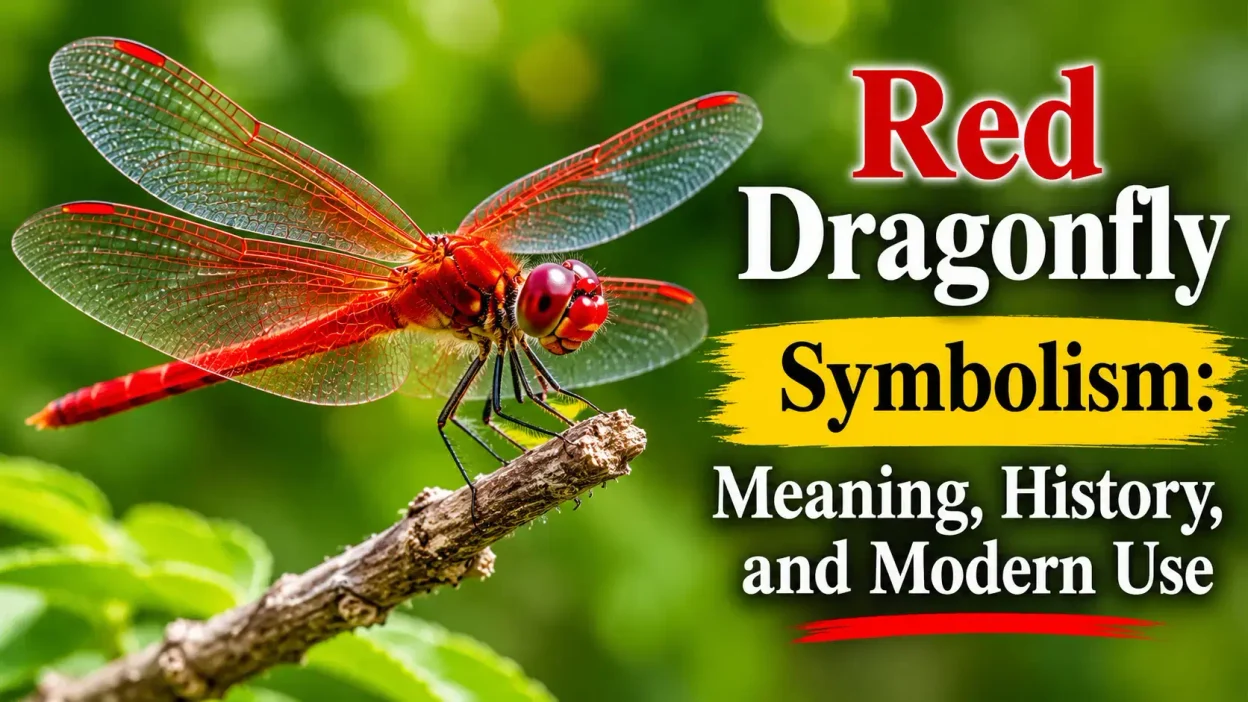
Red dragonfly symbolism often brings together ideas of vitality, courage, change, and the beauty of a passing moment. The insect’s bright color makes it stand out against green vegetation, still water, and the muted colors of late summer. Its quick, unpredictable flight adds another layer of meaning, suggesting movement, freedom, and the ability to adapt.
A red dragonfly is also more than a symbolic image. It is a real insect with a place in the natural world, and its meaning changes depending on where it appears and how people understand it. In Japan, the red dragonfly has a particularly strong connection to autumn, childhood memories, and traditional ideas of victory. In the United States, people may associate it with personal growth, love, remembrance, or simply the pleasure of encountering an unusual creature.
Understanding these different interpretations helps explain why a small insect can carry such varied emotional and cultural significance. It also helps separate documented traditions from modern spiritual interpretations and personal beliefs.
Quick Answer
Red dragonfly symbolism commonly represents vitality, courage, personal change, and emotional renewal in modern American culture. In Japanese tradition, the red dragonfly is especially associated with autumn, childhood nostalgia, and victory, while its bright color can also inspire personal interpretations of love, energy, and resilience.
TL;DR
- Red dragonflies often represent vitality, courage, and personal growth.
- Japanese culture connects red dragonflies with autumn and victory.
- Their life cycle provides a natural basis for transformation symbolism.
- American interpretations often combine dragonfly meanings with the symbolism of red.
- Tattoos and jewelry can express individuality, remembrance, or a new beginning.
- A dragonfly sighting does not have one universal spiritual meaning.
What Does a Red Dragonfly Look Like?
A red dragonfly is a dragonfly whose body displays noticeable red or reddish-orange coloring. Depending on the species, the color may appear across the abdomen, thorax, or parts of the head. Some have dark markings or contrasting wings, while others display a nearly uniform red body.
In the United States, several species can appear red. The red-veined darter, also known as the red-veined meadowhawk, and the autumn meadowhawk are examples of dragonflies that may show reddish coloring. The common name red dragonfly does not identify one particular species.
Dragonflies have large compound eyes, two pairs of wings, and long bodies. They are often seen near ponds, lakes, marshes, streams, and other places where water supports their development.
Their appearance helps explain their symbolic appeal. The red body attracts attention, while the transparent wings create a contrast between brightness and delicacy. The insect seems both energetic and fragile, an interesting combination that influences how people interpret it.
The Core Meaning of Red Dragonfly Symbolism
Red dragonflies do not have one universally accepted symbolic meaning. Their interpretation usually combines the established associations of dragonflies with the cultural and emotional meanings people attach to the color red.
Several ideas appear frequently in modern interpretations.
Vitality and energy: Red is commonly associated with warmth, activity, and physical energy. A red dragonfly can therefore suggest enthusiasm, motivation, or renewed interest in life.
Courage and confidence: The insect’s vivid appearance and agile movement can make it a natural image of boldness. In personal symbolism, it may represent the willingness to face uncertainty or take a new direction.
Change and adaptability: Dragonflies develop through distinct life stages and move with remarkable agility. Their biology offers a meaningful comparison to people adjusting to new circumstances.
Emotional renewal: A red dragonfly may represent returning to an activity, relationship, or goal after a difficult period. This interpretation is especially common in contemporary spiritual and personal symbolism.
Love and passion: Because red is strongly associated with romantic feeling in American culture, a red dragonfly can become a personal symbol of affection, attraction, or emotional commitment.
These meanings are interpretations rather than fixed rules. A person who chooses a red dragonfly for a tattoo may be expressing confidence, while someone else may associate it with a childhood memory or a loved one.
Why Red Adds a Different Meaning to the Dragonfly
The dragonfly itself is frequently associated with movement, change, and adaptability. Red adds another layer that makes the symbol feel more immediate and emotionally charged.
In the United States, red appears in many familiar settings: Valentine’s Day decorations, roses, warning signs, sports uniforms, and national symbols. Its meaning depends heavily on context. It can communicate love and celebration, but it can also signal danger, urgency, or anger.
When red appears on a dragonfly, the combination may suggest change accompanied by strong emotion. A blue dragonfly might be interpreted by some people as calm or reflective, while a red one may seem more energetic or assertive. These are contemporary color associations, not universal cultural rules.
The distinction matters because a red dragonfly does not automatically represent passion or courage in every tradition. Those meanings often come from combining modern interpretations of red with the broader symbolism of dragonflies.
Ancient Roots and the Historical Meaning of Dragonflies
Dragonflies have existed for hundreds of millions of years. Their ancient evolutionary history, however, should not be confused with the history of human beliefs about them.
People have observed dragonflies in different environments and assigned meanings based on their behavior, appearance, and relationship to local landscapes. Some traditions emphasize speed and strength. Others connect dragonflies with water, seasonal change, or good fortune.
In Japan, dragonflies have a particularly long cultural history. Their images appear on ceremonial objects from the ancient Yayoi period, and traditional stories connect the insect with the country’s early identity.
The Japanese name akatombo, meaning red dragonfly, also became associated with a well-known children’s song written in the early twentieth century. The song helped connect the insect with memories of childhood and the changing seasons.
Historical meanings should be understood within their own cultural settings. The fact that dragonflies appear in ancient art does not establish that every ancient society understood them as symbols of transformation, rebirth, or spiritual messages.
Red Dragonflies in Japanese Culture
Japan offers one of the clearest examples of a specific cultural tradition involving red dragonflies.
Dragonflies are commonly associated with summer and autumn in Japanese art and literature. Red dragonflies, in particular, are strongly connected with autumn, when their appearance becomes part of the seasonal landscape.
This association is not merely decorative. Japanese traditions often use familiar elements of nature to express the passing of time. A red dragonfly can evoke the end of summer, the beginning of autumn, and the bittersweet feeling of childhood memories.
The insect also has a history as a symbol of victory. Dragonflies were traditionally called kachi-mushi, or victory insects, and their imagery appeared on samurai armor, helmets, and other objects associated with warriors.
Their quick movement and tendency to fly forward contributed to their association with courage and success.
The red dragonfly therefore carries several meanings in Japanese culture, including seasonal change, childhood nostalgia, and victory. These meanings are more historically grounded than the claim that red dragonflies universally represent romantic love or spiritual awakening.
What Red Dragonflies Symbolize in the United States
In the United States, red dragonfly symbolism is less closely tied to one established cultural tradition. Instead, it often reflects a combination of general dragonfly associations, modern color symbolism, and individual experience.
A person who sees a red dragonfly during a major life transition may interpret it as a reminder to remain flexible. Someone who encounters one while spending time outdoors with family may associate it with childhood, summer, or a meaningful memory.
The insect also fits comfortably into American nature-oriented design. Dragonfly imagery appears in garden decorations, jewelry, greeting cards, stained glass, and artwork inspired by wetlands and wildlife.
Some Americans interpret a red dragonfly as a sign of good luck or a reminder to live in the present. Others see it as a symbol of resilience or personal freedom.
There is no single American belief about red dragonflies. Their meaning is usually shaped by the setting, the person’s experiences, and the particular qualities they notice in the insect.
Red Dragonfly Symbolism Across Different Contexts
| Context | Common Interpretation | Important Distinction |
|---|---|---|
| Modern American symbolism | Vitality, courage, change | Often combines general dragonfly meanings with red’s emotional associations |
| Japanese tradition | Autumn, victory, childhood nostalgia | Supported by specific cultural and artistic traditions |
| Personal spirituality | Renewal, encouragement, meaningful encounters | Individual belief rather than a universal teaching |
| Tattoos and jewelry | Identity, love, resilience, remembrance | Meaning depends on the person and design |
| Nature and environmental awareness | Water, seasonal change, healthy habitats | Based on the insect’s real ecological relationship with water |
Transformation and the Dragonfly Life Cycle
One reason dragonflies are associated with transformation is their actual development.
Dragonflies begin life as eggs, usually deposited in or near water. They hatch into aquatic nymphs, which may live underwater for months or years, depending on the species. Eventually, the nymph climbs out of the water and emerges as a winged adult.
The transition is visible and dramatic. The adult leaves behind its aquatic form and enters a different environment.
This natural process provides a useful comparison to human experiences such as graduating, starting a new career, moving to another place, or rebuilding after a difficult period.
A red dragonfly can therefore represent the moment when a person begins to live differently. The meaning is not that the insect predicts a future event, but that its life cycle offers an image through which people can understand their own changes.
Its ability to move quickly and change direction also supports the idea of adaptability. The insect does not need to follow one straight path to reach its destination.
Emotional and Psychological Meaning
The emotional meaning of a red dragonfly often depends on what the observer is experiencing.
For someone who feels stuck, its movement may suggest freedom and the possibility of taking a different approach. For someone facing a difficult decision, it may serve as a personal reminder to remain flexible.
The color red can make these associations feel more intense. In many modern settings, red is linked with strong emotions, including affection, excitement, anger, and determination.
The dragonfly’s brief adult life may also encourage reflection on time and attention. Its appearance can remind a person to notice an ordinary moment rather than remain focused entirely on future plans.
These interpretations can be psychologically meaningful without requiring a supernatural explanation. People often use images from nature to express emotions that are difficult to describe directly.
A red dragonfly may become a symbol of resilience because it reminds someone of a personal achievement, not because the insect carries a fixed message for everyone.
Red Dragonflies in Tattoos and Personal Style
Red dragonfly tattoos often combine the insect’s associations with transformation and freedom with the emotional significance of red.
A person may choose the design to mark a new chapter in life, celebrate independence, or remember an important relationship. Others may simply appreciate its shape and color.
The design can change the meaning:
- A red dragonfly with open wings may suggest freedom or confidence.
- A dragonfly with flowers may express a connection to nature or a particular memory.
- A small red dragonfly may serve as a quiet reminder of personal growth.
- A dragonfly with a name or date may commemorate a person or life event.
These are possible interpretations rather than a standardized tattoo code. The wearer determines what the image represents.
Red dragonflies also appear in earrings, pendants, bracelets, clothing, and decorative accessories. In these settings, the insect can communicate a love of nature, an appreciation of delicate design, or a personal connection to a particular season.
Red Dragonflies in Dreams and Spiritual Interpretations
Some modern spiritual traditions interpret dragonflies as signs of transformation, renewal, or encouragement. A red dragonfly may be understood as an invitation to act with confidence or pay attention to an emotional change.
Dream interpretations often associate dragonflies with adaptability and personal development. The color red may add themes of passion, urgency, or strong feelings.
However, dream symbolism is subjective. There is no scientific evidence that seeing a red dragonfly in a dream predicts a specific event or communicates a message from an external spiritual source.
A useful way to interpret such a dream is to consider the emotions it produced. Was the dragonfly comforting, alarming, beautiful, or unexpected? Did it appear during a period of change?
The answers may reveal what the image means to the dreamer without treating one interpretation as universally correct.
Red Dragonflies and Remembrance
Dragonflies sometimes become personal symbols of remembrance after the death of a loved one.
A person may associate an unexpected dragonfly sighting with someone they miss, especially if that person enjoyed gardening, fishing, or spending time near water. The insect’s brief appearance can make the encounter feel particularly memorable.
Red may add a sense of affection, emotional intensity, or enduring connection.
In American memorial culture, dragonflies appear in jewelry, memorial gardens, artwork, and keepsakes. These objects can help people express grief or preserve a connection to someone important.
Some people understand such encounters spiritually, while others view them as meaningful coincidences. Both interpretations can provide comfort, but neither should be presented as a proven explanation for why a dragonfly appeared.
The personal meaning lies in the relationship between the insect, the memory, and the person experiencing it.
Red Dragonflies in Other Cultural Traditions
Dragonfly symbolism varies considerably across cultures, and it is important not to treat all Indigenous American traditions as one belief system.
For example, dragonfly imagery has been documented in Pueblo and Zuni artistic contexts. Some accounts connect dragonflies in particular Southwestern traditions with water, healing, or transformation.
Other Indigenous traditions have associated dragonflies with speed, protection, or particular spiritual roles. These meanings depend on the specific community and historical context.
In Japanese culture, dragonflies are associated with victory and the changing seasons. In Chinese cultural traditions, dragonflies have appeared in art and literature, although their meanings are not identical to Japanese interpretations.
These examples show why a red dragonfly cannot be assigned one universal spiritual meaning. Cultural symbolism develops through particular histories, landscapes, stories, and practices.
When interpreting a symbol from a tradition that is not one’s own, it is more respectful to identify the specific community and avoid presenting a simplified interpretation as a shared belief among millions of people.
Common Misunderstandings About Red Dragonfly Symbolism
Several popular claims about red dragonflies deserve careful consideration.
Every red dragonfly is a spiritual sign. A dragonfly sighting is a natural event. A person may attach spiritual significance to it, but there is no universal rule that makes every encounter a message.
Red dragonflies always represent love. Red is associated with romance in many modern American settings, but dragonfly symbolism also includes nature, change, seasonal meaning, and personal memories.
All Native American cultures share the same dragonfly beliefs. Indigenous nations have distinct traditions. A meaning documented in one community should not automatically be applied to another.
Red dragonflies predict major life changes. Their association with transformation comes partly from their life cycle and modern interpretation. It does not establish that they can predict future events.
Red dragonflies are dangerous or poisonous. Dragonflies are not poisonous to people, and they do not have a stinging mechanism. Their strong flight and predatory behavior may look intimidating, but they are generally harmless to humans.
Understanding these distinctions allows people to appreciate symbolic meaning without confusing cultural interpretation with biological fact.
How the Meaning of Red Dragonflies Has Evolved
The meaning of red dragonflies has developed through several overlapping influences.
In Japanese culture, dragonflies acquired established associations with victory and the seasons. Their presence in art, poetry, and traditional objects helped preserve those meanings.
In modern American culture, dragonfly imagery became part of a broader interest in nature, personal expression, and symbolic design. The insect’s life cycle made it a natural choice for representing change, while red added associations with energy and emotion.
Contemporary spiritual and personal interpretations have expanded these meanings further. A red dragonfly may now represent confidence, love, renewal, or remembrance, depending on the individual.
This evolution does not mean that older meanings disappeared. Japanese seasonal symbolism, for example, remains distinct from a modern American interpretation of a red dragonfly tattoo.
The symbol continues to develop because people encounter it in different settings and use it to express different experiences.
Frequently Asked Questions
What does a red dragonfly symbolize spiritually?
In modern spiritual interpretations, a red dragonfly may represent renewal, courage, emotional growth, or a reminder to remain open to change. These meanings are personal beliefs rather than universal spiritual teachings.
Is seeing a red dragonfly a sign of good luck?
Some people interpret a red dragonfly sighting as a good omen or a reminder to welcome new opportunities. Japanese traditions also associate dragonflies with victory and good fortune, although that does not establish a universal belief about red dragonfly sightings.
What does a red dragonfly tattoo mean?
A red dragonfly tattoo can represent personal transformation, confidence, freedom, love, or remembrance. Its meaning depends on the wearer’s experiences, the design, and the reason for choosing it.
What does a red dragonfly mean in Japanese culture?
In Japan, red dragonflies are strongly associated with autumn, childhood nostalgia, and seasonal beauty. Dragonflies more broadly have also been connected with victory and courage in Japanese history.
Are red dragonflies associated with deceased loved ones?
Some people interpret a red dragonfly encounter as a comforting reminder of someone who has died. Others see it as a meaningful coincidence connected to their memories. There is no established evidence that dragonflies carry messages from deceased people.
Does a red dragonfly symbolize love?
Red dragonflies can symbolize love or passion in modern personal interpretations because red is commonly associated with romantic feelings. This is not a universal historical meaning, and the insect can represent many other ideas.
Are red dragonflies a sign of transformation?
They are commonly used as symbols of transformation because dragonflies undergo a major change from aquatic nymphs to winged adults. People often connect this natural process with personal growth, although a sighting does not predict a particular change.
Conclusion
Red dragonfly symbolism brings together vitality, courage, adaptability, and the emotional significance of change. Its meaning is shaped by the insect’s natural life cycle, the cultural history of dragonflies, and the associations people attach to the color red.
In Japan, the red dragonfly carries established connections to autumn, childhood memories, and victory. In the United States, it more often serves as a personal symbol of renewal, love, resilience, or a meaningful encounter with nature.
Ultimately, a red dragonfly does not need to carry one fixed message to be meaningful. Its significance can come from cultural tradition, a personal memory, or the simple experience of noticing something beautiful in the natural world.