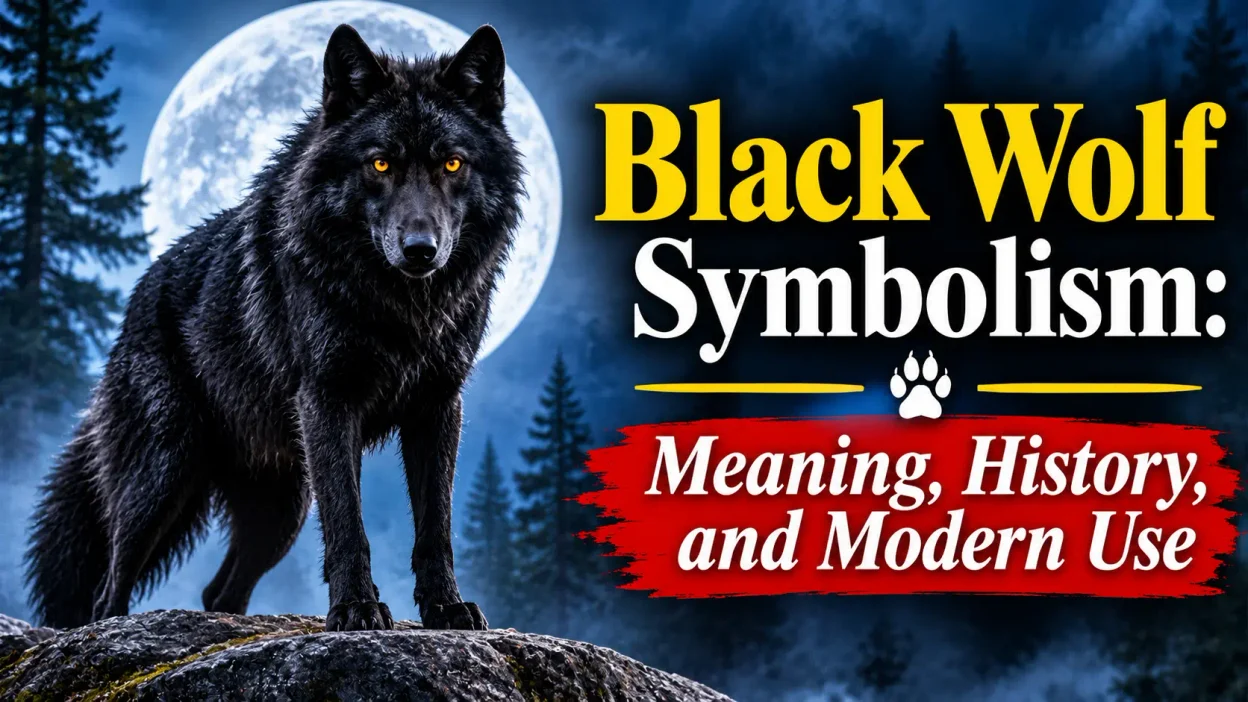
A black wolf is often associated with independence, strength, protection, mystery, and the ability to survive difficult circumstances. Black wolf symbolism brings together two familiar images: the wolf, an intelligent social predator known for its instincts and cooperation, and the color black, which can suggest authority, secrecy, mourning, or the unknown. Together, they create an image that people may interpret as both protective and intimidating.
In the United States, black wolves appear in wildlife photography, folklore-inspired artwork, tattoos, literature, films, and outdoor imagery. Some people connect them with personal resilience and self-reliance, while others see them as symbols of loyalty, family bonds, or a willingness to face uncertainty. Their meaning often depends on whether the wolf is shown alone, traveling with a pack, watching from a distance, or standing in a threatening pose.
It is also important to separate cultural symbolism from the behavior of real animals. A black-coated wolf is not a different species with supernatural qualities. Its appearance comes from natural variation in coat color, and its behavior is shaped by biology, environment, and social relationships. Understanding that distinction makes the symbol more interesting rather than less meaningful.
Quick Answer
Black wolf symbolism commonly represents independence, resilience, protection, mystery, and strength in modern American culture. Historically, wolves have appeared in folklore and spiritual traditions as figures of survival, danger, loyalty, and transformation, while the black coat adds associations with the unknown, authority, and hidden aspects of life.
TL;DR
- Black wolves commonly represent independence, resilience, and personal strength.
- Their pack behavior connects them with loyalty, family, and cooperation.
- Black fur adds associations with mystery, authority, and the unknown.
- Folklore portrays wolves as both dangerous predators and respected figures.
- Modern tattoos and artwork often express protection and self-reliance.
- Real black wolves are naturally occurring animals, not supernatural creatures.
1. What Does a Black Wolf Look Like?
A black wolf is a gray wolf with predominantly black or very dark fur. Its coat may contain subtle brown, gray, or silver areas, particularly around the face, shoulders, and legs. Depending on lighting, a black wolf can appear almost completely dark or show several shades within its coat.
Black-coated wolves occur naturally in North America, particularly among some populations of gray wolves. Their coloration is associated with genetic variation, including a genetic variant linked to coat pigmentation.
In symbolic artwork, however, the black wolf is often presented with exaggerated visual features. Artists may give it glowing eyes, a dark forest background, a raised head, or an isolated position on a mountain. These artistic choices influence interpretation.
For example:
- A black wolf standing alone may suggest independence.
- A black wolf beside its pack may represent loyalty.
- A black wolf looking directly at the viewer may communicate confidence or vigilance.
- A black wolf beneath a full moon may suggest mystery and wilderness.
The physical animal and its artistic representation are related, but they are not interchangeable. A photograph shows a real animal, while an illustration may communicate an emotional or cultural idea.
2. The Core Meaning of Black Wolf Symbolism
The black wolf combines several symbolic associations that people recognize independently.
The wolf is commonly connected with survival, intelligence, instinct, family bonds, and territorial awareness. Wolves are social animals that depend on communication and cooperation, making them useful symbols of loyalty and collective strength.
Black adds another layer. In American culture, the color can represent elegance, authority, mourning, secrecy, seriousness, or the unknown. Its meaning changes according to the setting. Black clothing, for instance, can communicate sophistication, while a dark landscape may create an atmosphere of uncertainty.
Together, these associations produce several common interpretations:
Independence: The wolf’s ability to travel through challenging environments makes it an image of self-reliance.
Protection: Its awareness of threats and close social bonds can suggest guarding loved ones.
Mystery: The dark coat and nighttime imagery create associations with secrecy and unfamiliar territory.
Resilience: The wolf’s ability to adapt to changing conditions makes it a symbol of endurance.
Loyalty: Its social behavior connects the image with commitment, cooperation, and family relationships.
Not every black wolf represents all these ideas. A peaceful illustration may emphasize loyalty, while an aggressive image may focus on strength and intimidation.
3. Ancient Roots of Wolf Symbolism
Wolves have occupied an important place in human stories because people have lived alongside them for thousands of years. Their hunting abilities, social organization, and relationship with livestock made them animals that communities both respected and feared.
In ancient Roman tradition, the wolf became associated with the legendary founding of Rome. The story of Romulus and Remus describes twin brothers who were nursed by a she-wolf after being abandoned. The animal became an enduring image of protection, survival, and the origins of a civilization.
In Norse mythology, wolves appear in stories involving the gods and the end of the world. Fenrir, a formidable wolf, is associated with destruction and the events of Ragnarök. Other wolves appear in connection with the movement of the sun and moon.
These traditions demonstrate that wolf symbolism was never limited to one interpretation. Wolves could represent protection, power, danger, and forces beyond human control.
The specific black coloration should not be automatically assigned to every ancient wolf story. Many traditional accounts concern wolves generally, not black wolves as a distinct symbolic category.
4. Black Wolves in Native American Traditions
Wolf symbolism holds different meanings among Indigenous peoples of North America. There is no single Native American interpretation because hundreds of distinct nations have their own languages, histories, spiritual traditions, and relationships with wildlife.
In some cultural contexts, wolves are respected for their intelligence, hunting skills, family relationships, and ability to work together. Their behavior can provide lessons about cooperation, responsibility, awareness, and survival.
For some communities, wolf figures also appear in stories, ceremonies, clan identities, or teachings. However, these meanings are specific to individual traditions and should not be combined into a universal interpretation.
It is especially important not to claim that every Indigenous tradition regards a black wolf as a spiritual guardian or messenger. Such statements often come from modern commercial interpretations rather than documented teachings.
When exploring Indigenous wolf symbolism, the most respectful approach is to identify the particular nation and cultural context. A general image of a black wolf may inspire modern personal reflection, but it should not be presented as an authentic traditional teaching without evidence.
5. What the Black Color Adds to the Symbol
Black changes how people interpret the wolf because color carries its own cultural associations.
In the United States, black is often connected with authority, elegance, seriousness, mourning, and the unknown. It can communicate confidence and control, but it can also create a feeling of danger or emotional distance.
When combined with the wolf, these associations create a more reserved and intimidating image than the familiar gray wolf.
Consider the difference between two illustrations. A gray wolf standing in a snowy landscape might emphasize wilderness, survival, and natural beauty. A black wolf standing in deep shadow may suggest secrecy, vigilance, or strength that does not need to be displayed.
Black also has positive associations in design and fashion. It is frequently used to communicate sophistication, independence, and understated confidence. Therefore, a black wolf does not have to represent evil or negativity.
Its meaning depends on the surrounding imagery and the viewer’s experience.
6. Independence and the Strength of Standing Alone
One of the most recognizable modern interpretations of a black wolf is independence.
A wolf shown alone against a mountain, forest, or moonlit sky often represents someone who prefers to make personal decisions rather than follow outside expectations. The image can appeal to people who value privacy, determination, and the ability to handle difficult situations.
This interpretation is common in modern American tattoo culture and motivational artwork. A person may choose a lone black wolf to represent a period of personal growth, recovery from hardship, or the decision to follow an individual path.
However, the lone-wolf image is not an accurate summary of wolf biology. Wolves are highly social animals, and their family groups play an important role in their lives.
That contrast makes the symbol more interesting. The lone black wolf can represent independence as a personal attitude rather than a literal description of how wolves normally survive.
It can also communicate a preference for solitude without suggesting hostility toward other people.
7. Protection, Loyalty, and Family Bonds
Although popular artwork frequently presents wolves as solitary animals, their social behavior offers another important symbolic meaning.
Wolves live in family-based groups and cooperate in activities such as hunting, raising young, and defending territory. Their relationships depend on communication, familiarity, and coordination.
Because of these characteristics, wolf imagery is often used to represent family loyalty and protection.
A black wolf standing beside smaller wolves may symbolize parental responsibility. Two wolves facing the same direction can suggest partnership and shared commitment. A wolf surrounded by a pack may communicate belonging and mutual support.
In American culture, these images often appear in family tattoos, outdoor artwork, clothing designs, and decorative prints.
The protective interpretation does not mean that wolves are naturally gentle or harmless. They remain wild predators. Their symbolic value comes from the combination of social cooperation and the ability to respond to threats.
8. Mystery, Shadow, and the Unknown
The black wolf is frequently associated with mystery because its dark appearance works well with nighttime and shadow imagery.
In literature and visual storytelling, darkness can represent uncertainty, concealed information, fear, or parts of human experience that people struggle to understand. A black wolf moving through a dark forest naturally fits this atmosphere.
The animal may represent an unexplored part of someone’s identity, an unresolved fear, or the courage needed to face an unfamiliar situation.
Some modern spiritual interpretations connect the black wolf with intuition and self-discovery. These are personal or contemporary symbolic readings, not universally established beliefs.
A black wolf can also represent comfort with uncertainty. Rather than treating darkness as something entirely negative, the image may suggest the ability to move forward without knowing exactly what lies ahead.
This interpretation is particularly common in fantasy art, poetry, and personal artwork.
9. Black Wolf Symbolism in American Culture
In the United States, wolves occupy an unusual cultural position. They are admired as symbols of wilderness and independence, yet they have also been feared because of livestock losses and historical conflicts with human settlements.
During the expansion of European-American agriculture and ranching, wolves were frequently treated as threats to livestock. Government-backed eradication programs and predator-control campaigns contributed to the severe decline of wolf populations in many regions.
Later conservation efforts changed public attitudes. The recovery of gray wolves in parts of the United States helped make the animal an important subject in environmental discussions.
Today, a wolf can represent different things depending on the audience:
- For wildlife enthusiasts, it may symbolize healthy ecosystems and wilderness.
- For outdoor communities, it can suggest endurance and adaptability.
- For artists, it may communicate mystery, strength, and freedom.
- For families, it can represent loyalty and protection.
- For conservation advocates, it may represent ecological balance.
The black wolf adds a visual identity to these existing associations. It is particularly popular in artwork that emphasizes wilderness, personal independence, and dramatic natural settings.
10. Black Wolves in Folklore and World Mythology
Different cultures have included wolves in stories about creation, danger, transformation, and the relationship between humans and nature.
In Norse mythology, Fenrir represents a dangerous force that cannot be permanently controlled. In Roman tradition, the she-wolf that cared for Romulus and Remus represents nourishment and survival.
In some Eurasian folktales, wolves appear as dangerous animals, clever adversaries, or guides through unfamiliar landscapes. Their roles vary according to the story.
In East Asian traditions, wolf-related imagery also has different regional interpretations. Japanese folklore, for example, includes traditions involving the Japanese wolf and protective associations in certain local religious contexts. These traditions should not be confused with a universal belief about black wolves.
The important distinction is that historical wolf symbolism is diverse. A modern black wolf image may draw inspiration from several traditions, but it does not automatically inherit their specific religious or cultural meanings.
11. Emotional and Psychological Meaning of a Black Wolf
People often connect with animal symbols because they provide a visual way to express feelings that are difficult to explain directly.
A black wolf can represent confidence for someone who has overcome a difficult period. For another person, it may express a need for privacy, emotional independence, or stronger personal boundaries.
Its symbolism can also reflect contrasting feelings:
- Confidence: The wolf communicates an ability to face challenges.
- Loneliness: A solitary wolf may reflect emotional distance or isolation.
- Belonging: A wolf pack can represent friendship and family.
- Courage: The animal can suggest facing difficult situations.
- Self-awareness: Its association with instinct may encourage reflection on personal decisions.
These meanings are personal interpretations rather than psychological diagnoses. Choosing a wolf image does not establish someone’s personality or emotional condition.
The symbol is most useful when considered as an expression of the meaning its owner wants to communicate.
12. Black Wolf Meaning in Tattoos, Jewelry, and Fashion
<escape> </escape>Black wolf imagery is popular in personal design because it combines a recognizable animal with a strong visual contrast.
Tattoos are among the most common ways people use the symbol. Different compositions can communicate different ideas:
| Design | Common symbolic meaning | Personal interpretation |
|---|---|---|
| Lone black wolf | Independence and resilience | Standing by personal values |
| Black wolf with a pack | Loyalty and family | Protecting loved ones |
| Howling black wolf | Expression and freedom | Finding one’s voice |
| Black wolf with a moon | Mystery and reflection | Accepting uncertainty |
| Black wolf with forest scenery | Survival and wilderness | Connection with nature |
Jewelry featuring wolves often uses the animal as a symbol of courage, loyalty, or personal identity. Pendants, rings, and engraved bracelets allow people to carry the image without choosing a permanent tattoo.
In fashion, black wolf graphics appear on shirts, hoodies, jackets, and outdoor-inspired accessories. Their popularity is partly connected to the broader appeal of wildlife artwork and nature-based designs.
The meaning ultimately comes from the person wearing or displaying the image, not from a universal rule about wolf imagery.
13. Positive and Negative Interpretations
The black wolf is not exclusively a positive or negative symbol. Its interpretation changes according to the image, cultural background, and personal associations.
<escape> </escape>Positive interpretations often focus on independence, loyalty, courage, and protection. Negative interpretations may emphasize aggression, isolation, danger, or distrust.
| Positive associations | Negative associations |
|---|---|
| Independence | Isolation |
| Protection | Aggression |
| Loyalty | Possessiveness |
| Resilience | Emotional distance |
| Confidence | Intimidation |
| Instinct | Uncontrolled impulses |
A black wolf protecting its pack creates a different impression from one showing its teeth in an aggressive pose.
This flexibility is one reason the animal appears in so many forms of modern artwork. It can communicate confidence without appearing friendly, or strength without suggesting violence.
The best interpretation considers the full image rather than judging the symbol by its color alone.
14. Misunderstandings and Misuse of Black Wolf Symbolism
Several common misunderstandings surround the black wolf.
The first is the belief that black wolves are a separate species or naturally more aggressive than gray wolves. Coat color alone does not establish an animal’s temperament or behavior.
The second is the assumption that black wolves universally represent evil, witchcraft, or bad luck. These associations may appear in particular fictional stories or local traditions, but they are not universal cultural beliefs.
Another misconception comes from the popular lone-wolf ideal. While independence is a common modern interpretation, real wolves depend heavily on social relationships. Presenting isolation as the defining feature of wolf behavior overlooks their family structure.
There is also a risk of misrepresenting Indigenous cultures by claiming that all Native American communities regard black wolves as spiritual guides. Cultural meanings differ, and specific teachings should not be invented or generalized.
Finally, wolf imagery is sometimes used in aggressive online communities or political artwork to communicate dominance and intimidation. That modern use should be distinguished from the animal’s natural behavior and from the many cultural traditions that have represented wolves in more varied ways.
Understanding these distinctions helps preserve the symbol’s meaning without turning cultural assumptions into facts.
15. How Black Wolf Symbolism Has Evolved
The meaning of wolves has changed as human relationships with the animals have changed.
In earlier societies, wolves were often viewed through the practical realities of hunting, livestock protection, and competition for resources. Their presence could mean danger, but their abilities also made them figures of respect in stories and traditions.
During the expansion of European-American settlement, wolves increasingly became associated with threats to farming and ranching. This perception contributed to widespread predator-control campaigns.
Modern conservation movements introduced another perspective. Wolves became associated with biodiversity, wilderness protection, and the importance of maintaining functioning ecosystems.
Popular entertainment added further meanings. Fantasy novels, films, games, and digital artwork frequently portray black wolves as mysterious companions, guardians, powerful adversaries, or symbols of personal transformation.
Social media has helped spread the image through tattoos, motivational graphics, and nature-inspired designs. In these settings, the black wolf often represents a combination of self-reliance and loyalty.
The symbol has therefore moved beyond a simple image of a feared predator. It now occupies a space between wildlife, personal identity, folklore, and modern visual culture.
Frequently Asked Questions
1. What does seeing a black wolf symbolize?
Seeing a black wolf in artwork, a dream, or a personal experience may represent independence, protection, resilience, or uncertainty. The meaning depends on the circumstances and the personal or cultural associations connected to the animal.
2. Is a black wolf a symbol of good luck?
Some modern interpretations associate black wolves with protection, confidence, and positive personal change. However, there is no universal historical belief that seeing a black wolf guarantees good luck.
3. What does a black wolf tattoo mean?
A black wolf tattoo commonly represents independence, loyalty, courage, and the ability to overcome adversity. A lone wolf may emphasize self-reliance, while a wolf with its pack can express family commitment and belonging.
4. What does a black wolf symbolize spiritually?
In contemporary spiritual interpretations, a black wolf may represent intuition, personal transformation, protection, and confronting hidden fears. These meanings vary among individuals and should not be confused with the teachings of specific Indigenous or religious traditions.
5. Are black wolves associated with protection?
Yes, many modern artistic and personal interpretations connect black wolves with protection because wolves cooperate to defend and care for their family groups. Images of an adult wolf standing beside its pack often communicate responsibility and loyalty.
6. Does a black wolf symbolize evil or darkness?
Not necessarily. Although black wolves are sometimes portrayed as threatening figures in fantasy and horror, their dark appearance can also communicate elegance, authority, mystery, and resilience.
7. What is the difference between a black wolf and a gray wolf symbolically?
Both can represent survival, intelligence, loyalty, and independence. The black wolf often receives additional associations with mystery and the unknown because of its darker appearance, although these differences are mainly cultural and artistic rather than biological.
Conclusion
Black wolf symbolism brings together independence, protection, resilience, mystery, and loyalty. Its meaning comes from the wolf’s real characteristics as a social predator, combined with the cultural associations people attach to the color black. This combination makes the animal an appealing image in American artwork, tattoos, literature, and personal expressions of identity.
Its history also reveals why the symbol cannot be reduced to a single interpretation. Wolves have represented danger, family, survival, and protection in different societies, while modern conservation has encouraged greater appreciation of their ecological importance.
Ultimately, a black wolf can represent the ability to stand independently without abandoning the importance of belonging. Its most meaningful message may be that strength is not simply about facing challenges alone, but also knowing when loyalty, cooperation, and connection matter.