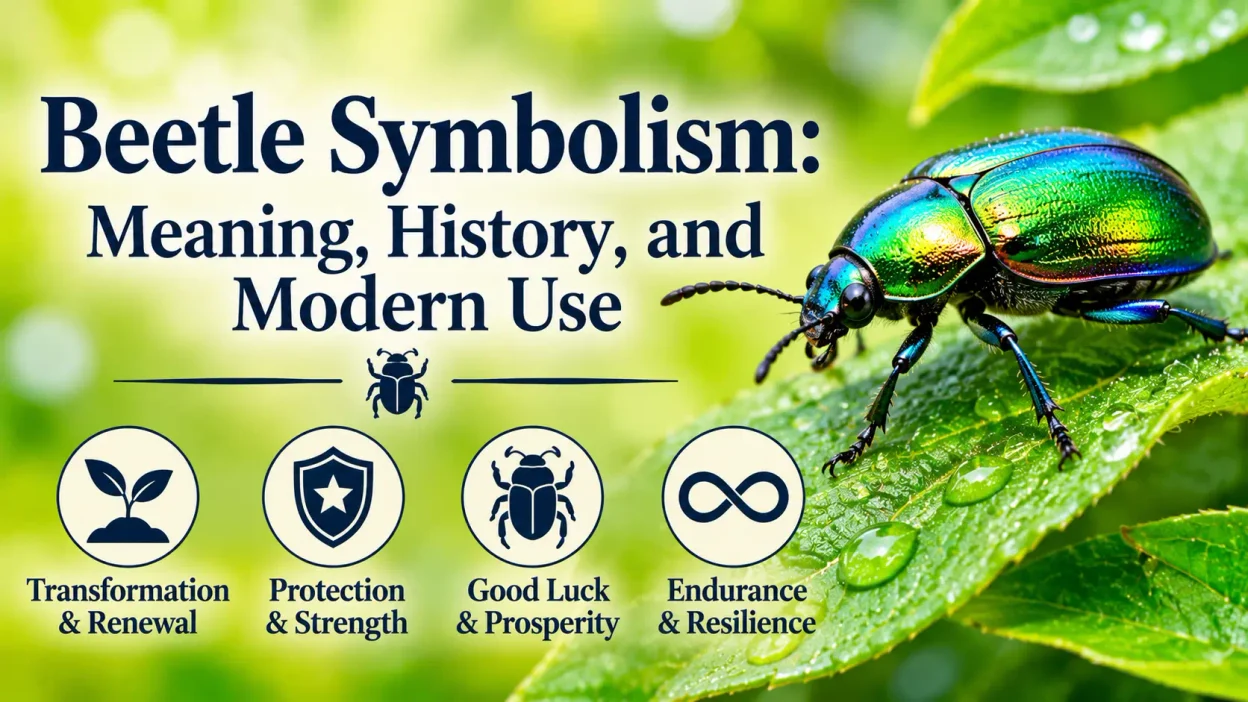
Beetle symbolism connects one of the world’s most recognizable insect groups with transformation, resilience, protection, persistence, and renewal. Beetles appear in gardens, forests, homes, artwork, jewelry, and ancient objects. Their ability to survive in different environments, undergo dramatic physical changes, and perform important roles in nature has made them meaningful in many cultural traditions.
A beetle may seem like an ordinary garden insect, but its appearance can carry different associations depending on the species and the setting. A scarab beetle in ancient Egyptian art, a ladybug resting on a flower, and a dark beetle crossing a doorway do not necessarily communicate the same idea. Their meanings come from different histories, beliefs, and human experiences.
In the United States, beetles are often associated with nature, environmental health, patience, and personal transformation. Some people also interpret an unexpected beetle encounter as a reminder to remain persistent or pay attention to changes in their lives. Understanding these interpretations requires looking at the insect’s natural behavior as well as the cultural traditions that have shaped its symbolic meaning.
Quick Answer
Beetle symbolism commonly represents transformation, resilience, persistence, protection, and renewal in modern American culture. Historically, beetles also represented rebirth, the sun, and the cycle of life, particularly in ancient Egyptian traditions involving the scarab.
TL;DR
- Beetles commonly symbolize transformation, endurance, protection, and renewal.
- Ancient Egyptians connected scarab beetles with the sun and rebirth.
- Their life cycle makes them natural symbols of personal change.
- Different beetle species carry distinct cultural and symbolic associations.
- Modern Americans use beetle imagery in tattoos, jewelry, art, and nature-inspired design.
- An unexpected encounter can inspire reflection without predicting future events.
1. What a Beetle Looks Like and Why It Became Symbolic
Beetles belong to the insect order Coleoptera, a group containing hundreds of thousands of described species. Their most recognizable physical feature is a pair of hardened front wings called elytra. These protective covers shield the delicate wings underneath and often give beetles their distinctive rounded or armored appearance.
Some beetles are small and brightly colored, while others are large, dark, metallic, or patterned. Ladybugs have familiar rounded bodies with spots, scarabs often have sturdy oval shapes, and jewel beetles can display brilliant green, blue, or copper-like surfaces.
Their physical characteristics help explain why people have attached symbolic meanings to them.
- Protective shells: Suggest defense, boundaries, and emotional strength.
- Changing life stages: Represent growth, development, and transformation.
- Persistence: Reflect determination and the ability to continue through difficult conditions.
- Metallic colors: Encourage associations with beauty, value, and renewal.
- Connection to the earth: Suggest grounding, natural cycles, and environmental balance.
A beetle’s appearance is only the beginning of its symbolism. Its behavior and ecological role also influence how people understand it.
2. The Core Meaning of Beetle Symbolism
The most common symbolic interpretations of beetles involve the ability to adapt, endure, and move through different stages of life. These meanings are not shared equally by every species or culture, but several themes appear repeatedly in modern interpretations.
Transformation is one of the strongest associations. Many beetles undergo complete metamorphosis, developing through egg, larva, pupa, and adult stages. This dramatic change provides a natural comparison to personal development, new beginnings, and major life transitions.
Resilience comes from their protective bodies and ability to survive in diverse habitats. Some species live in forests, others in deserts, gardens, wetlands, or decaying wood. Their adaptability makes them useful symbols of endurance.
Protection is connected to their hardened wing covers. People may interpret a beetle’s shell as a reminder to maintain healthy boundaries and protect what matters.
Persistence reflects the insect’s continued activity in environments where survival requires finding food, avoiding predators, and adapting to changing conditions.
Together, these associations make beetles meaningful symbols for people experiencing change, rebuilding confidence, or developing greater independence.
3. Ancient Egyptian Scarab Symbolism and the Meaning of Rebirth
<text> </text>
<AsyncImage query=”ancient Egyptian scarab beetle amulet blue green faience hieroglyphic carved scarab artifact museum photography” aspectRatio=”16:9″ width=”100%”/>
The scarab beetle holds one of the most historically documented symbolic roles in human culture. In ancient Egypt, the dung beetle, particularly species associated with rolling balls of dung across the ground, became connected with the movement of the sun and the process of renewal.
The Egyptian god Khepri was associated with the rising sun and the emergence of new life. He was frequently represented as a scarab or as a human figure with a scarab head. The beetle’s behavior offered a visible image that ancient Egyptians connected with the sun’s daily movement and the renewal of existence.
This association gave the scarab an important place in religious art and burial practices.
Scarab-shaped amulets were produced from materials such as faience, stone, and other substances. Some were worn as personal objects, while others served as seals or decorative items. Heart scarabs were especially significant in funerary traditions, where they were placed with the deceased and connected with beliefs about judgment and the afterlife.
The scarab therefore represented more than ordinary good fortune. It was connected with the continuation of life, divine order, and the possibility of rebirth.
Its influence remains visible today in museum collections, historical jewelry, decorative objects, and modern interpretations of Egyptian symbolism.
4. Beetles as Symbols of Transformation and New Beginnings
A beetle’s development offers a clear natural example of transformation. Unlike insects that develop through simpler life stages, many beetles experience complete metamorphosis. Their larval bodies can look very different from their adult forms.
This change makes beetles useful symbols of personal growth. A person may connect the insect with leaving an old identity behind, learning from difficult experiences, or entering a new stage of life.
For example, someone beginning a new career might choose a beetle tattoo to represent the effort required to become a different version of themselves. Another person recovering from a difficult period might see the insect as a reminder that change can happen gradually, even when the process feels uncomfortable.
The symbolism also carries an important distinction: transformation does not always mean an immediate improvement. The process involves development, adjustment, and sometimes uncertainty.
Beetles therefore represent a realistic form of renewal. Their life cycle suggests that meaningful change takes place through stages rather than appearing all at once.
5. What Beetles Symbolize in the United States
In the United States, beetles do not have one universal cultural meaning. Their interpretation depends on the species, the person’s background, and the setting in which the insect appears.
Nature enthusiasts may associate beetles with biodiversity, healthy ecosystems, and the importance of insects in maintaining environmental balance. Gardeners often recognize their practical value because some species help control pests, while others contribute to decomposition and nutrient cycling.
In art and personal design, beetles can represent individuality, endurance, and appreciation for the natural world. Their unusual shapes and colors also make them popular subjects for botanical illustrations, nature photography, and decorative artwork.
American interpretations are also influenced by familiar species:
- Ladybugs: Commonly associated with good luck, happiness, and protection.
- Fireflies’ close insect relatives: Often inspire associations with summer, childhood memories, and natural beauty, although fireflies belong to a different beetle family.
- Scarab beetles: Connected with ancient Egyptian history, renewal, and rebirth.
- Stag beetles: Often suggest strength, determination, and impressive natural design.
- Jewel beetles: Associated with beauty, rarity, and visual elegance.
These interpretations show why species identification matters. A beetle’s symbolic meaning can change considerably depending on which insect someone encounters.
6. Protection, Boundaries, and Personal Strength
A beetle’s hardened outer wings provide one of the clearest physical reasons for its association with protection. The elytra shield the delicate wings underneath and help protect the insect’s body from environmental hazards.
In symbolic interpretations, this natural armor can represent emotional boundaries, self-respect, and the ability to protect personal values. Someone going through a difficult relationship or a period of uncertainty might connect a beetle with the importance of maintaining inner strength.
The beetle’s protection does not make it invulnerable. It still faces predators, environmental threats, and the challenges of finding food and shelter. This makes its symbolism more realistic than an image of complete safety.
A beetle can remind someone that strength involves knowing when to defend themselves, when to adapt, and when to move forward.
7. Beetle Symbolism in Different Cultures
Beetles have appeared in different cultural traditions, but their meanings are not identical across societies. Some interpretations come from religious beliefs, while others develop from local folklore, agriculture, and everyday encounters with insects.
Ancient Egypt: Scarabs represented regeneration, the rising sun, and the continuation of life. They also appeared in protective amulets and funerary objects.
European folklore: Ladybugs, which are beetles, became associated with good fortune and protection in several European traditions. Their familiar appearance helped establish their positive reputation.
Japanese culture: The rhinoceros beetle and stag beetle have a recognizable place in children’s culture, collecting traditions, and seasonal entertainment. Their size and distinctive horns make them popular subjects of fascination.
Indigenous traditions: Insects have different meanings across Indigenous nations and communities. There is no single universal Native American interpretation of beetles. Specific cultural meanings should be understood through the traditions of the particular community rather than generalized.
These differences demonstrate why it is important not to assign one spiritual meaning to every beetle or assume that a belief from one culture applies everywhere.
8. Ladybug Symbolism and the Meaning of Good Luck
<text> </text>
Ladybugs deserve special attention because they are among the most recognizable beetles in American culture. Their rounded bodies, bright colors, and contrasting spots make them familiar symbols of good fortune, happiness, and protection.
In European folk traditions, ladybugs became associated with blessings and favorable outcomes. Their agricultural importance also contributed to their positive reputation. Many ladybug species feed on aphids and other plant pests, making them beneficial to gardens and crops.
In the United States, children often associate seeing a ladybug with making a wish. Some people also interpret one landing on their clothing or hand as a sign of good luck.
However, not every beetle carries the same meaning. A ladybug’s cheerful reputation should not automatically be applied to ground beetles, scarabs, or other species.
The distinction is useful when interpreting an encounter. Identifying the insect provides a better starting point than assuming all beetles represent happiness or good fortune.
9. What It Means When a Beetle Visits Your Home
Finding a beetle inside a home can feel unusual, especially when the insect appears unexpectedly in a bedroom, kitchen, or near a window. Symbolically, people sometimes interpret these encounters as reminders of change, protection, persistence, or the need to pay attention to their surroundings.
The location can influence personal interpretation.
- Bedroom: Some people associate a beetle with personal growth, privacy, or emotional boundaries.
- Kitchen: It may encourage reflection on home life, daily routines, and practical responsibilities.
- Near a window: It can suggest opportunity, transition, or movement toward something new.
- At the front door: Some interpret it as a reminder of protection or a new chapter.
These meanings are personal interpretations, not established predictions. A beetle entering a house does not prove that a visitor, financial change, or major life event is coming.
There are also ordinary explanations. Beetles may enter through open doors, windows, cracks, or gaps while searching for shelter, food, or suitable conditions. Some species are attracted to lights.
Understanding both the practical and symbolic sides of an encounter allows people to appreciate it without becoming unnecessarily worried.
10. The Emotional and Psychological Meaning of Beetles
Beetles can represent emotions that are connected with endurance, independence, and personal development.
Their protective appearance may appeal to people who value privacy or prefer to handle challenges quietly. Unlike animals commonly associated with speed or aggression, beetles often suggest steady movement and persistence.
Their symbolism can be particularly relevant during periods of personal change.
Someone rebuilding their confidence might associate a beetle with the ability to continue despite setbacks. A person starting a new chapter may see its life cycle as an image of development. Someone working toward a difficult goal might connect its persistence with patience and consistent effort.
There is also a less comfortable side to beetle imagery. Some people feel disgust or fear when they encounter insects, especially those with large bodies, unusual legs, or sudden movements. This response can influence how they interpret a beetle symbol.
Personal meaning is therefore not always positive. The same insect may represent protection to one person and discomfort to another.
11. Beetle Symbolism in Dreams
Dream interpretations involving beetles vary according to personal experience, cultural background, and the details of the dream. There is no scientifically established universal meaning for seeing a beetle while sleeping.
Some common symbolic interpretations include:
| Dream Situation | Possible Symbolic Interpretation |
|---|---|
| A beetle crawling on your hand | Awareness, responsibility, or personal change |
| A beetle flying | Movement, independence, or uncertainty |
| A large beetle | A challenge that requires attention |
| A beetle shedding or emerging | Development and a new stage |
| A dead beetle | An ending or a completed phase |
| Several beetles together | Accumulating responsibilities or environmental concerns |
The emotions experienced during the dream matter as much as the insect itself. A calm encounter may feel different from a dream involving fear or discomfort.
Rather than treating a dream as a prediction, consider what is happening in your waking life. It may reflect concerns about change, personal boundaries, or a situation that needs attention.
12. Beetle Tattoos, Jewelry, and Modern Design
<text> </text>
Beetles have become distinctive subjects in nature-inspired artwork, fashion, and personal accessories. Their recognizable bodies and varied colors make them suitable for both realistic illustrations and abstract designs.
Beetle tattoos: People may choose beetle tattoos to represent transformation, resilience, independence, or a connection with nature. A scarab design often communicates historical interest or associations with renewal.
Jewelry: Scarab pendants, rings, earrings, and brooches draw on the insect’s historical connection with ancient Egyptian art. Some designs emphasize protection and regeneration, while others focus on craftsmanship and visual appeal.
Home decor: Beetle illustrations appear in botanical prints, vintage-style artwork, framed natural-history collections, and decorative textiles. They can create an earthy or scientific atmosphere.
Fashion: Beetle-inspired patterns and metallic designs often emphasize unusual beauty, individuality, and appreciation for natural forms.
Digital culture: Beetle illustrations and insect photography appear in nature-focused social media communities, educational posts, and personal artwork.
The meaning of a design ultimately depends on the person choosing it. A scarab tattoo may reflect an interest in Egyptian history, while a stag beetle design may simply celebrate the insect’s unusual appearance.
13. Different Beetle Species and Their Symbolic Associations
There are many kinds of beetles, and their physical characteristics encourage different interpretations. The following distinctions are useful when exploring their symbolic meanings.
| Beetle Type | Common Symbolic Association | Natural Characteristic |
|---|---|---|
| Scarab beetle | Rebirth and regeneration | Dung-rolling behavior in certain species |
| Ladybug | Good luck and protection | Often feeds on plant pests |
| Stag beetle | Strength and determination | Large, antler-like mandibles in males |
| Rhinoceros beetle | Power and endurance | Prominent horn-like structures |
| Jewel beetle | Beauty and individuality | Metallic-looking body surfaces |
| Ground beetle | Persistence and adaptability | Many species are active predators |
These associations are interpretive rather than fixed cultural rules. For example, a rhinoceros beetle’s horns may inspire ideas about strength, but the insect does not carry one universal spiritual message.
Recognizing the species also helps people appreciate the biological diversity behind the symbolism.
14. Misunderstandings and Negative Associations
Not every beetle is beneficial, attractive, or welcomed by people. Some species damage crops, stored food, furniture, or buildings. Carpet beetles can damage natural fabrics, while certain wood-boring beetles can affect trees and timber.
These experiences have contributed to negative associations involving decay, infestation, inconvenience, and unwanted change.
It is important to distinguish these practical concerns from symbolic interpretations. A beetle infestation is a pest-management issue, not evidence of bad luck or negative spiritual activity.
Another misunderstanding involves ancient Egyptian symbolism. Modern decorative products sometimes describe every scarab as a universal good-luck charm. Historically, scarabs had more specific religious, funerary, administrative, and protective functions. Their meanings varied according to their form, inscriptions, and use.
People should also avoid treating beetles as supernatural messengers with guaranteed meanings. Spiritual interpretations may be personally meaningful, but they are matters of belief rather than scientifically established facts.
15. How Beetle Symbolism Has Changed Over Time
The symbolic meaning of beetles has developed alongside changes in religion, science, art, and everyday life.
In ancient Egypt, the scarab became connected with divine creation, the rising sun, and life after death. Its image appeared in amulets, jewelry, seals, and burial objects.
In later societies, different beetles gained local associations through agriculture, folklore, and encounters with nature. Ladybugs, for example, developed a favorable reputation partly because of their usefulness in protecting plants.
As scientific knowledge expanded, beetles became important subjects in entomology and environmental study. Their role in pollination, decomposition, pest control, and food webs helped establish a more ecological understanding of their importance.
Today, beetles occupy both scientific and symbolic spaces. Some people admire them for their environmental value, while others choose their images for tattoos, jewelry, historical artwork, or personal reflection.
Their meaning has not disappeared as scientific explanations have developed. Instead, biological knowledge and cultural interpretation now exist side by side.
Frequently Asked Questions
1. What does a beetle symbolize spiritually?
A beetle is commonly interpreted as a symbol of transformation, resilience, protection, and renewal. In ancient Egyptian spirituality, the scarab had a specific connection with Khepri, the rising sun, and the continuation of life.
2. Is seeing a beetle considered good luck?
Some people consider seeing a beetle a positive sign associated with persistence, opportunity, or personal growth. Ladybugs have a particularly strong association with good luck in American folklore, but beliefs differ between species and cultures.
3. What does a beetle tattoo mean?
A beetle tattoo can represent independence, endurance, personal transformation, or a connection with nature. A scarab design may also express an interest in ancient Egyptian history and its associations with rebirth.
4. What does a black beetle symbolize?
Black beetles are sometimes interpreted as symbols of protection, grounding, mystery, and resilience. These meanings are modern symbolic associations rather than a universal tradition shared by all cultures.
5. What does a scarab beetle symbolize?
A scarab traditionally represents regeneration, creation, and the rising sun in ancient Egyptian culture. Scarab amulets were also used in funerary practices, including heart scarabs associated with judgment in the afterlife.
6. Does a beetle in your house have a spiritual meaning?
Some people personally interpret a beetle entering their home as a reminder of change, protection, or persistence. However, beetles usually enter buildings for ordinary reasons, such as seeking shelter, food, or suitable environmental conditions.
7. Are beetles positive or negative symbols?
Beetles can carry both positive and negative associations depending on the species and cultural context. Scarabs and ladybugs are often viewed positively, while pest species may be connected with damage, inconvenience, or decay.
Conclusion
Beetle symbolism connects the natural world with ideas about transformation, resilience, protection, and renewal. Its historical significance is especially clear in ancient Egypt, where the scarab represented the rising sun, regeneration, and the continuation of life. Other species developed different associations through folklore, agriculture, and everyday experiences.
In modern American culture, beetles appear in tattoos, jewelry, nature-inspired artwork, and personal interpretations of unexpected encounters. Their meaning depends on the species, cultural background, and individual perspective rather than one universal spiritual explanation.
Whether viewed as a sign of persistence, an image of personal growth, or an example of nature’s remarkable diversity, the beetle offers a practical reminder: meaningful change often happens gradually, through adaptation and continued effort.


