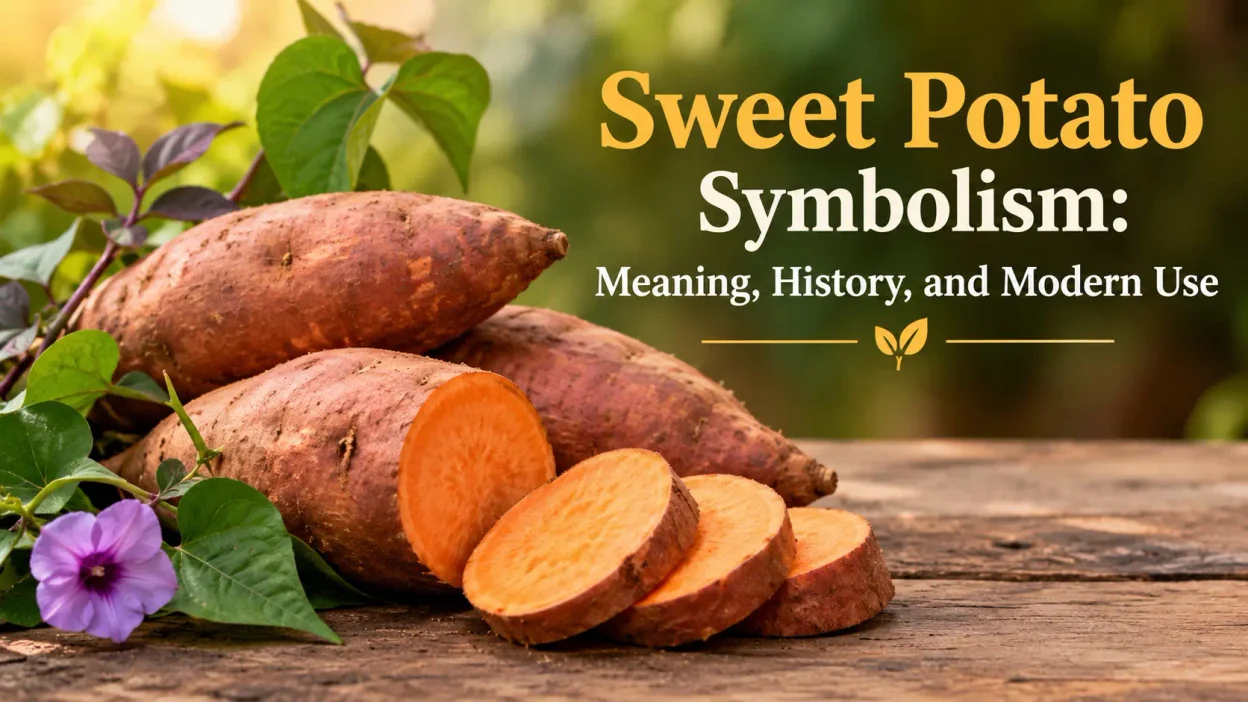
Sweet potato symbolism is closely connected to nourishment, abundance, resilience, family traditions, and the comfort of home. As a familiar food in American kitchens, the sweet potato represents more than a nutritious root vegetable. Its connection to harvests, traditional cooking, and the ability to grow in challenging conditions gives it several meaningful associations.
The sweet potato has a long history that reaches back to tropical regions of the Americas, where Indigenous communities cultivated it long before European colonization. Over time, it traveled across oceans and became an important food in parts of Africa, Asia, the Pacific, and other regions. Each culture developed its own ways of preparing, growing, and understanding the crop.
In the United States, sweet potatoes are especially associated with autumn meals, Thanksgiving, Southern cooking, and family recipes passed between generations. Their symbolic meaning can also extend to patience, resourcefulness, and appreciation for ordinary things that sustain everyday life.
Understanding this symbolism requires looking beyond modern holiday traditions. The sweet potato’s agricultural history, cultural significance, and place in family life explain why this humble crop can represent both physical nourishment and a lasting connection to home.
Quick Answer
Sweet potato symbolism commonly represents nourishment, abundance, family, comfort, and resilience in modern American culture, especially through harvest celebrations and traditional home cooking. Historically, the crop’s importance as a dependable food source has also connected it with agricultural knowledge, survival, cultural heritage, and the ability to thrive in suitable but sometimes challenging environments.
TL;DR
- Nourishment: Sweet potatoes represent food, care, and everyday well-being.
- Abundance: Harvest traditions connect them with prosperity and seasonal gratitude.
- Resilience: Their cultivation reflects adaptability and agricultural resourcefulness.
- Family: Traditional recipes preserve memories and cultural connections.
- Heritage: Their history links Indigenous American agriculture with global food traditions.
- Comfort: Their familiar taste often evokes warmth, home, and belonging.
What Does a Sweet Potato Symbolize?
The sweet potato most commonly symbolizes nourishment and the security that comes from having enough food. Because it is an edible root that can provide substantial energy and grow in a range of suitable environments, it naturally lends itself to ideas of sustenance, practical wisdom, and resourcefulness.
Its symbolism also depends on the situation in which it appears. A sweet potato served at a family dinner may represent affection and shared memories. A large harvest may suggest abundance and agricultural success, while a plant growing from the soil may invite comparisons with patience and steady development.
Unlike symbols with fixed meanings in a particular religion or mythology, the sweet potato does not have one universal symbolic definition. Its significance grows largely from its practical role in human life, the traditions built around it, and the associations people develop through food and family.
This makes the sweet potato an accessible symbol. It connects large ideas such as survival and cultural continuity with everyday experiences, including preparing dinner, tending a garden, or sharing a meal with loved ones.
Nourishment and the Security of Everyday Life
Food is one of the most direct expressions of care. Preparing a meal for a child, bringing food to a neighbor, or cooking for a family gathering communicates concern through an ordinary but necessary act.
The sweet potato fits this meaning because it has served as a substantial food crop for generations. Its edible flesh provides carbohydrates, fiber, and several vitamins, while its leaves are also eaten in many culinary traditions. These practical qualities help explain why the vegetable can symbolize sustenance and well-being.
Its meaning is not limited to physical nutrition. Food can create a sense of emotional security, particularly when it is associated with familiar meals and reliable routines. A bowl of mashed sweet potatoes may remind someone of a grandparent’s kitchen or a childhood holiday.
In this context, the sweet potato represents care that is practical rather than dramatic. It suggests the importance of meeting basic needs, maintaining a household, and making sure the people around us have what they need to feel supported.
Abundance, Harvest, and Prosperity
The sweet potato is closely associated with harvest because the edible part develops underground and is gathered after the plant has grown. Harvesting represents the result of earlier work: preparing soil, planting, managing weeds, protecting crops, and waiting for the appropriate time to collect the food.
This process provides a natural connection to abundance and prosperity. A successful crop means that time and effort have produced something useful. It can also mean greater food security for a household or community.
In American seasonal traditions, sweet potatoes frequently appear in autumn meals and Thanksgiving dishes. Their presence can reinforce the idea of gratitude for food, agricultural labor, and the people who help bring a meal to the table.
However, a harvest symbol does not guarantee wealth or good fortune. A sweet potato may represent the hope of having enough, rather than extravagant prosperity. Its meaning is often closer to stability and practical security than luxury.
That distinction gives the symbol an everyday quality. Prosperity can mean a well-stocked pantry, a successful garden, or the ability to share a meal without worrying about where the next one will come from.
Resilience and the Ability to Adapt
Sweet potatoes grow in warm conditions and can produce useful yields in a variety of soils when moisture, temperature, and other growing requirements are suitable. Their cultivation in different regions demonstrates how farmers adapt agricultural practices to local environments.
This adaptability provides a reasonable symbolic connection to resilience. A sweet potato can represent the ability to respond to changing circumstances, make practical use of available resources, and continue working toward a goal despite difficulties.
Resilience here should not be confused with the idea that hardship is always beneficial. Farming can be affected by drought, pests, disease, poor soil, and extreme weather. The crop’s usefulness depends on favorable conditions and informed care.
Its symbolism is therefore more grounded than a simple story of surviving anything. The sweet potato represents resourcefulness: using knowledge, preparation, and available opportunities to support life.
For a person going through a difficult transition, this association may offer a useful reminder that progress does not always require dramatic change. Sometimes resilience means developing reliable habits, asking for help, and making steady use of what is available.
Family, Home, and Emotional Comfort
Few foods carry meaning only through their ingredients. The way a dish is prepared, who serves it, and when it is eaten can matter just as much as its flavor.
Sweet potatoes often appear in meals connected with family gatherings, holidays, and regional cooking. Some households prepare them as a casserole with a sweet topping, while others prefer baked, roasted, mashed, or savory versions. Recipes vary considerably across families and communities.
These differences are part of what gives the food its emotional significance. A familiar preparation can preserve the memory of someone who cooked it for years. Making the same dish can help relatives feel connected even after moving to another state or losing a loved one.
The sweet potato can consequently symbolize home as a relationship rather than a physical location. A person who has moved far away may recreate a family recipe to maintain a connection to their upbringing.
This association also explains why changing a traditional dish can feel meaningful. Keeping a recipe unchanged may honor continuity, while adapting it for new ingredients or dietary needs can show how family traditions remain alive by evolving.
Sweet Potato Symbolism in American Culture
In the United States, the sweet potato occupies a distinctive place in food culture, especially in the South. It appears in home cooking, regional food traditions, farmers’ markets, school gardens, agricultural displays, and holiday meals.
Its symbolic associations vary according to region and personal experience. For some Americans, it represents Thanksgiving and the warmth of a family gathering. For others, it recalls Southern foodways, home gardens, or a favorite everyday side dish.
The vegetable also represents the relationship between agriculture and community. Growing sweet potatoes involves knowledge of planting schedules, soil conditions, harvesting, storage, and cooking. Farmers, gardeners, cooks, and food businesses all contribute to the crop’s place in local life.
Sweet potatoes are also sold in supermarkets year-round, so their meaning is not limited to autumn. Their everyday availability gives them an association with practical nourishment, while their seasonal prominence adds a sense of celebration.
There is no single American interpretation shared by everyone. Family history, regional traditions, access to homegrown food, and cultural background all influence what the vegetable means to an individual.
Thanksgiving, Autumn, and Gratitude
Sweet potatoes are a familiar part of many American Thanksgiving menus. They may appear as a casserole, a baked side dish, a roasted vegetable, or a pie ingredient. Their orange flesh and association with the autumn harvest make them a natural fit for seasonal meals.
Their symbolic role in Thanksgiving is mainly connected to gratitude, abundance, and gathering. A shared meal provides an opportunity to acknowledge the labor behind food and to spend time with family, friends, or community members.
It is important, however, to distinguish modern holiday customs from the historical origins of Thanksgiving. Contemporary menus developed over time, and today’s familiar dishes should not be assumed to represent the exact foods served at the earliest colonial harvest gatherings.
Sweet potatoes also have a much broader history than one American holiday. Their cultivation predates the United States by centuries, and their importance extends across several continents.
In modern celebrations, their symbolism comes from the way people use them: to welcome guests, preserve recipes, express hospitality, and mark a season associated with gathering and reflection.
The Historical Roots of Sweet Potato Symbolism
The sweet potato (Ipomoea batatas) originated in the tropical Americas, with domestication associated particularly with northwestern South America. Indigenous communities cultivated it long before European arrival, developing agricultural knowledge that supported food production and settlement.
Its history matters because the crop’s usefulness came before many of the symbolic meanings people attach to it today. A dependable food source could support families, reduce the risk of hunger, and help communities adapt their farming practices to local conditions.
After European contact in the late fifteenth and sixteenth centuries, sweet potatoes spread to Europe, Africa, Asia, and other regions through maritime travel and trade. The crop also reached parts of Polynesia before European contact, although the precise history and routes of its transoceanic movement remain subjects of scholarly discussion.
As it entered new environments, the sweet potato became part of different food systems. In some places it helped communities manage food shortages; elsewhere it became an everyday staple or an ingredient in regional specialties.
These historical developments support associations with adaptation, nourishment, and cultural exchange. They do not establish that every society viewed the sweet potato as a formal spiritual symbol. In many cases, its significance developed through cultivation, cooking, and the role it played in sustaining communities.
Sweet Potato Pie and African American Heritage
Sweet potato pie has an important place in African American food traditions, particularly in the American South. Its history connects household cooking with the experiences of enslaved people, the development of Black culinary traditions, migration, and the preservation of family knowledge.
Sweet potatoes offered a familiar, versatile ingredient that could be baked, mashed, seasoned, or incorporated into desserts. Over generations, cooks developed recipes that reflected personal preferences, available ingredients, regional influences, and family customs.
The meaning of sweet potato pie extends beyond its flavor. Preparing it for a holiday or family gathering can preserve a connection to earlier generations. A recipe may carry memories of relatives who taught others how to cook, hosted celebrations, or made sure everyone had something to eat.
The pie also appears in contemporary Kwanzaa celebrations and other gatherings within African American communities. In these settings, food can express cultural continuity, community responsibility, creativity, and pride in traditions maintained across generations.
It is important not to treat African American foodways as a single, unchanging tradition. Families and communities have different recipes and histories. Sweet potato pie’s symbolism is most meaningful when understood through those specific experiences rather than through generalized claims about what every Black American believes.
Sweet Potatoes in Other Cultures
Sweet potatoes have become important in many parts of the world, and their cultural associations vary according to local history and food traditions.
In parts of the Pacific, including Aotearoa New Zealand, the sweet potato known as kūmara is connected with Māori food traditions and cultivation. It can carry associations with ancestral knowledge, gardening, and the relationship between communities and the land. Its significance is culturally specific and should not be reduced to a generic symbol of prosperity.
In Japan, sweet potatoes are enjoyed roasted, steamed, and incorporated into desserts and other dishes. Their familiar presence in seasonal food traditions can evoke autumn, comfort, and everyday enjoyment.
In China and other parts of Asia, sweet potatoes have also served as important food crops. Their agricultural value has connected them with household sustenance and food security, particularly in communities where root crops help diversify diets.
Across parts of Africa, the crop has become an important component of local agriculture and cooking. Its use varies by region, and it should not be confused with the true yam, a different plant with its own culinary and cultural history.
These examples demonstrate a shared practical foundation without implying identical beliefs. Communities may develop similar associations with food and security while giving particular crops distinct cultural meanings.
Emotional and Psychological Meaning
A sweet potato may appear ordinary, but familiar foods can carry strong personal associations. Smell, taste, texture, and the setting in which a meal is served can bring back memories of childhood, family members, celebrations, or a place someone once called home.
This helps explain the vegetable’s connection to comfort. A favorite dish may provide a sense of familiarity during a period of change, especially for someone living far from family or adjusting to a new community.
Sweet potatoes can also represent patience. The edible root develops below the soil, out of sight, while the plant grows above ground. This natural process offers a metaphor for progress that takes place gradually and may not be immediately visible.
Such a metaphor can be useful, but it is an interpretation rather than a scientific claim about the plant’s spiritual properties. The sweet potato does not guarantee emotional healing, success, or protection. Its meaning comes from the associations people make with growth, food, and lived experience.
For some people, the strongest association may simply be pleasure: the sweetness of a roasted vegetable, the warmth of a freshly baked pie, or the satisfaction of sharing food with others.
Sweet Potato Symbolism in Gardens, Art, and Modern Life
Today, sweet potatoes appear in home gardens, farmers’ markets, cooking videos, food photography, seasonal decorations, and agricultural education. Their visual qualities make them easy to recognize: tapered roots with brown, red, or purple skin and flesh that may be orange, cream, yellow, or purple.
In garden settings, the plant can represent practical self-reliance and a connection to food production. Growing sweet potatoes encourages people to think about soil, climate, patience, and the work required to produce a meal.
In home decor and seasonal art, the vegetable is often associated with autumn, harvest displays, and Thanksgiving. Its earthy colors fit naturally into arrangements featuring pumpkins, dried leaves, corn, and other seasonal produce.
Online, sweet potatoes appear in recipes, gardening tutorials, nutrition discussions, and family food posts. A shared recipe can communicate cultural identity or preserve a memory, while a gardening photograph may express satisfaction in growing something useful.
Unlike flowers that are frequently chosen for symbolic bouquets or jewelry, sweet potatoes are not widely established as conventional tattoo or jewelry symbols. Someone could use the vegetable in personal artwork or a tattoo to express agricultural roots, humor, family heritage, or a love of cooking, but those meanings would be individual rather than universally recognized.
Common Misunderstandings About Sweet Potato Symbolism
One misconception is that sweet potatoes possess a single ancient spiritual meaning shared across cultures. Their history is extensive, but practical importance does not automatically establish a universal religious or mystical role.
Another misunderstanding is the assumption that sweet potatoes and yams are the same plant. They belong to different botanical groups, even though the word yam is sometimes used informally for certain sweet potato varieties in American grocery stores and recipes. This naming confusion can obscure the distinct histories of the crops and the communities that cultivate them.
It is also easy to romanticize the vegetable as proof that hardship always produces strength. Agriculture depends on labor, land, knowledge, and environmental conditions. A successful crop may represent resilience, but food insecurity and farming difficulties are real problems, not merely opportunities for personal growth.
Finally, sweet potato symbolism should not be used to assign beliefs to entire cultures. A dish may be deeply meaningful to one family and ordinary to another. The strongest interpretations respect that difference and explain the historical or personal context behind the association.
A Quick Guide to Sweet Potato Meanings
| Context | Common symbolic meaning | Why it fits |
|---|---|---|
| Family meals | Love, belonging, comfort | Recipes preserve shared memories |
| Harvest celebrations | Gratitude and abundance | The crop represents the result of agricultural work |
| Home gardening | Patience and resourcefulness | Growing food requires planning and care |
| African American food traditions | Heritage and continuity | Sweet potato pie connects generations of cooking |
| Pacific food traditions | Land, ancestry, and agricultural knowledge | Local cultivation has distinct cultural histories |
| Personal artwork | Individual identity and connection | Meaning depends on the artist’s experience |
Frequently Asked Questions
What does a sweet potato symbolize spiritually?
A sweet potato may represent nourishment, gratitude, grounding, resilience, and connection to the earth in a personal spiritual interpretation. These associations are not universal religious teachings, so the meaning depends on the individual’s beliefs and cultural background.
Is a sweet potato a symbol of good luck?
There is no single, widely recognized tradition that makes the sweet potato a universal good-luck symbol. Because it is associated with harvest and food security, some people may connect it with prosperity or the hope of a stable household.
What does it mean to dream about sweet potatoes?
Some people interpret sweet potatoes in dreams as symbols of comfort, family, patience, or the results of steady effort. Dream meanings are subjective, however, and a dream about food may reflect recent experiences, hunger, memories, or personal concerns rather than a prediction.
Why are sweet potatoes associated with Thanksgiving?
Sweet potatoes became familiar ingredients in American seasonal cooking and are now served in many Thanksgiving meals. Their association with harvest, family gatherings, and gratitude reflects modern food traditions rather than proof that sweet potatoes were served at the 1621 harvest gathering.
What does sweet potato pie symbolize in African American culture?
Sweet potato pie can represent family heritage, cultural continuity, hospitality, and the preservation of culinary knowledge. Its meaning is especially significant in households and communities where recipes have been passed between generations and included in holiday celebrations.
Are sweet potatoes and yams symbols of the same thing?
Not necessarily. Sweet potatoes and true yams are different plants, and their cultural meanings depend on local traditions, agricultural histories, and culinary practices.
What does growing sweet potatoes symbolize?
Growing sweet potatoes can symbolize patience, self-reliance, practical knowledge, and the satisfaction of producing food. These are interpretive associations based on the work involved in cultivation, not fixed meanings shared by every gardener.
Conclusion
Sweet potato symbolism centers on nourishment, abundance, resilience, family, and cultural heritage. Its significance comes largely from the role it has played in agriculture and everyday meals, from Indigenous American cultivation to Southern cooking and food traditions around the world.
In the United States, the sweet potato can represent Thanksgiving gratitude, the comfort of familiar recipes, and the continuity of family and community traditions. In other cultures, it may carry more specific associations with ancestral knowledge, local agriculture, and the relationship between people and the land.
Ultimately, sweet potato symbolism reminds us that meaning often develops through ordinary experiences. A crop that feeds a household, a recipe that connects generations, or a garden tended with care can turn an everyday vegetable into a lasting expression of nourishment, memory, and belonging.