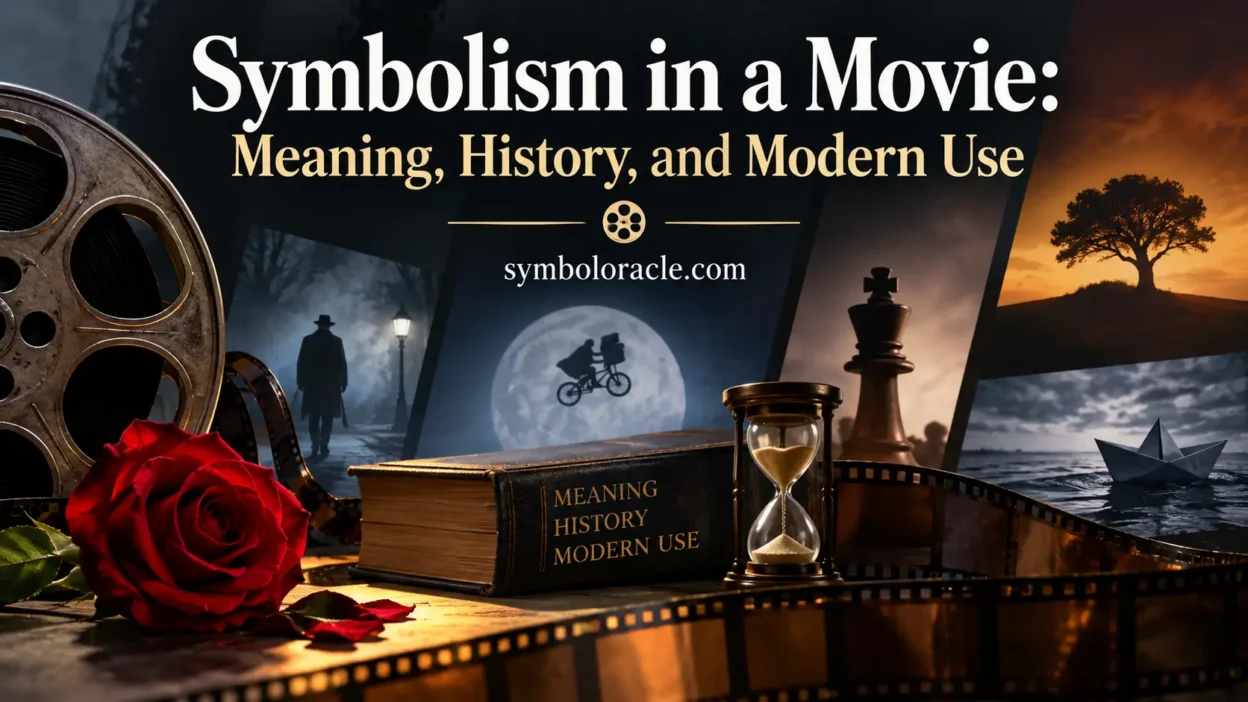
Symbolism in a movie helps filmmakers communicate ideas without explaining everything through dialogue. A red dress, empty chair, broken mirror, open door, repeated song, or changing landscape can suggest emotions, conflict, identity, loss, hope, or social pressure.
Movie symbols matter because audiences naturally look for meaning in visual details. Filmmakers can use familiar objects and images to make a story feel more personal while leaving room for interpretation. The same symbol can also change meaning depending on the character, scene, culture, and story.
In American film culture, symbolic storytelling appears in dramas, horror movies, science fiction, comedies, animation, thrillers, and even advertisements. Some symbols have long cultural histories, while others gain meaning from the specific movie in which they appear.
Quick Answer
Symbolism in a movie commonly represents an idea, emotion, conflict, or character trait through an object, color, action, setting, image, or repeated detail. Historically, filmmakers developed these techniques from visual art, theater, literature, photography, and film language, while modern movies use symbols to add meaning without stating everything directly.
TL;DR
- Movie symbols turn ordinary images into meaningful story details.
- Colors often suggest mood, identity, danger, love, or change.
- Repeated objects can reveal character development or hidden conflict.
- American audiences interpret symbols through culture, genre, and personal experience.
- A symbol’s meaning can change as a movie’s story develops.
- Modern films use visual, musical, digital, and environmental symbols.
What Is a Symbol in a Movie?
A movie symbol is a visible, audible, or repeated story element that points toward an idea beyond its literal purpose.
For example, a character may repeatedly look through a window. The window is still a physical object, but it may also represent separation, freedom, curiosity, or a desire to escape.
Symbols can take many forms:
- Objects such as keys, mirrors, photographs, clocks, or rings
- Colors such as red, white, black, or blue
- Animals and plants
- Weather and natural landscapes
- Clothing and personal possessions
- Repeated gestures or actions
- Music and specific sounds
- Architecture and rooms
- Lighting and shadows
- Names, numbers, or written signs
A symbol does not always have one fixed definition. Its meaning depends on context.
A key might represent freedom in one film and secrecy in another. A mirror might suggest self-knowledge in one story but fractured identity in another.
How Filmmakers Create Symbolic Meaning
Filmmakers usually create symbolism through repetition, contrast, placement, transformation, and context.
Repetition makes viewers notice an element. If a particular flower appears whenever a character remembers someone who died, the flower gradually becomes connected with memory and grief.
Contrast places opposing images together. A bright, cheerful room may appear during an emotionally painful scene, creating tension between appearance and reality.
Placement can also matter. A character standing alone beneath a huge building may appear powerless, even if the dialogue never says so.
Transformation gives a symbol a changing role. A character may begin a story carrying a locked box and finish by opening it. The physical action can reflect emotional change.
These techniques work because film communicates through images as well as words.
Ancient Roots Behind Movie Symbolism
Filmmaking is relatively modern, but symbolic storytelling is much older.
Ancient myths, religious art, ceremonies, theater, paintings, and literature used objects and images to communicate ideas. Animals could represent particular qualities, colors could carry cultural associations, and journeys could represent personal transformation.
European painting later developed extensive visual traditions in which objects carried recognizable meanings. Literature also used recurring images, metaphors, and motifs to connect physical details with abstract ideas.
When cinema developed in the late 19th and early 20th centuries, filmmakers inherited many of these storytelling methods.
Film added something new: movement.
A symbol could appear, disappear, return, change, or interact with characters over time. Editing also allowed filmmakers to place separate images together so that viewers created a connection between them.
How Film History Changed Symbolic Storytelling
Early filmmakers relied heavily on visual communication because silent movies had limited spoken dialogue. Gestures, facial expressions, settings, props, costumes, and editing therefore carried major storytelling responsibilities.
As sound became standard, symbolism did not disappear. Instead, filmmakers gained another layer of communication.
Music could become associated with a character. A particular sound could signal danger. Silence could represent emotional distance. A repeated line could acquire a different meaning after the audience learned more about the story.
Montage also became important. When filmmakers place two images next to each other, viewers may connect them even when neither image directly explains the other.
Modern directors continue to use this principle. A single image can sometimes communicate what several lines of dialogue would struggle to express.
What Movie Symbols Commonly Represent
Movie symbols often represent broad human experiences.
| Symbolic Element | Common Meaning in the USA | Common Associations | Important Context |
|---|---|---|---|
| Mirror | Identity or self-reflection | Appearance, truth, divided self | Meaning depends on the character |
| Door | Choice or transition | Opportunity, escape, secrecy | Open and closed doors can differ |
| Red | Strong emotion or danger | Love, anger, violence, desire | Cultural and genre context matters |
| Clock | Time or pressure | Aging, deadlines, mortality | Often important in thrillers |
| Water | Change or emotional movement | Cleansing, danger, rebirth | Can carry opposite meanings |
| Photograph | Memory or connection | Family, loss, history | Often linked to personal identity |
These are common associations, not universal rules. A skilled filmmaker may deliberately reverse them.
Color as a Symbolic Language
Color is one of the easiest symbolic tools for audiences to notice.
Red may suggest romance, anger, danger, blood, desire, celebration, or power. White can suggest innocence or cleanliness in some American contexts, while black may suggest mourning, authority, elegance, fear, or secrecy.
Blue often appears in scenes involving calmness, isolation, sadness, or distance, although filmmakers can use it in completely different ways.
Color symbolism becomes especially effective when a movie establishes its own visual pattern.
For example, if a character normally wears neutral clothing and suddenly appears in bright red during an important decision, the color may signal a change in identity or emotional state.
The important point is that color does not have one automatic meaning. The story teaches viewers how to read it.
Objects Can Reveal Character Without Dialogue
Props often carry symbolic weight because people attach memories and identity to possessions.
A wedding ring may represent commitment, but it can also represent grief after a relationship ends. A childhood toy may represent innocence, family, or unresolved trauma. A suitcase can suggest travel, escape, or a desire for a new life.
The object becomes more meaningful when the camera repeatedly returns to it.
Consider a photograph. At first, it may appear to be simple background decoration. Later, the audience may discover that the photograph contains an important person or event. Its meaning changes because the story has changed the viewer’s understanding.
This is one reason symbolic objects can make movies feel layered without requiring lengthy explanations.
Nature and Weather as Movie Symbols
Filmmakers frequently use nature to reinforce a character’s emotional or narrative situation.
Rain may accompany sadness, uncertainty, renewal, or isolation. Snow can suggest silence, beauty, loneliness, or emotional coldness. Storms may create a visual parallel for conflict.
Sunlight can represent hope or exposure. Darkness can suggest fear or uncertainty, but it may also provide safety or privacy.
Nature does not automatically mirror human emotion. Instead, directors create connections through timing and repetition.
If clear skies appear after a character resolves a conflict, the audience may connect the weather with relief. If storms repeatedly appear before disasters, the storm becomes part of the movie’s warning system.
Mirrors, Windows, Doors, and Other Visual Motifs
Certain objects appear often in movies because they naturally create visual relationships.
A mirror can suggest self-examination, divided identity, vanity, deception, or a confrontation with reality.
A window can separate characters from the outside world. It can also represent freedom, observation, longing, or emotional distance.
A door often represents a decision or boundary. Walking through one may signal a transition, while refusing to open one can suggest fear or secrecy.
A road can represent movement, escape, independence, uncertainty, or personal growth.
These interpretations are useful starting points, but viewers should examine how each movie uses the object rather than assuming a fixed definition.
Symbolism and Character Development
Symbols can track a character’s transformation.
Imagine a character who begins a movie wearing a formal uniform because they follow strict rules. Later, they remove the uniform during a major personal decision. The clothing change may communicate independence without a speech about freedom.
The same technique can apply to hairstyles, homes, vehicles, photographs, jewelry, or personal spaces.
A character’s bedroom may become increasingly organized as their life becomes more controlled. Alternatively, a once-crowded room may become empty after a major loss.
These details allow physical environments to reflect changes in identity.
Religious and Mythological Symbols in Film
Movies frequently borrow images from religious traditions and mythology.
Crosses, halos, angels, demons, serpents, doves, crowns, fire, water, gardens, and journeys can carry associations shaped by centuries of religious storytelling.
Greek, Norse, Egyptian, Christian, Jewish, Hindu, Buddhist, and other traditions have also influenced visual storytelling in different films and cultures.
However, filmmakers sometimes adapt these symbols rather than preserving their traditional meanings.
A serpent may be connected with temptation in one story but healing or transformation in another. A crown may represent leadership, inherited power, or corruption.
Understanding the original tradition can help viewers recognize an intentional reference, but the movie’s own context remains important.
What Symbols Mean in American Movie Culture
American audiences encounter symbolic storytelling across mainstream cinema, independent films, television, streaming series, animation, and advertising.
Certain themes appear frequently because they connect with familiar American experiences: independence, family, ambition, individual identity, freedom, success, loss, reinvention, and belonging.
For example, the open road can carry associations with independence and personal freedom. The suburban house can represent security, family life, social expectations, or the appearance of perfection.
American films also frequently use national imagery, including flags, small towns, highways, school settings, sports, diners, military objects, and urban skylines. These images can represent belonging, nostalgia, conflict, class, or changing ideas about the country.
Their meanings depend heavily on the story.
Emotional and Psychological Meaning
Symbols can influence viewers because they connect abstract ideas with concrete experiences.
A character may never say, “I am afraid of losing my family.” Instead, the film may repeatedly show an empty place at the dinner table.
That image gives emotional weight to the absence.
Psychological symbolism can also involve memory. An object from childhood may trigger a character’s past. A familiar song may return during moments of emotional stress. A particular location may become associated with guilt or comfort.
Viewers also bring their own experiences to these symbols. Someone who has lost a loved one may interpret a photograph differently from someone who has not experienced that kind of loss.
This makes film interpretation partly personal.
Why the Same Symbol Can Have Opposite Meanings
One of the most important rules of movie symbolism is that context can reverse meaning.
A rose can suggest love, but a dying rose can suggest the end of a relationship. A wedding dress can represent commitment, but in a thriller it might represent fear or entrapment.
A knife may symbolize violence, but it could also represent survival or protection.
Even darkness can have contrasting meanings. A dark room may feel threatening in one scene and comforting in another.
Therefore, viewers should ask three questions:
- When does the symbol appear?
- What happens around it?
- Does its meaning change by the end?
These questions are often more useful than searching for a universal symbolic dictionary.
Symbolism in Horror, Romance, Drama, and Science Fiction
Different movie genres tend to favor different symbolic techniques.
Horror often uses mirrors, shadows, dolls, houses, blood, religious objects, and distorted spaces to represent fear, trauma, guilt, or loss of control.
Romance frequently uses flowers, letters, photographs, jewelry, songs, seasons, and locations to represent intimacy, separation, commitment, or memory.
Drama often relies on homes, family objects, clothing, food, photographs, and everyday routines because ordinary details can reveal personal conflict.
Science fiction commonly uses technology, artificial environments, machines, planets, screens, and futuristic architecture to explore identity, humanity, control, isolation, or social change.
Comedy can also use symbolism, often by exaggerating objects or situations until they reveal something about social behavior.
Genre expectations influence how audiences interpret an image before the story provides additional information.
Symbolism in Tattoos, Fashion, and Pop Culture
Movie symbols often leave the screen and enter everyday culture.
Fans may choose tattoos based on objects, animals, symbols, or images associated with favorite films. Others may wear clothing inspired by a character because the design represents an identity, memory, or community.
Social media has increased this process. A visual symbol from a movie can become a recognizable reference that fans understand without explanation.
However, the meaning can shift outside the original story.
A symbol that represented grief in a film might become a sign of friendship among fans. A fictional emblem might become a fashion design with little connection to its original narrative.
Once an image enters popular culture, audiences can give it new meanings.
Common Misunderstandings About Movie Symbols
Not every unusual object is a symbol.
Filmmakers also include ordinary details because real environments contain ordinary details. A cup on a table may simply be a cup.
Another common mistake is assuming that every color has a universal meaning. Film symbolism works through context, and directors sometimes intentionally challenge familiar associations.
Viewers can also overinterpret a movie by assigning meaning to details the filmmaker never intended to emphasize.
A useful approach is to look for patterns. If an image appears repeatedly, changes at important moments, receives unusual camera attention, or connects with the story’s central conflict, it is more likely to carry symbolic significance.
How Movie Symbolism Has Changed in the Digital Age
Modern filmmaking has expanded the symbolic vocabulary available to directors.
Smartphones, computer screens, social media profiles, surveillance cameras, video calls, digital photographs, location data, and artificial intelligence can now function as story symbols.
A deleted message may represent lost communication. A cracked phone screen may suggest emotional disorder or isolation. A character constantly checking notifications may reflect anxiety or dependence on social approval.
Digital spaces can also symbolize identity. An online profile may show how a character wants others to see them rather than who they really are.
These symbols feel especially relevant to contemporary American audiences because digital technology is deeply integrated into everyday life.
How to Interpret Symbolism in a Movie
You do not need specialized film training to analyze symbols.
Start by identifying something that receives unusual attention. Then watch for repetition and change.
Ask:
- Does the object appear more than once?
- Does it appear during important scenes?
- Does its meaning change?
- Does a character react strongly to it?
- Does the camera emphasize it?
- Does it contrast with the dialogue?
- Does the color or setting change around it?
- Does the ending give the image new meaning?
Then consider the larger story.
A symbol is strongest when it connects to a character’s goals, conflict, relationships, or transformation.
The best interpretation usually comes from several pieces of evidence rather than one isolated image.
Frequently Asked Questions
What does a symbol in a movie usually mean?
A movie symbol usually represents an idea beyond its literal function. It may communicate emotions, identity, conflict, memory, social issues, relationships, or character development.
How do I know if something is a symbol in a movie?
Look for repetition, unusual visual emphasis, strong connections to a character, or changes in meaning. If an object appears during several important moments, it may be functioning as a recurring motif.
Can one movie symbol have more than one meaning?
Yes. A symbol can represent different ideas at different points in the same story. Its meaning may change as characters gain knowledge or experience major events.
Why are colors important in movies?
Colors can influence mood and help distinguish characters, locations, or emotional states. However, colors do not have universal meanings, so the movie’s visual pattern and story should guide interpretation.
Are movie symbols always intentional?
No. Some interpretations may be deliberately created by filmmakers, while others come from viewers noticing patterns or cultural associations. A strong interpretation should be supported by what actually happens in the movie.
Why do horror movies use so many symbols?
Horror depends heavily on atmosphere, anticipation, and visual suggestion. Objects such as mirrors, doors, religious items, dolls, and shadows can create fear while also representing psychological or narrative themes.
Can movie symbolism influence real-life culture?
Yes. Memorable film images can become recognizable references in fashion, tattoos, art, social media, and fan communities. Once an image becomes popular, people may give it meanings that differ from its original role in the movie.
Conclusion
Movie symbols allow filmmakers to communicate ideas through images, sounds, objects, colors, settings, and repeated actions. Their meanings are rarely fixed; context, character development, genre, and cultural background all influence how audiences understand them.
The most useful way to interpret symbolism in a movie is to look for patterns instead of assuming that every object has a universal definition. When a visual detail returns at important moments or changes alongside a character, it may reveal an idea that the dialogue leaves unstated.
Good symbolic storytelling does not require the audience to find one perfect answer. It gives viewers enough evidence to make a thoughtful connection between what they see and what the story is trying to express.


