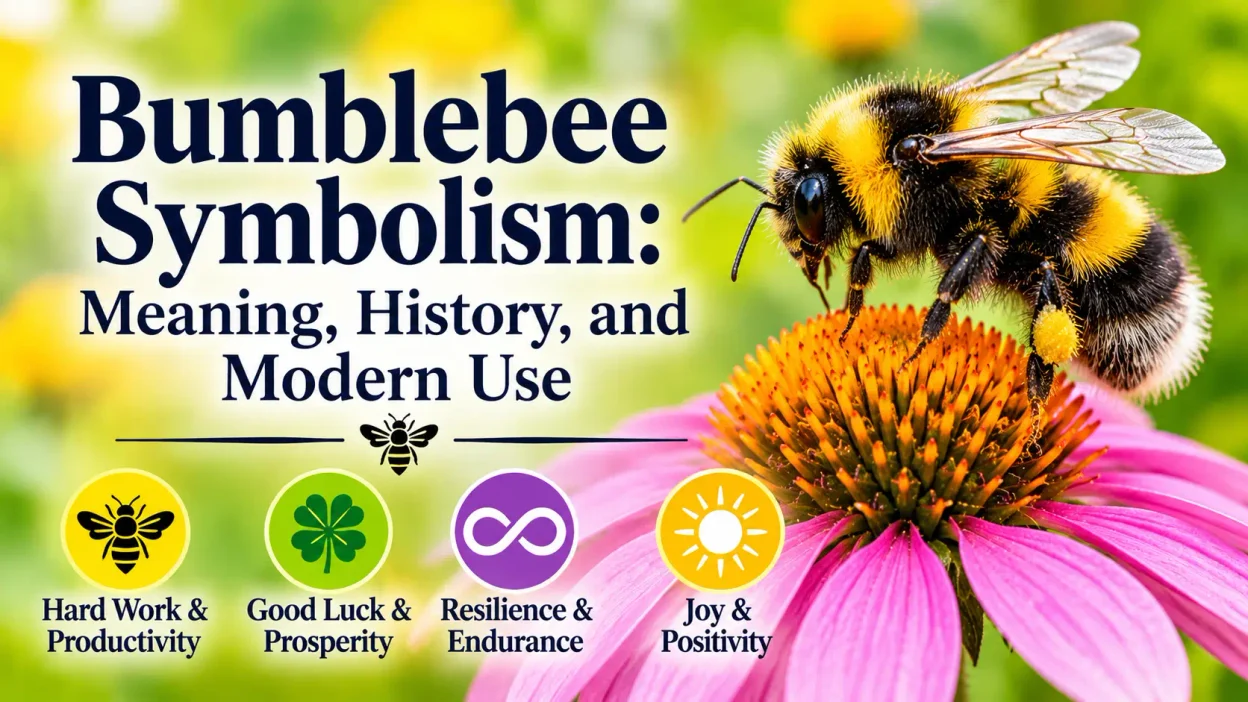
Bumblebee symbolism is commonly associated with hard work, cooperation, resilience, and the importance of community. Recognized by its round, fuzzy body and distinctive black-and-yellow markings, the bumblebee is more than a familiar garden visitor. Its behavior offers a natural example of how individual effort can support a larger group, while its role in pollination connects it with growth and the renewal of plant life.
In the United States, bumblebees are familiar sights in gardens, parks, meadows, and flowering landscapes. They are also popular in illustrations, jewelry, tattoos, clothing, and home decorations. Their friendly appearance makes them appealing, but their ecological importance gives them a more substantial meaning.
Unlike symbols with fixed religious definitions, the bumblebee’s significance develops from its natural behavior and the qualities people associate with it. Its persistent search for nectar suggests determination, its colony structure highlights cooperation, and its contribution to pollination connects it with fertility and new beginnings. These characteristics explain why the bumblebee has become an appealing symbol of purposeful effort and everyday progress.
Quick Answer
Bumblebee symbolism commonly represents hard work, cooperation, perseverance, community, and personal growth in modern American culture. Historically, bees have also been associated with fertility, abundance, wisdom, and organized social life, although many of these older traditions refer to bees generally rather than bumblebees specifically.
TL;DR
- Bumblebees symbolize dedication, teamwork, and perseverance.
- Their colonies represent cooperation and shared responsibility.
- Pollination connects them with fertility, growth, and renewal.
- Their resilience reflects persistence through changing conditions.
- Modern designs use bumblebees to express positivity and environmental awareness.
- Their ecological role makes them symbols of nature’s interconnectedness.
1. What Does a Bumblebee Look Like?
A bumblebee is a large, fuzzy-bodied insect belonging to the genus Bombus. It is recognized by its rounded shape, dense hair, and usually black-and-yellow coloring, although some species also have orange, white, or reddish markings.
Bumblebees are different from honeybees in several ways. They generally have rounder bodies, live in smaller colonies, and do not produce large stores of honey for human consumption. Most species establish seasonal colonies, although their queens survive winter and begin new colonies when conditions become suitable.
People commonly encounter bumblebees visiting flowers in gardens, parks, agricultural fields, and wild meadows. Their familiar appearance has made them popular in children’s illustrations, educational materials, garden decorations, and nature-inspired artwork.
The combination of a soft-looking body, bright markings, and constant movement gives the insect an interesting visual identity. It appears gentle and approachable, yet it is also a capable pollinator that plays an important role in maintaining healthy ecosystems.
2. The Core Symbolic Meanings of Bumblebees
Bumblebees carry several symbolic associations based on their behavior and ecological importance. Although interpretations differ between individuals and cultures, a few themes appear particularly often.
Hard work: Bumblebees spend much of their active time collecting nectar and pollen, making them natural representations of dedication.
Teamwork: Their colonies depend on different members performing different roles, illustrating cooperation and shared responsibility.
Resilience: Bumblebees continue functioning in changing weather and environmental conditions, suggesting persistence through difficulty.
Growth and renewal: Their pollination work supports plant reproduction, connecting them with fertility, new beginnings, and natural development.
Community: Their colony structure represents belonging and the benefits of contributing to something larger than oneself.
Purpose: Their repeated movement between flowers suggests focused effort and commitment to a practical goal.
These associations do not mean that every bumblebee encounter carries a special message. They are interpretations inspired by the insect’s observable characteristics and the role it plays in nature.
3. Hard Work and the Value of Consistent Effort
Hard work is probably the most recognizable symbolic association of the bumblebee.
During the warmer months, worker bumblebees visit flowers to collect nectar and pollen. Their activity supports the colony while also helping plants reproduce. A single bee may visit many flowers during its foraging trips, making repeated small efforts that contribute to a larger ecological process.
This behavior provides a useful comparison with everyday human life. Important achievements often depend less on one dramatic action than on consistent work performed over time.
The bumblebee can therefore represent:
- Staying committed to long-term goals.
- Completing small tasks with care.
- Maintaining discipline when progress feels slow.
- Taking responsibility for personal contributions.
- Valuing effort rather than immediate recognition.
For students, employees, business owners, and people developing new skills, the insect offers a familiar image of steady progress.
Its symbolism is not about working without rest. Bumblebees have natural periods of activity and inactivity. A more balanced interpretation recognizes the value of purposeful effort without treating exhaustion as a measure of success.
4. Teamwork, Cooperation, and Community
Bumblebees are social insects that live in colonies, although their colony structure differs from the highly developed systems of honeybees.
A typical bumblebee colony includes a queen, workers, and, later in the season, males and new queens. Workers help gather food, care for developing young, and maintain the nest.
This organization makes the bumblebee a useful representation of cooperation. Different individuals contribute in different ways, and the colony depends on their combined efforts.
In human symbolism, this can represent:
- Supporting family members.
- Working toward shared goals.
- Respecting different responsibilities.
- Contributing to a community.
- Understanding that individual actions affect others.
The meaning is especially relevant in workplaces, schools, volunteer groups, and families where successful outcomes depend on cooperation.
The bumblebee also offers a reminder that community does not require everyone to perform identical tasks. Different contributions can serve the same shared purpose.
5. Resilience and the Ability to Adapt
Bumblebees are known for their ability to function in relatively cool conditions compared with many other insects. Their large, hairy bodies help them retain heat, and they can use muscular activity to warm themselves before flying.
These characteristics contribute to their association with resilience.
The bumblebee does not depend entirely on ideal weather or one type of flower. Different species occupy a range of habitats, and their seasonal activity requires them to respond to changing environmental conditions.
Symbolically, this behavior can represent people who continue moving forward despite uncertainty.
For example, someone rebuilding a career after a setback might identify with the bumblebee’s persistence. A person adjusting to a new environment may connect with its ability to function under different conditions.
Its message is not that challenges should be ignored. Rather, resilience involves recognizing changing circumstances and adjusting behavior accordingly.
6. Pollination, Fertility, and New Beginnings
One of the most important reasons bumblebees matter is their contribution to pollination.
As they visit flowers for nectar and pollen, pollen grains attach to their bodies and can be transferred between flowers. This helps many plants reproduce and supports the development of seeds and fruits.
Bumblebees are particularly effective pollinators for certain plants because of their size, behavior, and ability to perform a technique known as buzz pollination. During this process, they vibrate their flight muscles while holding onto a flower, releasing pollen from flowers that respond to this movement.
This natural role connects the bumblebee with several symbolic ideas:
- Fertility and reproduction.
- New beginnings.
- Healthy development.
- Abundance in nature.
- The continuation of life.
For gardeners, the bumblebee may represent a thriving garden and a healthy growing environment. In personal symbolism, it can represent the beginning of a project, relationship, or period of development.
The connection with fertility is primarily biological and metaphorical. It should not be confused with a universal religious belief.
7. Ancient Bee Symbolism and Historical Origins
Bees have appeared in human art, religion, mythology, and political imagery for thousands of years. However, many historical references concern bees generally, not the bumblebee species specifically.
In ancient Egypt, bee imagery was connected with royal authority and the organization of the state. The bee became an important emblem in the symbolism surrounding the Egyptian king and the political identity of Lower Egypt.
In ancient Greek traditions, bees were associated with honey, sacred offerings, and certain religious practices. Honey was valued as food and as an offering, giving bees connections with abundance and the sacred.
In ancient Mediterranean cultures, bees also appeared in stories about divine nourishment, prophecy, and the relationship between nature and religious life.
These traditions helped establish broader associations between bees and productivity, fertility, order, and abundance.
It would be inaccurate, however, to claim that ancient Egyptians or Greeks specifically assigned all these meanings to modern bumblebee species. The historical record supports the importance of bees as a wider category of insect imagery.
8. Bumblebee Symbolism in the United States
In modern American culture, bumblebees are closely associated with gardens, spring, environmental awareness, and the natural world.
Their familiar appearance makes them easy to recognize, even among people who know little about insect biology. They frequently appear in garden signs, educational illustrations, children’s books, nature-themed clothing, and decorative products.
The bumblebee also has an important place in conversations about pollinator conservation. American gardeners and environmental organizations often encourage people to plant native flowers, reduce unnecessary pesticide use, and protect habitats that support bees.
This gives the insect a modern cultural meaning beyond productivity. It can represent environmental responsibility and the relationship between everyday choices and the health of local ecosystems.
For some Americans, a bumblebee design also communicates a love of gardening or a preference for a nature-centered lifestyle.
Its image is generally welcoming and recognizable, making it suitable for public education, community gardens, and environmental campaigns.
9. Yellow and Black: The Meaning of Bumblebee Colors
The bumblebee’s black-and-yellow appearance contributes to its symbolic identity. These contrasting colors are among the easiest ways to recognize the insect and are frequently used in illustrations and decorative designs.
Yellow is commonly associated with sunshine, optimism, warmth, happiness, and mental energy in modern American color symbolism. Its bright appearance makes it useful for communicating friendliness and positivity.
Black carries a different range of associations, including protection, authority, mystery, seriousness, and strength.
Together, the two colors create an interesting visual contrast:
- Yellow: Happiness, optimism, warmth, and vitality.
- Black: Protection, confidence, strength, and boundaries.
- Black and yellow together: Energy, determination, visibility, and balance.
These associations are cultural interpretations rather than fixed psychological rules. The insect’s actual coloration serves biological functions, including warning potential predators that it may sting.
In decorative art, however, the combination often creates a cheerful and energetic appearance. It is one reason bumblebees work well in garden illustrations, stationery, clothing, and children’s designs.
10. Cross-Cultural Meanings and Religious Connections
Bee symbolism appears in several cultural and religious traditions, although the meanings differ depending on the community and historical period.
In ancient Greek traditions, bees were connected with sacred practices, honey offerings, and certain religious figures. Their association with nourishment and organized activity contributed to their symbolic importance.
In Hindu traditions, bees and honey can appear in religious poetry and imagery associated with nature, devotion, and divine qualities. The specific meaning depends on the text or religious context.
In Christian symbolism, bees have sometimes represented diligence, order, and cooperation. Their organized social behavior also made them useful metaphors for collective religious life and shared responsibility.
In some European folklore, bees were traditionally treated with respect because of their connection with household prosperity, agricultural life, and honey production. Certain communities maintained customs involving communication with bees during significant family events, although these practices varied by region.
It is important to distinguish these broader bee traditions from bumblebee-specific beliefs. The bumblebee may share some modern interpretations with other bees, but it does not have one universal spiritual meaning across religions.
11. Emotional and Psychological Meaning of Bumblebees
Bumblebees often create a combination of comfort, curiosity, and admiration.
Their round bodies and fuzzy appearance can make them seem approachable. Their movement between flowers creates an impression of activity and purpose, while their ecological role gives them a positive connection with healthy natural environments.
Different people may associate them with different emotional experiences.
Comfort and familiarity: Someone who grew up around gardens may connect bumblebees with childhood memories, spring afternoons, and familiar outdoor spaces.
Motivation: Their repeated foraging activity can remind people to remain consistent with personal goals.
Belonging: Their social colonies can represent family connections and the importance of contributing to a group.
Personal growth: Their connection with pollination and plant reproduction can provide a metaphor for developing new opportunities.
Confidence: Their ability to function despite their small size can represent the idea that physical size does not determine a person’s capabilities.
These interpretations are subjective. A person who fears stinging insects may experience a bumblebee differently from someone who enjoys gardening. Personal experience plays an important role in determining emotional symbolism.
12. What Does It Mean When a Bumblebee Visits You?
A bumblebee visiting your garden, balcony, or outdoor space usually has a practical explanation: it is searching for nectar or pollen.
However, some people attach personal meaning to these encounters.
A bumblebee visiting flowers may remind someone to appreciate small opportunities. Its persistent movement can inspire thoughts about determination, while its presence in a garden may bring attention to growth and the changing seasons.
Some common personal interpretations include:
- A reminder to keep working toward a goal.
- Encouragement to remain patient during change.
- A connection with nature and the present moment.
- A reminder to support family and community.
- An invitation to notice opportunities for personal growth.
There is no reliable basis for treating every bumblebee encounter as a supernatural message or prediction. The meaning can still be personally significant without requiring a supernatural explanation.
For example, someone beginning a new chapter in life may choose to interpret a bumblebee sighting as a reminder to remain persistent and open to change.
13. Bumblebee Symbolism in Tattoos, Jewelry, and Fashion
Bumblebees have become popular subjects in nature-inspired artwork and personal designs. Their recognizable shape and contrasting colors make them suitable for both detailed illustrations and simple decorative patterns.
<escape>Bumblebee tattoos:</escape> A bumblebee tattoo can represent hard work, perseverance, community, independence, or personal transformation. Some people choose it to commemorate a difficult period they successfully overcame.
Jewelry: Bumblebee necklaces, earrings, rings, and bracelets can express an appreciation for nature or serve as reminders of personal goals. Small bee pendants are also popular as thoughtful gifts.
Fashion: Bumblebee designs appear on shirts, dresses, scarves, bags, and accessories. The black-and-yellow pattern creates a recognizable appearance that can communicate energy and a playful personality.
Home decor: Bumblebee illustrations are common in garden-themed kitchens, outdoor decorations, wall art, cushions, and decorative signs. They can create a cheerful atmosphere and reflect an interest in nature.
Social media: Bumblebee images and illustrations are often used in posts about gardening, spring, environmental awareness, motivation, and positive personal experiences.
The meaning depends on the design and the individual. A small bee tattoo may represent a personal achievement, while a decorative illustration may simply express appreciation for pollinators.
14. Bumblebees, Environmental Awareness, and Conservation
Modern bumblebee symbolism has increasingly become connected with environmental responsibility.
Bumblebees are important pollinators for many wild plants and agricultural crops. Their activity supports plant reproduction and contributes to healthy ecosystems.
However, many bumblebee species face environmental pressures, including habitat loss, pesticide exposure, disease, climate change, and reduced availability of suitable flowers.
In the United States, conservation efforts often focus on protecting native plants, preserving nesting areas, and creating habitats that provide food throughout the growing season.
Gardeners can support bumblebees by:
- Planting native flowering species.
- Choosing flowers with different blooming periods.
- Reducing unnecessary pesticide use.
- Leaving suitable areas for natural nesting.
- Providing diverse habitats rather than relying on one type of flower.
The rusty patched bumblebee, for example, is federally listed as endangered in the United States. Its decline highlights the challenges facing some native pollinators.
This environmental context adds another layer to the insect’s modern meaning. The bumblebee can represent the responsibility to protect the natural systems that support human food production and biodiversity.
Its presence is not simply a decorative sign of spring. It can also remind communities that small species have important ecological roles.
15. Common Misunderstandings About Bumblebee Symbolism
Although bumblebees are widely viewed positively, several misunderstandings can develop when their symbolism is separated from biological and historical facts.
All bees represent the same thing. Honeybees, bumblebees, and solitary bees have different behaviors and ecological roles. Their symbolic meanings may overlap, but their natural histories are not identical.
A bumblebee always represents good luck. Some individuals associate bee encounters with positive opportunities or good fortune, but there is no universal historical tradition establishing this meaning.
Bumblebees symbolize endless hard work. Their activity represents purposeful effort, but healthy interpretations should not promote exhaustion or constant productivity.
Bumblebees are completely harmless. They are generally not aggressive when left alone, but females can sting when threatened. Their friendly appearance should not encourage people to handle them unnecessarily.
Every bumblebee sighting is a spiritual sign. Natural behavior usually explains why the insect appears in a particular location. Personal interpretations are meaningful to individuals but should not be presented as established facts.
Separating biology, cultural tradition, and personal belief makes the symbolism more accurate and respectful.
16. How Bumblebee Symbolism Has Changed Over Time
The bumblebee’s modern symbolic identity has developed from broader historical associations with bees and its own recognizable ecological behavior.
In ancient cultures, bees were connected with nourishment, fertility, religious practices, royal authority, and organized communities. These associations largely developed around honeybees and other familiar bee species.
As natural history became more widely studied, the bumblebee gained recognition for its distinctive behavior, social colonies, and pollination abilities.
In modern American culture, it has become a familiar symbol of gardening, cooperation, perseverance, and environmental awareness.
Its image has also entered popular design. Bumblebee illustrations appear in children’s products, fashion, tattoos, household decorations, and conservation campaigns.
One important change is the growing emphasis on environmental responsibility. While older interpretations often focused on productivity and abundance, modern uses increasingly recognize the importance of protecting pollinators and their habitats.
The bumblebee now represents both individual qualities and a larger ecological relationship: small actions can contribute to the health of an entire community.
Frequently Asked Questions
1. What does a bumblebee symbolize spiritually?
A bumblebee can represent perseverance, cooperation, personal growth, and connection with nature in individual spiritual interpretations. These meanings are personal rather than part of one universally recognized religious tradition.
2. Is seeing a bumblebee a sign of good luck?
Some people interpret a bumblebee encounter as a positive reminder of opportunity, progress, or abundance. However, there is no established evidence that seeing one predicts future events.
3. What does a bumblebee tattoo symbolize?
A bumblebee tattoo commonly represents hard work, resilience, teamwork, and personal development. It can also honor a family connection, a meaningful life experience, or an appreciation for nature.
4. What does a bumblebee symbolize in love?
In personal symbolism, a bumblebee can represent loyalty, cooperation, and the effort required to maintain a healthy relationship. Its connection with community also makes it a suitable symbol for shared responsibility and lasting companionship.
5. What is the difference between bumblebee and honeybee symbolism?
Bumblebees are particularly associated with resilience, adaptability, and pollination, while honeybees have stronger historical associations with honey production, abundance, and organized social life. Many modern interpretations overlap because both insects contribute to pollination.
6. What does a bumblebee represent in dreams?
A bumblebee in a dream may personally suggest productivity, cooperation, motivation, or the need to focus on a goal. Its meaning depends on the dream’s setting and the emotions experienced rather than a universally accepted interpretation.
7. Why are bumblebees important to the environment?
Bumblebees pollinate many flowering plants and agricultural crops, supporting plant reproduction and biodiversity. Their presence can also draw attention to the importance of healthy habitats and responsible environmental practices.
Conclusion
Bumblebee symbolism represents hard work, cooperation, resilience, personal growth, and the importance of community. Its natural behavior provides clear reasons for these associations: it gathers resources, supports its colony, adapts to changing conditions, and helps plants reproduce.
In American culture, the bumblebee also represents gardening, environmental awareness, and an appreciation for the small creatures that keep ecosystems functioning. Its familiar black-and-yellow appearance has made it a popular choice for tattoos, jewelry, clothing, and home decorations.
Ultimately, the bumblebee offers a practical reminder that meaningful progress often comes from consistent effort, shared responsibility, and an ability to adapt when circumstances change. Even the smallest contribution can help something larger grow.