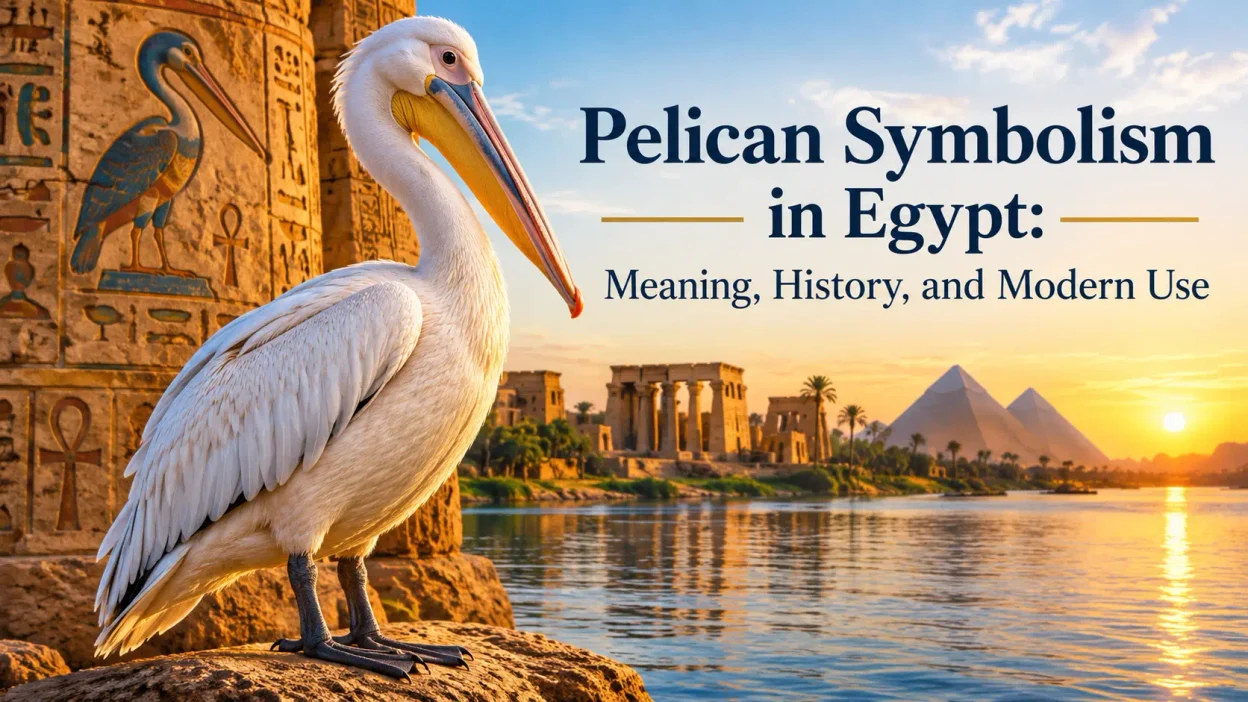
Pelican symbolism in Egypt connects an unusual bird with ideas about protection, family care, death, and renewal. Pelicans live in and around Egyptian wetlands, lakes, and the Nile region, where their large bills, expandable throat pouches, and communal behavior make them easy to recognize. Their place in Egypt’s natural environment is clear, but their symbolic meaning requires a closer look at ancient religious imagery, funerary traditions, and the stories later cultures attached to the bird.
Ancient Egyptians connected animals with gods, natural forces, and the cycles that sustained life. Birds could represent divine movement, protection, the soul, or the relationship between the earthly world and the afterlife. However, not every bird carried a fixed religious meaning, and a modern interpretation should not automatically be treated as an established ancient Egyptian belief.
The pelican is particularly interesting because later traditions, especially medieval Christian art, associated it with parental sacrifice and the nourishment of its young. These later meanings sometimes become mixed with claims about ancient Egypt. Separating documented Egyptian beliefs from later symbolism helps readers understand what the pelican can represent without confusing different periods and cultures.
Quick Answer
Pelican symbolism in Egypt can suggest parental care, protection, and renewal in modern interpretations, while the bird’s actual historical significance depends on the context in which it appears. Ancient Egyptian religious symbolism included many birds, but the familiar image of a pelican sacrificing itself to feed its young is chiefly associated with later Christian tradition rather than a firmly established ancient Egyptian doctrine.
TL;DR
- Pelicans are associated with wetlands, water, and Egypt’s natural environment.
- Modern interpretations connect the bird with family care and protection.
- Ancient Egyptian bird symbolism varied by species, deity, and religious context.
- The self-sacrificing pelican became prominent in medieval Christian symbolism.
- Water and renewal offer useful modern interpretations, not universal ancient meanings.
- Historical evidence matters when distinguishing Egyptian traditions from later religious stories.
1. What Does a Pelican Look Like, and Why Does It Matter?
A pelican is a large waterbird with a long bill and a distinctive throat pouch used to catch and carry fish. Depending on the species, it may have white, gray, or brown plumage, broad wings, and a heavy body adapted for life around lakes, lagoons, rivers, and coastal waters.
These features influence how people interpret the bird. Its size can suggest strength, while its pouch and feeding behavior invite associations with nourishment and care. Its relationship with water also makes it a natural symbol of wetlands, food sources, and the environments that sustain wildlife.
Pelicans are social birds that may gather in groups and feed cooperatively. Watching them care for their young or work together around water can encourage human observers to associate them with family life and community.
Those associations are reasonable interpretations of observable behavior. They do not, by themselves, establish that ancient Egyptians worshiped the pelican or assigned it a specific religious role.
2. Pelicans in Egypt’s Natural Environment
Egypt is often imagined as a country dominated by desert, but its wetlands and waterways support a wide variety of birdlife. The Nile Valley, Nile Delta, coastal lagoons, and other wetland habitats provide feeding and resting places for migratory and resident birds.
The great white pelican, also known as the eastern white pelican in some regional contexts, is associated with African and Eurasian wetlands. Pelicans can be encountered in Egypt, particularly in suitable aquatic habitats and during seasonal movements.
Their dependence on fish and healthy wetlands creates an ecological connection between the bird and water. In a landscape where the Nile has historically supported farming, settlement, transportation, and food production, water naturally carries associations with survival and continuity.
A modern writer may therefore interpret the pelican as a reminder of environmental balance and the importance of protecting waterways. This is a contemporary symbolic reading grounded in the bird’s habitat, rather than proof that ancient Egyptians used the pelican as a formal symbol of the Nile.
3. How Ancient Egyptians Understood Birds
Birds held important places in ancient Egyptian art, religion, writing, and burial practices. Their ability to fly between earth and sky made them useful images for thinking about movement, divine power, and the relationship between the living and the dead.
Different species could have distinct roles. The falcon was associated with Horus and kingship, while the ibis was linked with Thoth, a deity connected with knowledge, writing, and wisdom. The ba, an aspect of a person’s spiritual identity, was often depicted as a human-headed bird, emphasizing the relationship between the person and the afterlife.
These examples show why species identification matters. An image of a falcon, ibis, vulture, or other bird could carry a specific meaning based on established religious conventions. It would be inaccurate to transfer those meanings automatically to a pelican.
Ancient Egyptian symbolism was not a single dictionary in which every bird represented the same idea. Its meanings depended on religious narratives, visual details, inscriptions, and the setting in which an image appeared.
4. Was the Pelican a Sacred Bird in Ancient Egypt?
The pelican’s precise place in ancient Egyptian religion is less clearly established than that of several better-known sacred birds. There is no sound basis for claiming that all ancient Egyptians regarded pelicans as sacred or that the bird universally represented resurrection, sacrifice, or divine protection.
Ancient Egyptian artists and scribes observed a wide range of animals, and birds could appear in decorative scenes, hieroglyphic writing, and representations of the natural world. Yet an animal’s appearance in art does not necessarily mean it was worshiped or carried a formal religious identity.
The difficulty is that modern interpretations sometimes combine ancient Egyptian beliefs with Greek, Roman, medieval Christian, or contemporary spiritual ideas. Once these traditions are blended together, a meaning developed in one period can be mistakenly presented as an ancient Egyptian teaching.
A careful interpretation begins with what can be established: birds were significant in Egyptian religion, and the pelican belongs to Egypt’s natural environment. More specific claims about a dedicated pelican cult or a universal sacred meaning require direct historical evidence.
5. The Pelican in Egyptian Funerary Texts
Although the pelican’s religious role is less familiar than that of the ibis or falcon, it does appear in scholarly discussions of ancient Egyptian religious texts. Research on the bird’s place in Egyptian life has examined references in the Pyramid Texts, Coffin Texts, and Book of the Dead, as well as images associated with tombs and temples.
These materials belong to different periods and religious settings, so they should not be treated as one uniform collection of beliefs. The Pyramid Texts originated in royal funerary contexts during the Old Kingdom, while the Coffin Texts developed later and the Book of the Dead became a major source of funerary spells in subsequent periods.
The reported appearances of the pelican in these traditions suggest that the bird deserves more attention than a simple comparison with later Christian symbolism might imply. Some interpretations connect it with protection, magical power, resurrection, and the sun’s return. However, the meaning of an individual reference depends on its wording and context.
This distinction is important: ancient Egyptian religious literature could give animals roles that modern readers might not immediately recognize. Rather than assigning the pelican one universal meaning, it is more accurate to examine the particular text or image in which it appears.
6. Pelican Symbolism and the Egyptian Idea of Renewal
Renewal was an important theme in ancient Egyptian religion. The rising sun, the annual agricultural cycle, and beliefs about life after death all provided ways to understand continuity after periods of darkness, absence, or apparent destruction.
The story of Osiris, whose death and restoration were central to Egyptian religious thought, became closely connected with funerary beliefs and the hope of continued existence. The sun god’s daily journey also offered a model of repeated return, linking cosmic order with the rhythm of day and night.
Some modern discussions of the pelican’s Egyptian symbolism associate it with resurrection or solar renewal. Such interpretations should be presented cautiously, because a connection between the bird and these ideas does not mean every pelican image was intended to communicate resurrection.
The broader comparison remains useful. A bird that moves between water, land, and sky can invite reflection on movement and change, while its seasonal presence in wetlands can suggest recurring cycles of life. These are reasonable symbolic readings, especially for modern audiences, even when the specific historical meaning of an ancient depiction remains uncertain.
7. Protection and the Pelican’s Relationship With Its Young
Modern readers often connect pelicans with protection because the birds feed and care for their offspring. Their large bodies, close attention to their young, and feeding behavior can make them appealing images of parental responsibility.
In contemporary symbolism, this may translate into meanings such as family loyalty, guardianship, patience, and providing for others. A pelican caring for its chicks can serve as a visual reminder that nurturing requires time, resources, and sustained attention.
These associations are particularly understandable in the United States, where bird imagery frequently appears in family-themed artwork, nature illustrations, and personal designs. The pelican’s distinctive shape makes it recognizable even when depicted in a simplified style.
Nevertheless, the modern association between a pelican and parental protection should not automatically be described as an ancient Egyptian religious doctrine. It grows partly from observable bird behavior and partly from later cultural traditions.
The distinction does not diminish its usefulness. It simply allows readers to appreciate the pelican as a symbol of care without attributing every modern interpretation to the ancient Egyptians.
8. The Pelican’s Later Christian Meaning
One of the pelican’s best-known symbolic meanings developed in early Christian and medieval European traditions. In the story popularized through Christian bestiaries, a parent pelican wounds its own breast and uses its blood to revive or nourish its young.
The story is not an accurate description of pelican biology. It belongs to a tradition of moral and religious storytelling in which animal behavior was interpreted as a lesson about faith.
Christian writers connected the pelican’s supposed self-sacrifice with Jesus Christ’s sacrifice and the redemption of humanity. The bird consequently became an image of divine love, suffering, nourishment, and spiritual renewal.
Medieval artwork often shows a pelican bending its beak toward its breast, with chicks waiting in a nest beneath it. This image appeared in manuscripts, religious decorations, church furnishings, and other Christian settings.
The Egyptian connection is significant because medieval accounts sometimes described the pelican as a bird associated with the Nile or the Egyptian wilderness. But this does not mean the Christian story originated as a straightforward expression of ancient Egyptian religion. Its familiar theological meaning belongs primarily to the development of Christian literature and art.
9. Egyptian Symbolism Compared With Christian Pelican Imagery
The same bird can acquire different meanings in different cultural settings. Comparing Egyptian references with Christian imagery demonstrates why historical context matters.
In ancient Egyptian religious literature, the pelican appears in discussions of the natural and supernatural worlds, including funerary traditions. In medieval Christianity, the bird’s supposed self-wounding became an explicit analogy for Christ’s sacrifice.
These interpretations are not interchangeable. One must consider the original text, period, religious framework, and intended audience before deciding what a particular image means.
| Context | Common association | Historical qualification |
|---|---|---|
| Ancient Egyptian religious texts | Context-dependent religious or magical significance | Individual references require interpretation |
| Egyptian wetlands | Water, food, and ecological continuity | Grounded in the bird’s natural habitat |
| Medieval Christian art | Christ’s sacrifice and redemption | Developed through Christian bestiaries and theology |
| Modern American symbolism | Care, family, protection, and renewal | Often combines observation with later cultural traditions |
| Contemporary environmental imagery | Wetland conservation and wildlife | A modern interpretation rather than a universal ancient belief |
This comparison also explains why online descriptions of pelican symbolism sometimes appear contradictory. One account may focus on Egypt, another on Christianity, and another on parenting or personal growth. Each may be discussing a different stage in the bird’s symbolic history.
10. What Pelican Symbolism Means in the United States Today
For most Americans, the pelican is more immediately recognizable as a waterbird than as a symbol from ancient Egyptian religion. People may associate it with coastal landscapes, fishing, wildlife photography, and the protection of marine or wetland habitats.
The bird also appears in regional identity and public imagery. Louisiana, for example, is widely associated with the brown pelican, which appears on the state’s flag and seal. The pelican can therefore communicate local pride, resilience, and a connection to coastal life.
This American context differs from ancient Egyptian religious traditions. A person choosing a pelican design today might be expressing love for the ocean, a family connection, environmental concern, or admiration for the bird itself.
Some Americans interested in ancient Egypt may instead use the pelican as a starting point for exploring funerary texts and animal symbolism. In that setting, historical accuracy matters more than assigning the bird a generic spiritual meaning.
Modern symbolism is not fixed. It reflects the communities, stories, and personal experiences through which people encounter the animal.
11. The Emotional and Psychological Associations of the Pelican
A pelican can evoke calm, curiosity, affection, or admiration. Its association with water may remind people of peaceful coastal settings, while its feeding behavior can suggest care and responsibility.
The bird’s appearance also influences its emotional effect. Its large bill and pouch make it unusual, and its slow movements can create a different impression from the speed or aggression associated with birds of prey.
For someone who grew up near the coast, a pelican may represent home, family vacations, or a particular landscape. For someone interested in ancient history, it may instead prompt questions about religion, mortality, and the ways people used animals to understand their world.
There is no universal psychological meaning that applies to everyone who sees a pelican. Personal memories, cultural background, and the setting all influence interpretation.
A grounded reading therefore asks what the bird means in a particular context rather than assuming that seeing a pelican predicts a future event or carries a guaranteed spiritual message.
12. Pelican Symbolism in Tattoos, Jewelry, and Home Decor
Pelican designs can communicate several different ideas in contemporary American art and personal style. Their meaning usually depends on the accompanying imagery, the person’s experiences, and the reason for choosing the bird.
A pelican tattoo near waves or coastal plants may express a connection to the sea, a favorite place, or an interest in wildlife. A design showing an adult bird with its chicks may emphasize parenting, family commitment, or the responsibility of caring for others.
In jewelry, a small pelican pendant can serve as a personal reminder of a family relationship, a coastal home, or a meaningful trip. In home decor, pelican artwork often fits naturally into beach-inspired interiors, nature collections, and spaces designed around water and wildlife.
Someone choosing a design specifically for its Egyptian associations should look for accurate historical context. A general pelican illustration does not automatically represent an ancient Egyptian deity, funerary practice, or religious teaching.
Likewise, the Christian image of a pelican feeding its young through self-sacrifice has a distinct visual tradition. Recognizing that difference helps people choose designs that express the meaning they actually intend.
13. Misunderstandings About Pelican Symbolism in Egypt
The biggest misconception is that every familiar meaning associated with a pelican originated in ancient Egypt. The bird’s later Christian symbolism is well documented, but its association with Christ’s sacrifice developed within a different religious tradition.
Another misconception is that all ancient Egyptian birds symbolized the soul or resurrection. Egyptian religious art used multiple species in distinct ways, and the human-headed ba-bird, for example, belonged to a specific understanding of the deceased’s spiritual identity. It should not be confused with a pelican simply because both are birds.
It is also misleading to claim that the pelican always represents protection, abundance, or good fortune. These meanings may work as modern personal interpretations, but they are not universal rules shared by every culture.
Finally, the pelican’s association with renewal should not be used to claim that an actual bird sighting guarantees spiritual transformation or predicts a specific event. Symbolism can help people reflect on their experiences, but it does not establish supernatural facts.
The strongest interpretation distinguishes documented history from later tradition and personal meaning. This approach respects both ancient Egyptian religion and the cultures that subsequently adopted the pelican as a religious image.
14. How Pelican Symbolism Has Changed Over Time
The pelican’s symbolic history illustrates how a familiar animal can acquire different meanings as people reinterpret it. In Egypt, the bird existed within a natural landscape that also shaped religious imagination. References to it in ancient religious texts suggest a historical role worth investigating, although that role should be understood through individual passages rather than broad assumptions.
Later Christian traditions transformed the pelican into a recognizable image of sacrifice and redemption. The story of the parent bird giving its blood to revive its young gave Christian writers a way to explain theological ideas through an animal narrative.
In modern America, the bird’s meaning has broadened further. People may connect it with family care, coastal identity, environmental protection, or personal memories. Some also explore its Egyptian and Christian histories as part of a wider interest in symbolism.
These layers can coexist, but they should not be collapsed into one timeless definition. A historical religious symbol, a medieval moral story, and a contemporary tattoo can all feature the same bird while communicating different ideas.
Understanding that evolution makes the pelican more interesting, not less. It reveals how symbolism develops through observation, storytelling, religious interpretation, and changing cultural needs.
Frequently Asked Questions
What does the pelican symbolize in ancient Egypt?
The pelican appears in discussions of ancient Egyptian religious texts, including funerary literature, although its exact significance depends on the passage and context. Claims about its meaning should be distinguished from the better-established religious roles of birds such as the ibis and falcon.
Did ancient Egyptians believe the pelican represented resurrection?
Some scholarly interpretations connect the pelican with resurrection and solar renewal in ancient Egyptian sources. However, it would be inaccurate to claim that every pelican image carried this meaning or that the bird had one universally accepted religious role.
Why is the pelican associated with sacrifice?
The association is chiefly known from Christian bestiaries, which described a parent pelican supposedly feeding its young with its own blood. Christian writers interpreted this story as an image of Christ’s sacrifice and redemption, not as an accurate account of bird behavior.
What does a pelican symbolize in modern American culture?
In the United States, pelicans can represent coastal life, wildlife conservation, family care, and regional identity. Their meaning varies according to personal experience and context, including whether the bird appears in nature art, a state emblem, or a personal design.
Is a pelican a symbol of protection?
A pelican caring for its young can reasonably symbolize protection, nourishment, and parental responsibility. These associations are especially common in modern personal interpretations, but they should not automatically be attributed to a specific ancient Egyptian religious belief.
What does a pelican tattoo mean?
A pelican tattoo may express family devotion, a connection to the coast, environmental awareness, or interest in religious symbolism. A design depicting the bird feeding its young may carry Christian associations with sacrifice, while an Egyptian-inspired design requires separate historical context.
Is seeing a pelican considered a spiritual sign?
Some people interpret encounters with wildlife as personal reminders of care, patience, or renewal, but there is no established evidence that seeing a pelican predicts a particular event. Its significance is best understood through the observer’s beliefs, memories, and circumstances.
Conclusion
Pelican symbolism in Egypt brings together the bird’s natural place in Egyptian wetlands, its appearance in ancient religious discussions, and the later traditions that gave it additional meanings. Its historical significance should be approached with care, particularly when comparing Egyptian funerary literature with medieval Christian stories of sacrifice and redemption.
For modern American readers, the pelican can represent family care, environmental connection, protection, or renewal. These interpretations can be meaningful without being presented as universal ancient beliefs.
The pelican’s story shows how one animal can carry different meanings across time and culture. Understanding those differences allows us to appreciate both the historical record and the personal meanings people continue to find in the natural world.


