
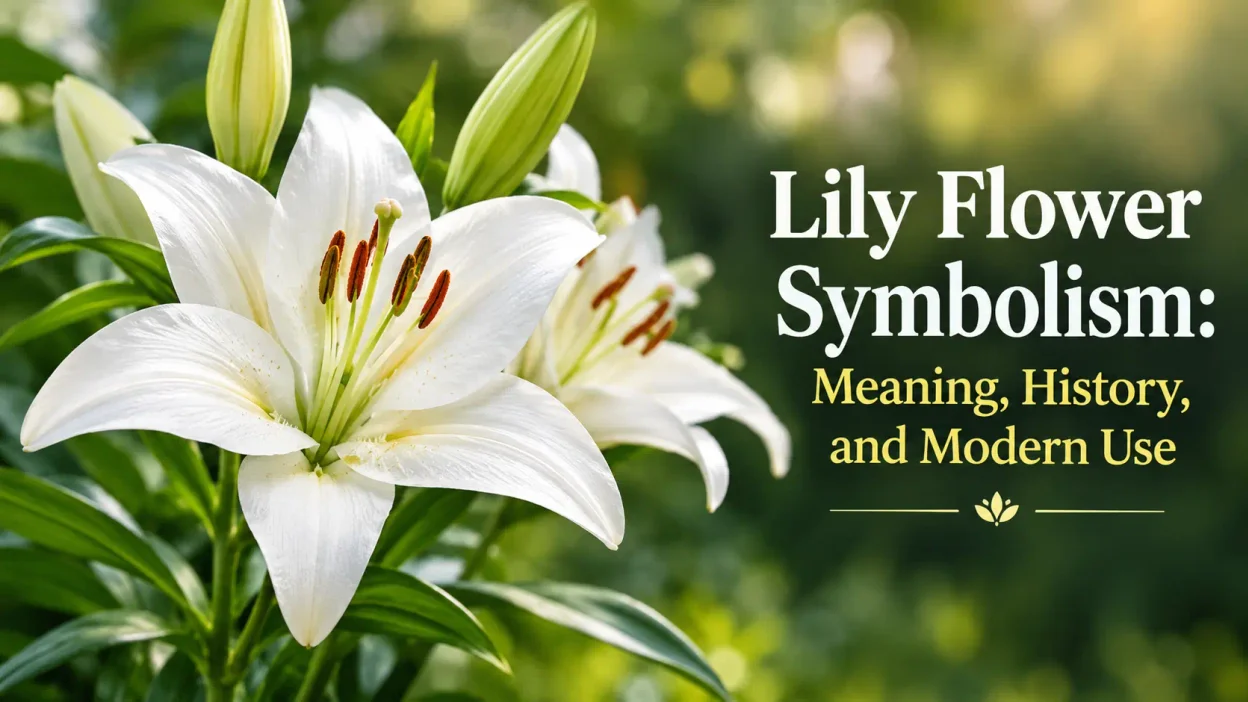
Lily Flower Symbolism Meaning meaning is closely connected to purity, renewal, love, and remembrance, although the message changes with the flower’s color and cultural setting. Lilies appear in American weddings, funeral arrangements, religious artwork, gardens, and gifts because their elegant petals and varied colors can communicate feelings that words sometimes struggle to express.
The lily is not a single flower with one universal meaning. The name covers several species, and different flowers sold as lilies, including calla lilies and water lilies, belong to different botanical groups. Their appearances and cultural associations overlap in everyday conversation, but their symbolism does not always share the same history.
Understanding lily symbolism means looking beyond a flower’s appearance. Ancient myths, Christian art, family traditions, changing ideas about beauty, and modern floral customs have all influenced what lilies communicate today. Knowing these connections can help you choose the right variety for a celebration, a memorial, a personal tattoo, or a meaningful gift.
Quick Answer
The symbolism lily flower meaning most commonly includes purity, renewal, devotion, and remembrance in modern American culture, especially in weddings, religious settings, and funeral arrangements. Historically, lilies have also represented divine associations, fertility, rebirth, and royal status in different cultural traditions.
TL;DR
- White lilies often symbolize purity, peace, and remembrance.
- Pink lilies commonly express affection, admiration, and appreciation.
- Easter lilies connect with resurrection and new beginnings in Christian traditions.
- Funeral lilies help families express sympathy and honor a life.
- Ancient myths linked certain lilies with divine figures and fertility.
- Modern lily tattoos often represent personal growth, love, or remembrance.
1. What Does the Lily Flower Symbolize?
Lilies commonly represent purity, renewal, devotion, and the cycle of life. Their large, open blooms can suggest beauty and dignity, while their seasonal growth offers a natural image of renewal. In American culture, these associations appear in religious celebrations, wedding bouquets, sympathy flowers, and personal gifts.
The exact meaning depends on the variety, color, and occasion. A white lily in a church may communicate spiritual purity, while the same flower in a funeral arrangement may express peace, sympathy, or hope for rest. Pink lilies given to a friend may convey admiration without carrying a religious message.
Lilies also have associations with fertility and prosperity in some historical traditions. Their symbolism developed through different stories and customs rather than from one original meaning shared by every culture.
The most useful way to interpret a lily is to consider who gives it, who receives it, and why it appears in that setting.
2. What Makes a Lily Recognizable?
<PRIVATE_PERSON> lilies are known for their prominent blooms, often featuring six petal-like segments arranged around a central group of stamens. Depending on the species, the flowers may face upward, outward, or downward, and their colors range from white and yellow to orange, pink, and deep red.
True lilies belong to the genus Lilium. Asiatic lilies, Oriental lilies, and tiger lilies are familiar examples. Calla lilies belong to a different genus, while water lilies belong to another botanical family altogether. Despite their shared common name, these plants have distinct forms and histories.
The flower’s shape contributes to its visual appeal. Its open petals can suggest openness or grace, while its upright stem can create an impression of dignity. These are interpretations of its appearance, not fixed meanings found in nature.
The distinction matters when discussing symbolism. A flower’s popular name may group several plants together, but a specific cultural tradition may refer to one variety in particular.
3. White Lily Symbolism: Purity, Peace, and Innocence
White lilies are among the most recognizable symbolic flowers in the United States. Their pale petals are commonly associated with purity, sincerity, peace, and spiritual devotion. These meanings make them popular in religious ceremonies, weddings, and memorial arrangements.
In Christian imagery, the white Madonna lily has a long association with the Virgin Mary. Artists have used it to express purity and holiness, particularly in scenes of the Annunciation, when the angel Gabriel announces that Mary will give birth to Jesus.
The flower’s appearance supports these associations, but its meaning also comes from repeated use in art and worship. Generations of viewers learned to recognize the lily as a visual sign of spiritual purity.
White lilies can also communicate respect without an explicitly religious message. At a funeral, they may express sympathy and a wish for peace. At a wedding, they can represent sincerity and the hope for a committed partnership.
However, white does not always mean innocence in every cultural setting. Its associations vary across traditions, so the occasion and the recipient’s background should guide the interpretation.
4. Pink Lily Symbolism: Love, Affection, and Admiration
Pink lilies often express affection, admiration, gratitude, and appreciation. Their softer appearance makes them suitable for birthdays, anniversaries, congratulations, and gifts that celebrate an important relationship.
In contemporary American flower-giving customs, pink often occupies a space between the romance associated with red and the restraint associated with white. A bouquet of pink lilies may communicate warm affection without the intensity some people associate with red roses.
The shade can influence the message. Pale pink may feel gentle and appreciative, while a brighter pink can appear more energetic and celebratory. These distinctions are customary interpretations rather than strict rules.
Pink lilies can also work in arrangements for mothers, friends, mentors, or relatives. Their meaning does not have to be romantic, which makes them a flexible choice when the giver wants to express admiration or care.
As with other flowers, a personal connection can matter more than a traditional definition. A pink lily chosen because it reminds someone of a loved one may carry a meaning that no general flower guide can fully capture.
5. Red Lily Symbolism: Passion, Courage, and Intensity
Red lilies can suggest passion, romantic desire, confidence, and strong emotion. In American visual culture, red is frequently associated with love and intensity, especially in gifts, fashion, and decorative arrangements.
A red lily may therefore suit a romantic occasion or a celebration intended to feel dramatic and expressive. Its large petals and saturated color can make it a striking alternative to more familiar red flowers.
Red also has associations with courage, vitality, and warning. Those meanings depend heavily on the setting, however, and should not be treated as universal properties of the flower.
Unlike the established Christian associations of the white Madonna lily, red lily symbolism is less closely tied to one dominant religious tradition in American culture. Its meaning often comes from broader color associations and modern floral design.
For a gift, red lilies can communicate intensity and admiration. For a personal artwork or tattoo, they may represent confidence, desire, or a willingness to embrace strong emotions.
6. Yellow and Orange Lily Symbolism
Yellow lilies commonly symbolize joy, friendship, gratitude, and optimism. Their bright color makes them suitable for celebrations, thank-you bouquets, and gifts intended to lift someone’s spirits.
Orange lilies tend to communicate enthusiasm, confidence, energy, and boldness. Tiger lilies, known for their orange petals and dark spots, are particularly recognizable and can create a dramatic visual statement in gardens and floral arrangements.
These meanings are shaped partly by familiar color associations. Yellow often suggests sunlight and cheerfulness, while orange can evoke warmth, movement, and excitement. Yet color meanings differ among people and communities, and neither shade has a single universal interpretation.
Yellow and orange lilies can be especially useful when the goal is to celebrate rather than mourn. They offer a way to express encouragement, friendship, or appreciation without relying on the romantic or spiritual meanings often attached to white and pink varieties.
The recipient’s preferences still matter. Some people associate particular flowers with memories or family traditions that outweigh general color symbolism.
7. Lily Symbolism in Ancient Greek and Roman Traditions
Lilies appear in ancient Mediterranean mythology, where they became associated with divine figures, fertility, and beauty. Greek traditions connected the lily with Hera, the goddess associated with marriage, women, and childbirth. Later retellings linked the flower’s origin to stories about divine milk and the formation of lilies.
These stories were not all recorded in one consistent version. Ancient mythology developed through poetry, religious practice, local traditions, and later interpretations, so the details can differ between accounts.
The lily’s association with fertility also reflects the way people interpreted the natural world. A flower that returns seasonally and produces prominent blooms could serve as an image of life, growth, and renewal. Its beauty made it suitable for stories about divine figures and idealized femininity.
Roman culture inherited and adapted many Greek artistic and religious traditions. Floral imagery appeared in decorative art, celebrations, and representations of beauty, although the significance of a particular flower depended on the setting.
These ancient associations help explain why lilies can carry meanings beyond innocence or mourning. Their history includes ideas about fertility, beauty, and the relationship between human life and the divine.
8. Lily Symbolism in Christianity and the Bible Lily Flower Symbolism
In Christianity, lilies are frequently associated with purity, resurrection, hope, and spiritual renewal. The white Madonna lily became especially important in artistic representations of the Virgin Mary, while the Easter lily is widely used in churches and homes during Easter celebrations in the United States.
The Bible mentions lilies in several passages. In the Sermon on the Mount, Jesus refers to the lilies of the field when teaching about worry, clothing, and trust in God’s provision. The passage encourages readers to consider the beauty of creation and the limits of anxious concern.
The wording and identification of the biblical flowers require care. The plants described in ancient texts are not always identifiable with certainty as the modern cultivated species sold as lilies. The broader religious association comes from the passage’s imagery, not from proof that every reference describes a modern garden lily.
In Christian art, the white lily became a recognizable emblem of Mary’s purity. Artists often placed it in Annunciation scenes to help viewers understand the spiritual meaning of the event.
Today, these associations continue through church decorations, religious paintings, Easter services, and Christian floral arrangements. For many American Christians, lilies communicate faith and hope as much as they communicate beauty.
9. Easter Lily Symbolism: Resurrection and New Beginnings
<AsyncImage query=”white Easter lilies trumpet shaped blooms church spring flowers natural photography” aspectRatio=”16:9″ width=”100%”/>
The Easter lily is one of the most recognizable flowers associated with Easter in the United States. Its large, trumpet-shaped white blooms appear in churches, homes, and seasonal floral displays during the Christian celebration of Jesus Christ’s resurrection.
The flower’s symbolism draws on the Christian understanding of resurrection as victory over death and the promise of new life. Its white petals can suggest purity, while its springtime appearance reinforces the association with renewal.
The Easter lily’s popularity in American churches grew substantially during the twentieth century. Commercial cultivation and distribution helped make the plant a familiar part of seasonal celebrations, especially in the United States. Its cultural prominence reflects both religious meaning and the development of a recognizable holiday tradition.
For Christians, the Easter lily can express hope grounded in religious belief. For others, it may simply represent spring, fresh beginnings, or the return of flowers after winter.
This difference illustrates how one symbol can serve multiple audiences. A flower displayed during Easter may communicate a specific theological message to one person and a more general feeling of seasonal renewal to another.
10. Lily Symbolism in Weddings and Relationships
Lilies appear in wedding bouquets, ceremony decorations, and reception arrangements because they can communicate devotion, elegance, and the hope for a lasting relationship. White varieties are particularly popular when a couple wants a refined appearance associated with sincerity and new beginnings.
Their meaning is not limited to purity. A lily can also represent the care required to maintain a relationship, the commitment to a shared future, or the desire to create a welcoming home. These interpretations are shaped by the couple’s values rather than dictated by the flower itself.
Lilies also work well in anniversary arrangements. Pink varieties may express affection and appreciation, while red lilies can introduce a more dramatic expression of romance. The right choice depends on the recipient’s taste and the tone of the occasion.
Practical considerations matter, too. Some lilies produce pollen that can stain clothing, and many true lilies are highly toxic to cats. Couples who include lilies in a home celebration should consider pets and choose arrangements accordingly.
A wedding flower becomes meaningful through the promises and memories surrounding it. Traditional symbolism can add context, but the couple’s own story gives the arrangement its personal significance.
11. Why Lilies Are Used for Funerals and Mourning
Lilies are common in American funeral arrangements because they can communicate sympathy, peace, dignity, and remembrance. White lilies, in particular, are frequently chosen for memorial services and expressions of condolence.
Their use reflects several overlapping associations. White flowers may suggest peace or spiritual purity, while the lily’s graceful form can convey respect without relying on elaborate decoration. For religious families, lilies may also express hope in resurrection or an afterlife.
Not every funeral lily carries the same message. Some people choose them because they were a loved one’s favorite flowers. Others select them because they fit the family’s religious traditions or the atmosphere of the service.
In nonreligious settings, lilies can still serve as a gesture of care. They may acknowledge grief, honor a person’s memory, or offer comfort when words feel inadequate.
The association between lilies and mourning can also influence how people interpret them outside funeral settings. Someone who strongly connects white lilies with a loss may not see them as an appropriate choice for a cheerful celebration. Understanding these personal associations is part of choosing flowers thoughtfully.
12. Lily Symbolism Across Cultures
Lily meanings differ across cultural and religious traditions. Some associations overlap, such as beauty and renewal, while others arise from particular stories, artistic conventions, or social customs.
In Chinese art and cultural traditions, certain lilies have associations with motherhood, family happiness, and auspicious wishes. The Chinese name for the lily genus, bǎihé (百合), can also evoke a phrase associated with harmony and lasting union, contributing to its use in wedding-related symbolism. Meanings vary by variety and context.
In Japanese floral culture, lilies may communicate purity, elegance, or grief depending on the species and occasion. As with many flowers, arrangements and social settings influence how they are understood.
Christian traditions in Europe and the Americas helped establish the white lily as an emblem of the Virgin Mary and spiritual purity. These meanings later became familiar in religious art, church decoration, and American Easter customs.
It is important not to treat these interpretations as universal rules for entire countries. Cultural traditions contain regional differences, and individual families may attach meanings to flowers that differ from widely recognized conventions.
A respectful interpretation begins with context. The same lily can be a wedding flower in one setting, a memorial flower in another, and a garden plant with no special symbolic role elsewhere.
13. Lily Symbolism in Tattoos, Jewelry, and Personal Style
<AsyncImage query=”elegant fine line lily flower tattoo botanical illustration on forearm” aspectRatio=”16:9″ width=”100%”/>
Lily tattoos are popular among people who want a design associated with renewal, devotion, family, remembrance, or personal growth. The meaning often comes from a life event or relationship rather than from the flower’s traditional symbolism alone.
A white lily tattoo may represent spiritual faith, a fresh start, or the memory of someone who has died. A pink lily can suggest affection or admiration, while an orange or tiger lily may communicate confidence and individuality.
Design choices also shape the message. A single flower can feel restrained and personal, while a bouquet may represent family connections or several important stages of life. Adding a date, name, or other botanical element can make the design more specific.
Lily motifs also appear in pendants, earrings, embroidered clothing, and decorative accessories. In these settings, the flower may function primarily as an expression of taste, femininity, elegance, or a connection to nature.
There is no universal interpretation of a lily tattoo. Someone may choose the flower because it reminds them of a parent, marks recovery after a difficult period, or simply appeals to them aesthetically. The personal story remains the most reliable guide to its meaning.
14. Psychological Associations and the Emotional Appeal of Lilies
Flowers can communicate emotion without requiring a direct explanation. Their colors, shapes, fragrance, and familiarity may influence how people respond to an arrangement. Lilies are especially noticeable because many varieties have large blooms and a distinctive form.
White lilies may feel calm or solemn in a memorial setting, while bright yellow and orange varieties can create a more energetic impression. Pink lilies may suggest warmth and affection. These responses are influenced by cultural learning and personal experience, not by a fixed psychological law.
The meaning of a flower can also change with memory. Someone who receives lilies during a difficult period may later associate them with support and recovery. Another person may connect the same flowers with a wedding, a grandparent’s garden, or an important religious celebration.
This personal dimension explains why floral symbolism can feel meaningful even when people disagree about traditional definitions. The flower provides a recognizable form, while the experience surrounding it gives the image emotional weight.
Lilies can therefore represent both shared cultural ideas and private memories. Their symbolism is most accurate when it leaves room for both.
15. Common Misunderstandings About Lily Symbolism
One common misconception is that every lily represents purity. White lilies have a particularly strong association with purity in Christian art and modern American floral customs, but pink, red, yellow, and orange varieties may suggest different feelings. Even white lilies can communicate mourning or sympathy rather than innocence.
Another mistake is assuming that every plant sold as a lily belongs to the same botanical group. True lilies, calla lilies, and water lilies differ in their classification and may have different cultural histories. A symbol associated with one variety should not automatically be applied to every flower with “lily” in its name.
People sometimes treat flower meanings as ancient rules that have remained unchanged. In reality, meanings develop through religious practice, literature, trade, commercial flower cultivation, and changing social customs. A popular modern interpretation may not reflect the earliest known use of a flower.
It is also inaccurate to assume that lilies always communicate happiness or comfort. Their connection with funerals means they can evoke grief, while their use in weddings can suggest celebration. Context changes the message.
Finally, no flower meaning should be used to judge someone’s character, beliefs, or intentions. A person may give lilies because they understand the traditional symbolism, because the recipient likes them, or because the flowers were available and appropriate. Symbolism offers a way to interpret gestures, not a reliable method of reading someone’s mind.
Lily Flower Meanings at a Glance
| Lily type or context | Common symbolic meaning | Typical modern use |
|---|---|---|
| White lily | Purity, peace, remembrance | Weddings, religious settings, funerals |
| Pink lily | Affection, admiration, appreciation | Gifts, birthdays, anniversaries |
| Red lily | Passion, confidence, intensity | Romantic arrangements, expressive designs |
| Yellow lily | Joy, friendship, gratitude | Celebrations and thank-you gifts |
| Orange or tiger lily | Energy, confidence, boldness | Gardens, bright bouquets, personal artwork |
| Easter lily | Resurrection, faith, renewal | Easter services and seasonal displays |
Frequently Asked Questions
What is the spiritual meaning of a lily flower?
A lily may represent purity, renewal, devotion, or hope, especially in Christian contexts. Its spiritual meaning depends on the flower’s variety and the tradition in which it appears.
Does a lily symbolize life or death?
Lilies can represent both new life and remembrance. Their connection with spring and renewal supports life-related meanings, while their use at funerals makes them familiar symbols of sympathy and mourning.
What does a lily flower mean as a gift?
A lily can express affection, admiration, appreciation, sympathy, or respect. Consider the flower’s color, the occasion, and the recipient’s preferences before choosing an arrangement.
What does a lily tattoo symbolize?
A lily tattoo often represents renewal, love, devotion, family, or remembrance. Its meaning may become more personal through the design, color, or connection to a particular life event.
Are lilies mentioned in the Bible?
Yes. Lilies appear in biblical passages, including Jesus’ teaching about the lilies of the field in the Sermon on the Mount. The exact botanical identity of flowers mentioned in ancient texts is not always certain.
Why are white lilies associated with funerals?
White lilies are commonly associated with peace, sympathy, and spiritual hope. Their established role in religious art and American memorial customs has helped make them a familiar funeral flower.
Do lilies have the same meaning in every culture?
No. Some traditions connect lilies with purity or renewal, while others emphasize family happiness, marriage, mourning, or beauty. The meaning depends on the cultural setting, the variety, and the occasion.
Conclusion
The symbolism lily flower meaning brings together purity, renewal, affection, devotion, and remembrance. These associations developed through ancient mythology, Christian art, cultural traditions, and modern American customs, giving lilies a place in weddings, Easter celebrations, funerals, gardens, and personal expressions of identity.
Color and context remain essential. White lilies may communicate spiritual purity or sympathy, pink lilies can express affection, and brighter varieties often suggest joy or confidence. Cross-cultural traditions add further meanings, while personal memories can make a particular flower significant in ways that general symbolism cannot fully explain.
A lily’s meaning is not fixed by its petals alone. It becomes meaningful through the traditions people inherit, the occasions on which they share it, and the memories they choose to preserve.

[…] confused with the flowers they support, but the distinction matters. The leaf and the water lily flower can carry related yet different associations. Understanding the plant itself, its role in aquatic […]